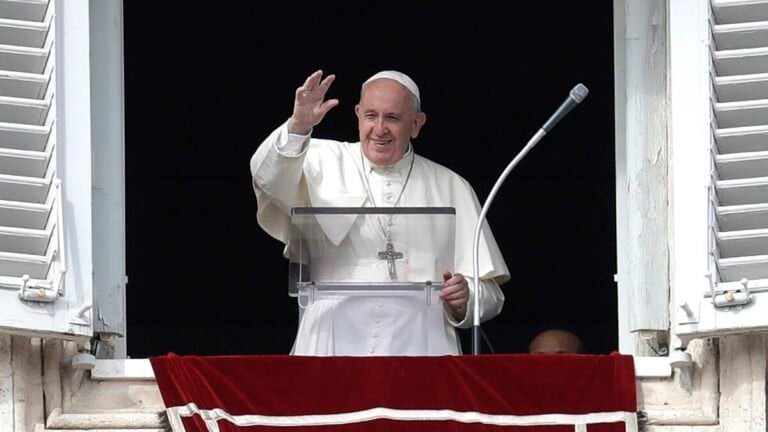
Pope Francis has denounced the “unacceptable” spiral of violence between Israel and the Palestinians, saying the deaths in particular of children was a “sign that they don’t want to build the future but want to destroy it.” Francis prayed for peace, calm and international help to open a path of dialogue during his Sunday blessing, delivered from his studio window overlooking St. Peter’s Square.
The pope said: “I ask myself: this hatred and vendetta, what will it bring? Do we truly think that we can build peace by destroying the other?”
In unusually pointed comments, Francis added: “In the name of God, who created all human beings equal in rights, duties and dignity and are called to live as brothers, I appeal for calm” and an end to the violence.
Israel’s bombardment of the Gaza Strip entered its sixth consecutive day, with air raids hitting a refugee camp where at least 10 Palestinians – eight children, two women – were killed and flattening a high-rise building housing the offices of media organisations, including Al Jazeera.
The airstrikes on Saturday – the sixth consecutive day of hostilities between Israel and Hamas – came roughly an hour after the Israeli military ordered people to evacuate al Jalaa tower.
There was no immediate explanation beforehand for why the 15-storey building was targeted. As well as the two international media organisations, the high-rise was home to several other media outlets, offices including several internet providers, and private apartments.
The building was hit approximately six times before collapsing in plumes of black smoke, which engulfed the entire neighbourhood.
A statement from the Israel Defence Forces said the building had contained military assets belonging to the intelligence offices of Hamas.
“Prior to the strike, the IDF provided advance warning to civilians in the building and allowed sufficient time for them to evacuate the site,” the IDF statement said.
“Hamas deliberately places military targets at the heart of densely populated civilian areas in the Gaza Strip.”
“We ran down the stairs from the 11th floor and now looking at the building from afar, praying Israeli army would eventually retract,” an AP reporter, Fares Akram, tweeted just before the tower was hit.
Earlier on Saturday, Akram published a first person piece in which he described how an Israeli bomb had destroyed his family’s farm in the northern Gaza Strip the day before. Six of his relatives, including his father, three friends and several colleagues have died in the three wars and other hostilities between Israel and Hamas, he wrote.
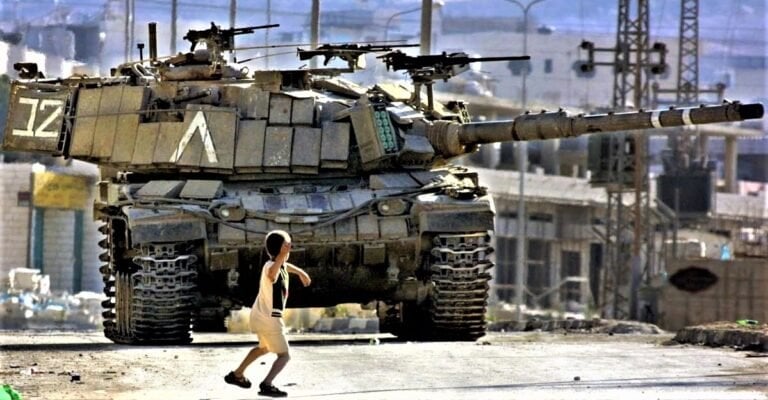
Meanwhile, Palestinians on Saturday gathered in parts of the occupied West Bank to protest against continued Israeli occupation and the ongoing bombardment of Gaza.
At least 140 Palestinians, including 39 children, have been killed in the Gaza Strip since Monday. Some 950 others have been wounded. In the occupied West Bank, Israeli forces have killed at least 13 Palestinians.
At least nine people in Israel have also been killed, with one new death reported on Saturday in Ramat Gan. The Israeli army said hundreds of rockets have been fired from Gaza towards various locations in Israel and they have added reinforcements near the enclave’s eastern lands.
Thousands of Palestinian families are taking shelter in United Nations-run schools in northern Gaza to escape Israeli artillery fire. The UN has said it estimates approximately 10,000 Palestinians have left their homes in Gaza amid the Israeli offensive.
Jeremy Dear, deputy general secretary of the International Federation of Journalists told Al Jazeera he was “shocked and horrified”, expressing outrage that “once again there is an attempt to cover up what is happening in Gaza by directly attacking media facilities.
“This is the third attack on a tower which houses various media, on top of that we’ve recorded 30 incidents of journalists being beaten or being detained,” Dear said.
“It is quite clear that this isn’t an accident, this is systematic targeting of media in Gaza in order to prevent reporting from there.”
Indian Youth Congress chief Srinivas BV, whose Twitter account has been among the most active in responding to Covid-related SOS, was questioned by the Delhi Police today on allegations linked to distribution of Covid medicines. Leaders of the Aam Aadmi Party (AAP) and the BJP said they were also questioned.
The police said they were acting on a petition filed in the Delhi High Court that says politicians from different parties are involved in the illegal distribution of medicines used for Covid treatment. Though no one is named in the petition, a Crime Branch team arrived at Mr Srinivas’s office to record his statement.
“On a writ filed by Deepak Singh about politicians involved in illegal distribution of Covid medicines etc, the Delhi High Court has directed the Delhi Police to conduct an enquiry. In compliance of Delhi High Court’s order, Delhi Police is conducting an enquiry on several politicians including Srinivas,” the Delhi Police said.
Congress leader Rahul Gandhi tweeted in his support.
बचाने वाला हमेशा मारने वाले से बड़ा होता है।#IStandWithIYC
“We will not stop our work, we are not scared,” Mr Srinivas, 39, told NDTV.
“We have not done anything wrong, if our smallest efforts can help save a life we will not stop or be scared of such PILs.”
BJP MP Gautam Gambhir slammed what he called “needless politicisation” of “due process” and indicated that he was asked questions too.
Opposition should not indulge in needless politicisation of due process. Delhi Police has asked for a reply from us & we’ve provided all details. I will keep serving Delhi & its people to the best of my abilities always!
AAP MLA Dilip Pandey posted that he was questioned too. “Helping people has become a crime under the Modi government. My whole family is affected by the Covid infection, but Crime Branch came asking me how did you help people? Answer us? I will help people not once but a thousand times, even if I am hanged for it, ” Mr Pandey tweeted.
Soon, BJP leader Harish Khurana tweeted that he was questioned. “I was also questioned by crime branch today for helping people . I gave statement in the afternoon,” he wrote.
Srinivas BV, a cricketer-turned-politician, has been managing a war room inside the Youth Congress office in the capital, which monitors and acts on tweets asking for help or requests for oxygen and medicines. Last year, he set up a network of Youth Congress volunteers under “SOS IYC”.
His efforts gained attention when a large number of tweets started tagging him on calls for help in the deadly second surge of Covid that has seen a huge demand for oxygen for patients.
This is my land of decisiveness. Where I thrive in the tunes of resistance, I relish in the culture of beneficence. It has been getting reverberated throughout my ears since our inception, Intifada is in my blood.
Had you ever flashed fear in my eyes, Either our inhumanely encroachments. We regard, we respect, we revere. Divine instanced our kids as combatants, And we bow just to his precepts.
They revel in their reveries, we repudiated our resistance. Munitions are neither our recourse, nor in the backings of monopolistic aids. If felt, why still rebellious beyond destructions, Divine spirit and humane incitements. This is our land, and will remain as.
Ayyubi’s recitations of mortal combat, Arafath reiterated against infringements, Said has wrecked over their incivility, Mariam resembled our untiring determination. Rahaf’s gazes have been permeating your corporealities.
We worshipped over your crumbles, Bullets couldn’t withstand our eemans, We declaimed through your shells, We intonated intifadas on your barricades, We kept not flowers, but legendaries on graves.
Forebearers imparted the folktales of appraisals, Mothers sang the lullabies of contentions, Baby brother just heard shahada before he breathed. Homie has been swirling his Keffiyeh at Gaza.
If you could behold the smiles in shrouds, you need not to look beyond our children. I heard this rigor as expansively reiterated, in the dauntlessness of Kashmir, Iraq and Vietnam.
Heads will be certainly bowed at Aqsa, Barricades would be thwarted at west bank, Handalas would be ornamenting Jarrah. Blacks would be changed into our flags at Jerusalem. We would render the verses of victory, Over the Zionist dooms.
For the lives that has been destructed, In the cries that has been rumbled, Through our legends of muqawama, The triumphant smile would be certainly on ourselves, Death has never strained us.
My blood is resistance, and my spirit is perseverance. We speak revolution, and we impart emancipation. Our livelihood is our dignity. This land belongs to us, I’m a Palestinian.
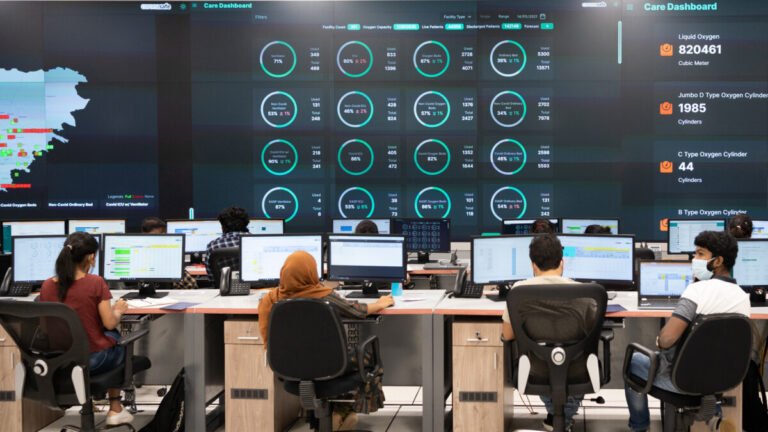
Around 120 volunteers including medical practitioners are working in the Centralised war room in Eranakulam. The district is one of the most hit by Covid 19 cases in Kerala. State government has put Eranakulam within triple lockdown along with other three districts having comparatively higher number of cases. And state also has extended its lockdown in all 14 districts till 23rd of this month.
Centralised war room in Eranakulam is the biggest of its kind set up by the Kerala government to provide adequate medical facilities to Covid patients by categorising and prioritising patients. The government has asked the citizens to avail this facility rather going for the hospitals on their own. As per telephonic requests, volunteers give proper advices about Covid 19 treatments. An open source data software, Coronasafe Network, that was introduced last year is used to run this war room drive.
Suhas S IAS, the district collector of Ernakulam, in a discussions with the officials and volunteers of Covid 19 war room. Photo: Sreekanth Sivadasan, Milan JohnCovid 19 war room is run with an open software called Coronasafe Network which was developed by some volunteers last year. Volunteers in the Centralised Covid 19 war room scrutinize the information according to the availability of ventilators, beds and oxygen in Ernakulam district. Photo: Sreekanth Sivadasan, Milan JohnVolunteers in the centralised Covid war room in Ernakulam. Photo: Sreekanth Sivadasan, Milan John
It ensures that ventilator rooms are given to the patients that require them the most. Now, war room has been facilitated with an Oxygen availability monitoring section also. War room in Eranakulam coordinates with 70 private hospitals and 12 government hospitals.
Government has also ensured that adequate treatments are provided by the private hospitals too and initiated Karunya Arogya Program by which the government provide financial support to patients who are being treated by the private hospitals.
A volunteer in the Centralised Covid 19 war room in Ernakulam engages in a telephonic communication. Photo: Sreekanth Sivadasan, Milan JohnA police official walks in the corridor of the Centralised Covid 19 War room in Ernakulam. Photo: Sreekanth Sivadasan, Milan John
The violence against Palestine by Israel had exacerbated in recent days. Israel had put up blockades preventing Palestinians from gathering in the Damascus Gate— the most famous space during the month of Ramadan. Israeli police forces had launched attack inside the Masjid Al-Aqsa, the third-holiest site in Islam where the Palestinian worshippers gathered for prayers of Laylat al-Qadr (Night of Destiny) and police fired rubber bullets and stun grenades on them. Also at Palestine neighbourhood, Sheikh Jarrah, Israel ordered six Palestinian families to leave their homes on May 2 to replace it entirely for Jewish settlers. Palestinian families have been living in there for generations. The hostilities have killed at least 56 Palestinians in Gaza – including 14 children – and six Israelis died, and hundreds wounded, This is the most intense ebullition since the seven-week 2014 Israeli war on Gaza.
Since 1967, in which the occupation of Palestinian lands began, Israeli forces have been using excessive and pestilent force against Palestine civilians including women and children by brutally retaliating the protestors and stifling dissent and forcing them to off their lands, confiscating and illegally using it to establish settlements which is exclusively for accommodating Israeli Jewish settlers. This has inflicted terrific sufferings on Palestinians, depriving basic human rights. Their homes and livelihoods have been desolated, they’ve had constraints enforced on their mobility, access to their own water, land, electricity and other natural resources. They have also been ruthlessly attacked by the Israeli military and settlers. Palestinians are forced to live with daily disruption, humiliation, fear and oppression from Israel. People’s entire lives are completely held under them.
Human Rights Watch, a US-based NGO, reported five categories of “major violations of international human rights law and humanitarian law” which disadvantage Palestinians. The violations included are unlawful killings, abusive detention, blockade of the Gaza Strip and restrictions on Palestinian movement, the development of settlements, and discriminatory policies.
Historical events that lead to the establishment of Jewish state in Palestine
• The period from 1917-1948, the mandate of British for Palestine was carried out which laid the real groundwork for a Jewish state in Palestine.
• The historical Balfour Declaration(1917)was held in response to Britain’s World War I commitment to support the establishment of a “Jewish national home” in Palestine by displacing Palestinians away. In the words of eminent Palestinian scholar Edward Said, this was a declaration “made by a European power.. About a non-European territory.
• In 1948, nearly three-quarters of a million Palestinians extruded from their homes and demolished many villages and towns. Palestinians call this event as” Nakba”, the word means catastrophe in Arabic.
• In 1967, Israel occupied the West Bank, including East Jerusalem, and the Gaza Strip which resulted in systematic human rights violations against Palestinians living there.
• In 1987, after 20 years of brutal military occupation, the First Intifada launched in the Occupied Palestinian Territory.
• In 1993 Palestinian Liberation Organization and Israel signed the declaration of principles on interim self government arrangements(OSLO)which heralded a new chapter of modern Palestinian history.
• In 2008, Israel attacks the Gaza Strip which is called as “Operation Cast Lead”
• In 2014, Israel inflicted its biggest assault on Gaza since 1967, which is known as “Operation Protective Edge”.
Palestine in the International sphere
As Palestinians are being the victims of grave human rights violations and abuse, the need for solidarity and support from domestic and international arenas is important. But, unfortunately, many of the countries are tongue tied to condemn the acts of Israel. They have their own paraphernalia to denounce the abuses as simply as a “clash” between Israel and Palestine.
The Abraham Accord between Israel, United Arab Emirates and Bahrain which is mediated by the United States of America is the first Arab-Israeli peace accord which are aimed at normalizing Israel’s relations with the two Arab countries. The Accord shows how the Arab countries are gradually sundering themselves from the Palestinian question. Palestinian Authority has responded to the deal by asserting that a comprehensive and perpetual peace is unachievable “as long as the United States and the Israeli occupation authority do not recognize the right of the Palestinian people to establish their independent state. They called the UAE’s decision a “treason”. U.S. President Joe Biden has said that his new administration will be committed to human rights and would be at the centre of his Foreign Policy. So, Palestine will be a reality check of his statements.
India and Israel had nurtured diplomatic and trade relations. Narendra Modi and Benjamin Netanyahu share an inclination for majoritarianism, neoliberalism and religious conservatism. Also, the authoritarian decision of Indian government to abrogate the autonomy of the state of Jammu and Kashmir and the violence unleashed by Indian forces towards Kashmiris resonates with Israel’s behavior towards Palestinians.
Way forward
Israel will continue to scorn the international law and violate the human rights of the Palestinian people until the whole oppressed sections are united. NGOs, Civil Society Organisations, Concerned International bodies and the people should unite and pressurise the International Organisations and fight for justice. Our commitment to human rights and justice should transcend the boundaries. The fight against occupation and oppression is a strong and resilient battle towards equality and justice.
Israel has been expanding its border in Palestine, violating international laws and conventions. According to the report of the Peace Now (2019), an Israeli human rights organisation, 32 new settlement outposts, of which 21 are farms, have been established since 2012 in the West Bank. Moreover, by constructing a wall through the West Bank, Israel disconnected a large part of Palestinian territories from the rest of the West Bank. Sheikh Jarrah is the latest example of the expansion of the Israeli occupation.
Additionally, the pandemic period witnessed increasing Israeli settlers’ attack on Palestinian civilians. For example, March and April 2020, the time of the outbreak of COVID-19, witnessed around 40 attacks in a month, resulting in either casualty or property damage. The settlers enjoy a climate of impunity to unleash violence against the Palestinians. According to the report of Yesh Din, an Israeli human rights organisation, out of 273 Police investigations, only 25 (9%) resulted in the prosecution of offenders, and 248 files closed without an indictment. Moreover, in many cases, Palestinians do not file a complaint due to the lack of trust in the Israeli legal authorities. According to Oxfam, only less than half of the victims file complaints on settler violence. Since the complaints have to be filed in an Israeli police station, Palestinians consider it dangerous due to the presence of the Israeli Defence Force soldiers or settlers in the office. Many Palestinians are afraid that if they file a criminal complaint against the settlers, they or their relatives will not get permission for entering Israeli land for work. It will result in the loss of their income. Due to widespread unemployment in the West bank, this fear is sufficient to deter Palestinians from complaint against the settler violence.
The ongoing demolitions of the Palestinian home and confiscation of assets by the Israeli government, along with the settlers’ unchecked violence, cause forced displacement of Palestinians and de facto annexation of the Palestinian land. It is also followed by the threat of De jure annexation. During his election campaign, Israeli Prime Minister Binyamin Netanyahu promised the annexation of a large part of the West Bank. Sheikh Jarrah illustrates the Israeli policy of annexation.
The settlement and annexation plans, including settlement in Sheikh Jarrah, violate international humanitarian laws. Transferring civilians to the occupied territories violates the Fourth Geneva Convention. Moreover, the Israeli plan to annex the occupied territories is a threat to international norms. The International Commission of Jurists (ICJ) calls both de facto or de jure annexation attempts of Israel from the parts of the Occupied Palestinian Territories (OPT) as null and void under international law. Additionally, according to ICJ, such annexation does not change the protections of the international humanitarian law to the Palestinians living there.
The annexation violates many human rights of Palestinians. It will restrict the Palestinians’ right to freedom of movement in the West Bank. The permission of Israel will be required to travel from one side of the West Bank to the other. Additionally, the expropriation of privately-owned Palestinian land violates property rights. The loss of farms affects the income source of Palestinians. It will cause further expansion of the settlement. There is also a threat of house demolitions and expulsion in communities unrecognised by Israel. The status of Palestinians in the annexed territories, whether it is permanent citizenship or not, is another concern. The control of Israel over the natural resources of the annexed territory also will affect the economy of Palestine.
In addition to the violation of human rights, the annexation also has international implications. Since it is a violation of international law, it undermines the legitimacy of international institutions and laws. So, the annexation, settlement and other forms of human rights violations pose threats to international laws and institutions. Above all, the COCID-19 pandemic worsens its humanitarian impacts. So, the international community must take urgent steps to solve the crisis.
At least 20 Palestinians have been killed in Israeli air raids on the besieged Gaza Strip, according to the Palestinian health ministry, after Hamas launched rockets from the coastal territory towards Israel.
The Gaza health ministry told Al Jazeera on Monday that 20 people, including children, had been killed in the strikes.
The strikes were carried out after Hamas fired several rockets at Israel, following the expiration of the group’s ultimatum demanding Israel stand down forces from the Al Aqsa Mosque compound in Jerusalem.
Earlier on Monday tensions at the compound, the third holiest in Islam which is also revered by Jews, escalated with more than 300 Palestinians wounded when Israeli police stormed the mosque, firing rubber bullets, stun grenades and tear gas.
Clashes erupted between Palestinian protesters and Israeli police outside the Old City of Jerusalem on Saturday as tens of thousands of Muslim worshippers prayed at the nearby Al-Aqsa Mosque on Islam’s holy night of Laylat al-Qadr.
Palestinian youth threw stones, lit fires and tore down police barricades in the streets leading to the walled Old City gates as officers on horseback and in riot gear used stun grenades and water cannons to repel them.
At least 80 people were injured, including minors and a one-year-old, and 14 were taken to hospital, the Palestine Red Crescent said. Israeli police said at least one officer was hurt.
“They do not want us to pray. There is a fight every day, every day there are clashes. Every day there are troubles,” said Mahmoud al-Marbua, 27, speaking near the Old City’s Damascus Gate. Pointing to police chasing youths and firing thunder-flashes at them, he added: “Look how they are firing at us. How can we live?”
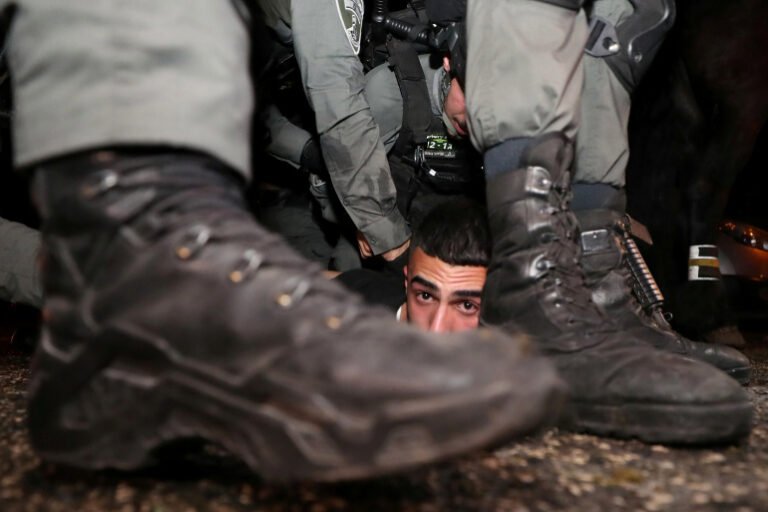
Israeli police detain a Palestinian during clashes at Damascus Gate on Laylat al-Qadr during the holy month of Ramadan, in Jerusalem’s Old City, May 8, 2021. REUTERS/Ronen ZvulunA Palestinian gestures during clashes with Israeli police at Damascus Gate on Laylat al-Qadr during the holy month of Ramadan, in Jerusalem’s Old City, May 8, 2021. REUTERS/Ronen ZvulunIsraeli police take position during clashes with Palestinians on Laylat al-Qadr during the holy month of Ramadan, at Jerusalem’s Old City, May 8, 2021. REUTERS/Ronen ZvulunPalestinians pray in front of the Dome of the Rock on Laylat al-Qadr during the holy month of Ramadan, at the compound that houses Al-Aqsa Mosque, known to Muslims as Noble Sanctuary and to Jews as Temple Mount, in Jerusalem’s Old City, May 8, 2021. REUTERS/Ammar AwadPalestinians pray on Laylat al-Qadr during the holy month of Ramadan, at the compound that houses Al-Aqsa Mosque, known to Muslims as Noble Sanctuary and to Jews as Temple Mount, in Jerusalem’s Old City, May 8, 2021. REUTERS/Ammar Awad
Tensions have mounted in the city throughout the Muslim holy month of Ramadan, amid growing anger over the potential eviction of Palestinians from Jerusalem homes on land claimed by Jewish settlers.
In the Palestinian Gaza Strip, hundreds of protesters gathered along the border with Israel. The Israeli military said the crowds threw burning tyres and firecrackers toward the troops.
Gaza militants fired at least one rocket into Israel which landed in an open area, the military said.
“We salute the ppl. of Al-Aqsa, who oppose the arrogance of the Zionists & we call on our ppl. in Palestine to support their brothers by all means,” Moussa Abu Marzouk, a leader of the armed Islamist group Hamas that rules Gaza, said on Twitter.
Israel said it was beefing up security forces on Saturday in anticipation of further confrontations in Jerusalem, the occupied West Bank and Gaza after fierce clashes erupted the previous night at Al-Aqsa Mosque.
A Palestinian official said Egypt was mediating between the sides to prevent further escalation and Saturday’s violence appeared less pronounced than Friday’s events.
On Friday, police fired rubber bullets and stun grenades towards rock-hurling Palestinian youths at the mosque on the Noble Sanctuary/Temple Mount plaza holy to both Muslims and Jews.
At least 205 Palestinians and 18 Israeli officers were injured in Friday’s confrontations, which drew international condemnations and calls for calm.
Clashes have erupted nightly in East Jerusalem’s Sheikh Jarrah – a neighbourhood where numerous Palestinian families face eviction in a long-running legal case. Police said dozens of protesters threw stones at officers there on Saturday.
Police Commissioner Yaakov Shabtai said extra officers were being deployed in Jerusalem on Saturday to “enable freedom of worship and maintain order and security.”
“At the same time, we will not allow violent riots, lawbreaking or the harming of police officers. We ask everyone to calm the spirits and violence, particularly on such an important day for the Muslim religion,” Shabtai said in a statement.
The Israeli military said it was boosting troops in the West Bank and near the Gaza Strip, where Palestinians have sent incendiary balloons over the border, igniting brushfires in Israeli territory. A military spokesman said extra forces there would largely be firefighting ones.
The students’ association of Pune-based FTIIhas sought immediate suspension of online classes for the 2020 batch students, saying that it is becoming increasingly difficult for them to attend classes due to the challenges posed by the Coronaviruscrisis.
The FTIIStudents Association (FSA) has also sought a meeting with the institute’s chairman Shekhar Kapur to express their concerns.
The Film and Television Institute of India (FTII) administration, however, said that online classes are going on only for one batch, and many students are attending the classes and demanded that they should continue.
It also made it clear that online classes will continue to be held for the duration they are planned.
In a release, the FSA said, “We are witnessing an exponential increase in cases each day and people are struggling to avail medical facilities. FTIIadministration has been enforcing mandatory online classes for the newly- admitted 2020 batch students.”
It said that the students raised concern over the online medium of education, but the FTII administration has made it mandatory for the students to attend online classes, which is in violation of the attendance criteria mentioned in the UGC guidelines for online classes.
“FTII chairman Mr Shekhar Kapur is reluctant to meet us and has given us a date 11 days later from now for a meeting to discuss our urgent concerns. We are sad and concerned to state that students, faculties, staff members and families are getting affected not just by COVID-19, but also by financial and mental health issues associated with it,” it said.
The students are from different parts of the country and it is becoming increasingly difficult for them to attend classes amid this health crisis, the release added.
The FSA demanded that the FTII chairman should meet them at the earliest and understand the concerns in view of the devastating phase of the pandemic to bring in an immediate suspension of the online classes.
Meanwhile, FTII director Bhupendra Kainthola said, “Online classes are on only for the 2020 batch and many students are attending the classes and have asked that the classes should continue. Connectivity and other issues are there, but still students are regular in their classes and in direct contact with their teachers.”
“FTII administration is also helping the students. For instance, in the case of a student from Kargil, on the request of FTII the Ladakh administration is facilitating the student with venue and connectivity,” he said.
In case students miss a lecture or a session, a review or recap session is planned on Saturdays.
“Teachers are also ready to help them on phone or e-mail. When on campus, a recap or review of these online sessions would also be made,” the director added.
FTII’s academic and governing councils have discussed the matter and directed the institute to continue with online classes for the benefit of those students who are interested, so the online classes will continue for the duration they are planned, he said.