The number of active cases of COVID-19 has been steadily reducing since late September 2020 and it was then that most public places, schools, colleges, and offices began opening their doors for regular operation.
Despite this, COVID protocols were being maintained with the utmost scrutiny in all such public places. As of February 2021, more than half of all the Indian states reported that there was not a single death due to COVID-19 and this ushered in some much-needed hope.
However, recent studies conducted by scientists at Delhi, using a mathematical model have examined that cases will be at a peak around 20th April 2021.
Reason for the Second Wave
Leading Indian scientists from the most renowned institutes and research centres have suggested that 2 distinctive factors can be used to trace this sudden and sharp rise of active cases in India.
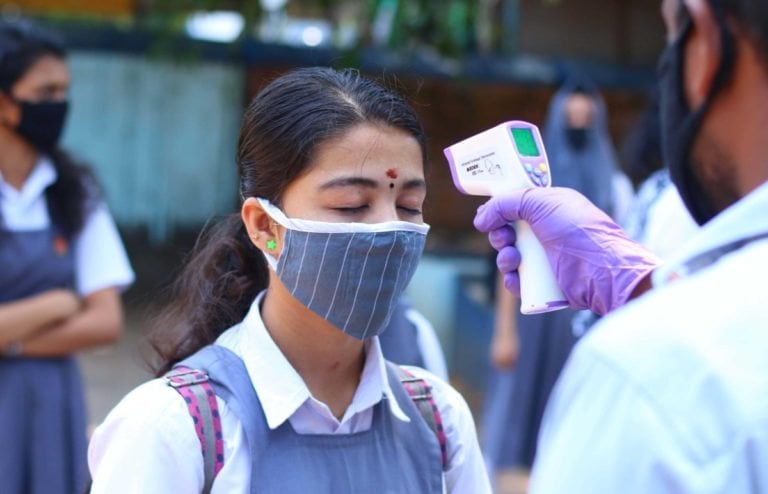
Opening of Schools and Colleges – Although such institutions are following all the COVID protocols reiterated by the government, there has been little control over public transit and the people, many of whom have not been following the necessary COVID protocols. This has led to several asymptomatic carriers transmitting the virus.
A New Mutant Strain – The double mutant variant of the virus has caused a significant rise in the number of infected cases. Scientists believe that this strain is about 70 times more contagious than the previous one.
Which States are Likely to be Affected?
With such a sharp rise in new cases of COVID-19, the states of Maharashtra, Karnataka, Tamil Nadu, Delhi, Haryana and Uttar Pradesh have been touted to be high-risk states that are already experiencing the effects of the Second Wave.
Despite the rapid testing and the extensive vaccination drives undertaken by the government, the daily caseload of infected people is averaging at around 55,000 as opposed to the few couple thousands last year.
What is the Expected Duration of the Second Wave?
Many states like Gujarat, Maharashtra, Haryana and Punjab have been counting the number of cases peaking either equal to or more than their earlier records from the previous year. Although states like West Bengal, Andhra Pradesh, Bihar and Uttar Pradesh are likely to be still in the infant stages of the Second Wave, state governments have ramped up their testings and inoculation drives. Scientists expect this Second Wave to last more than 2 or 3 months, given the progress of vaccinations of a population that is 1.3 billion strong.
Congress leader Rahul Gandhi on Sunday said that his party will protect every principle of the Assam Accord and will never implement the Citizenship (Amendment) Act or CAA if voted to power in the state. Addressing his first public rally in Assam ahead of the assembly elections due in March-April, Mr Gandhi said that the state needs its “own chief minister” who will listen to the voice of the people.
“The Assam Accord has brought peace and it is the protector of the state. I and my party workers will protect each principle of the Accord. There will not be a single deviation from it,” he said. Mr Gandhi said illegal immigration is an issue in Assam and expressed confidence that the people of the state have the capability to resolve the issue through dialogue.
Alleging that BJP and its ideological mentor Rashtriya Swayamsevak Sangh (RSS) are trying to divide the state on the issue of Assam Accord, he said, “If Assam is divided, then Prime Minister Narendra Modi or Union Home Minister Amit Shah will not be affected, but the people of Assam and the rest of India will be affected.”
Targeting the current Assam Chief Minister Sarbananda Sonowal, Mr Gandhi said Assam needs a chief minister from their “own people” who will listen to their issues and try to resolve them. “Remote control can operate a TV but not a CM (Chief Minister). The current CM listens to Nagpur and Delhi. If Assam gets a CM like this again, it will not benefit the people. The youths need a CM who will give jobs to them,” he said.
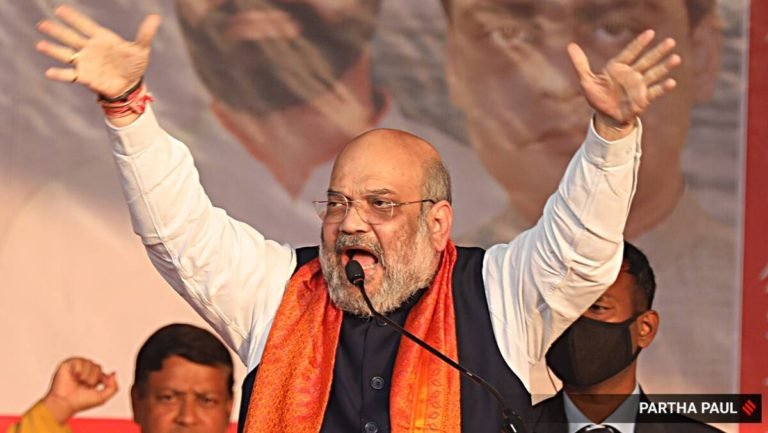
Union Home Minister Amit ShahThursday said the process of granting Indian citizenship to refugees under the CAA, including to the Matua community of West Bengal, will begin once the process of COVID vaccination has ended.
Accusing the opposition parties of misleading the minorities about the Citizenship (amendment) Act, he said, its implementation will not impact the citizenship status of Indian minorities.
Shah said the Modi government had in 2018 promised it will bring in a new citizenship law and kept it when the BJP was voted to power in 2019.
He said, after the country was hit by the COVID-19 pandemic in 2020, its implementation had to be kept in abeyance.
“Mamata didi said we made a false promise. She started opposing the CAA and saying she will never allow it. The BJP always fulfils the promises it makes. We have brought this law and refugees will get citizenship.
“As soon as the COVID vaccination process ends the process of granting citizenship under CAA will begin. All of you will be respected citizens of this country,” he said, addressing a rally in Thakurnagar in the bastion of the Matua community.
Matuas, originally from East Pakistan, are weaker section Hindus who migrated to India during the Partition and after the creation of Bangladesh. Many of them have been accorded Indian citizenship but a sizeable section of the population has not got it.
The Matua community, with an estimated population of three million in the state, can tilt the scales in favour of a political party in at least four Lok seats and more than 30 assembly seats in Nadia, and North and South 24 Parganas districts. It once stood solidly behind the TMC but had supported the BJP in the 2019 Lok Sabha polls.
A section of state BJP leadership is apprehensive that the delay and confusion over the implementation of the CAA could make them turn against the saffron party.
Shah asserted that Banerjee will not be in a position to oppose the implementation of the CAA as she will cease to be the chief minister after the assembly polls likely in April-May this year.
“Mamata Didi is misleading the people on the CAA. But let me tell you that she won’t be a position to oppose as she will not be the chief minister after April-May. We will implement the CAA, it is a law that has been passed by Parliament,” he said.
“As the Home Minister of this country, I want to assure the minorities of India that none of you will lose citizenship. The CAA is about granting citizenship to refugees, it is not about taking away anyone’s citizenship,” he said.
Accusing the erstwhile Congress and the Left Front governments of West Bengal of never bothering about granting citizenship to the refugees, Shah said they betrayed them much in the same way as the TMC did.
Shah also attacked the Mamata Banerjee government over Bangladeshi infiltration, and asserted only a BJP government can stop it.
Courting the Matua community, Shah said if voted to power, the BJP government will propose renaming the Thaukurnagar railway station ‘Shri Dham Thakurnagar’ after Sri Sri Harichand Thakur, their socio-religious guru.
After coming to power in West Bengal, the BJP government will introduce ‘Chief Minister Sharnarthi Kalyan Yojana’ for the welfare of the refugee population.
Reacting to Shah’s assertion about implementing the CAA, Mamata Banerjee said he should mind his language and declared she will never allow it to be enforced in West Bengal.
“The home minister of the country should be careful about his utterances. We will never allow CAA, NRC or NPR in Bengal. They can say whatever they want to. They want to destroy Bengal. We will never allow them to do that,” she asserted.
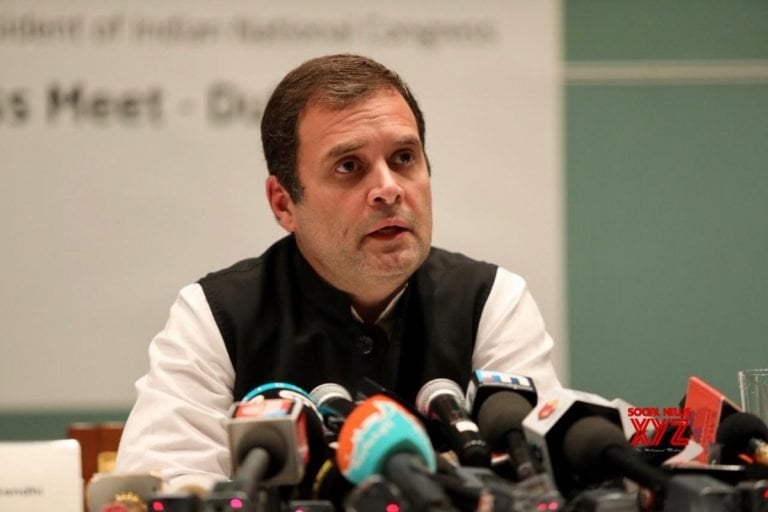
Former Congress president Rahul Gandhi today came down hard on the Nrendra Modi government, alleging that the Centre has conceded Indian territory to the Chinese. Addressing media persons today, Rahul Gandhi said, “The PM is a coward who cannot stand up to the Chinese. He is spitting on the sacrifice of our army. He is betraying the sacrifice of our army. Nobody in India should be allowed to do it.”
The Congress MP’s remarks come a day after Defence minister Rajnath Singh informed Parliament that India and China had mutually agreed to withdraw troops along the Line of Actual Control. Singh said in his statement that not an inch of Indian territory had been ceded to the Chinese.
Rahul Gandhi said that it is the responsibility of the Prime Minister to protect the territory of this country and how he does it is his problem.
“Yesterday, Defence Minister made a statement in both the houses on the situation in Eastern Ladakh going on with China. Now, we find our troops are now going to be stationed at Finger 3. Finger 4 is our territory, that is where our post used to be. Now, we’ve moved from Finger 4 to Finger 3. Why has Prime Minister Modi has given up Indian territory to the Chinese?” questioned Rahul Gandhi.
Gandhi questioned the government over the withdrawal of troops from Kailash ranges. “Why have Indian troops, after the hard work they did in capturing Kailash ranges, been asked to move back? What’s India got in return for this? More importantly, the more important strategic area Depsang Plains, why haven’t the Chinese moved back from there?”
Rahul Gandhi said that the Defence Minister didn’t speak a word on Depsang Plains from where China had entered. “The truth is that the Prime Minister has given away the Indian territory to China. He must answer to the country,” said Gandhi.
Gandhi claimed that the Indian government has given our sacred land to the Chinese.
Earlier yesterday, Congress spokesperson Randeep Singh Surjewala had also questioned the government over the withdrawal agreement with China. “According to reports, the Chinese army is patrolling as far as Chumur, Southern Ladakh. What is the reason that the Prime Minister and the Defence Minister are not saying a word about this important issue of national security?” he asked.
Defence Minister Rajnath Singh had made a statement in Parliament saying that India will not let anyone take even an inch of country’s land.
Contagious effect of the economic slump due to covid19, strikingly similar in effects to that of the “Great Depression” has wreaked havoc on the whole economic sphere. Dilution of labour laws in Gujarat to bring greater flexibility of the market in terms of bargaining power, workers safety standards, – and operations related to retrenchments to attract investments were contradicting. Hitherto CMIE (Centre for Monitoring Indian Economy) monthly time series data on the Gujarat unemployment rate (increased from July to December) status gives us a deep revelation on the failure of an entrenched belief in neoliberal policies as a panacea of all economic and social issues.
As the classical school of thought proposed flexible labour market would reduce the unemployment more than that of a rigid market, this “Laissezz faire” approach eroded the welfare state proposed by Keynes. During a recession, these reforms are not effective in dealing with the fundamental problem of lack of effective demand. Increased working hours from 48 to 72 hours weekly,9 to 12 hours daily hand in hand with no overtime pay is truly exploitation of workers who really can’t meet their means of subsistence. This only lowers the worker’s real wage and attributes in lowering aggregate demand, especially consumption. To regain prosperity and for effective growth the government needs to intervene through expansionary fiscal policy, not solely concentrating on the labour market which is a micro perspective treatment will not reap growth.
According to 2017-18 Annual Survey of Industries, wages to workers were only 2% of total input cost for Gujarat. This gives us inferences that labour is not the biggest constraint holding back firms and investment for a state like Gujarat. Further India ranks 58th in the Global Competitiveness Index against China which ranks 62nd in the same and for flexibility of labour market India ranked 33 rd rank and China occupied 62 nd rank. Thus, lack of competitive labour markets is not the prime factor driving India’s poor competitiveness and there is little evidence that this deregulation spree of the labour market alone will attract overseas investment, especially from the firms looking to leave China.
Political polarisation masked the economic realm and froze the policies that are needed to implement in this pandemic. State authoritarianism is practising to achieve the vested political interest through neoliberal policies. It is also difficult for workers to collectively organise a strike in such a dreadful situation. We witnessed the unprecedented exodus of migrant workers during this time, from the total pool of the migrant workers in Gujarat 68% of them were employed in unorganised sector and 24% worked in the organised sector.
There is an increasing trend for the proportion of workers without a job contract in the non-agricultural sector (PLFS data 2018-19). So further deregulation in the labour market worsens the informalisation, easy hiring and firing of workers imparting multidimensional effects like lacking educational standards of their children (Gross enrolment ratio of Gujarat is lower than the national average), occupational health issues, social justice, opportunities. These “capability deprivation” further increases poverty, not surprisingly these ill-effects also reflected in the decrease in the labour force participation rate of Gujarat (-3.7% according to CMIE data).
This deliberate move necessarily decreases the skilled labour force which further hampers the growth of good investment opportunities. Cash transfer in hands can compensate for the loss in purchasing power of these workers to ensures that they have enough resources to increase their propensity to consume. Expanding social safety nets through welfare funds, strengthening policies like MGNREGA promoting work-life balance, decent working hours, safety health standards will be beneficial.
For a profuse growth of investment, they look for a skilled workforce with good health standards for enhancing higher productivity. Ease of business motive policies during this time exacerbate the inequality gap between the higher and lower income-earning households leading to a diverged growth (K shape recovery) that we are experiencing now. Keynesianism advocates government have the supremacy to change ill effects of capitalism through judicious injection of money into the economy for the proactive generation of aggregate demand.
“What it really takes India to attain atma nirbharta”? as the large population cannot survive and grow without the active intervention of state which certainly works as a combination of “accelerator” and “multiplier” mechanism on the economy generating huge demand and for proper utilisation of demographic dividend which would kickstart industrial production and adds more revenue for the government.
The fact that Muslim content has become a marketing ploy in the news industry is one of the day truths that is being snuggled out of the Indian media. Why are the presenters who utter Anti-Muslim rhetoric in the news room and present the self fabricated news like sweets, so hostile to Muslims?. It stems from an accurate market scene. It is born out of the need to maintain market dominance and capriciousness of new Indian media activity. As the social polarization becomes more of a political objective for the government, sometimes the news rooms become the working forums of Sangh parivar.
The time is not far away when people who have been deceived into believing the media to be the fourth pillar of democracy will turn into self-trial courts. The farmer’s protest reminds us again through the media ban from the protests. New hopes are born there about the second gold win of the Indian democracy.
During the 1990s the media was completely out of the government’s control. Corporate powers took control of such media. Therefore, at many critical junctures in indian politics since the 1990s, the media exposed it’s corporate character. Later, the news hit the market as a commodity for sale. People had to wonder amidst the excessive rush of news sellers. By the time,Narendra Modi government came to power in 2014, all the major newspapers and media networks were abandoned and went far behind from all their media roles and commitments. Most people will suddenly swallow the dirty news spread by the corporate media. Those who are reluctant to bear its intolerance are very few.
According to a leading research team, India is one of the countries with the highest market value for fake news. Says in a report published by BBC World, ‘more than 30 people have been killed so far in the incidents that spread fake news on social media’. Never before in history has the media had such an impact on people’s lives.
Demonize the Muslims as the violators and thereby ensure the radical unity of the majority of the country. The mission of current media is to symbolize India as a Hindutva-dominated country globally. The sufferings of the oppressed including Dalits and Muslims will not be breaking news more. Only when Muslims are acussed of crimes, such as murder, and sexual assault, theft and terrorism, then happen channel discussions about Muslims. Even if it is a lie, any news that demonizes Muslims will definitely be on the trending list. It will turn into hot news on the front page of Newspaper. Even the leading newspapers in Kerala are keeping and participating in this trend. At the same time, they try to cover up all the violence and crime unleashed by Sangh Parivar supporters and give birth to alternative ‘Breakings’.
Students opened up a peaceful protest against the citizenship Laws in Jamia Nagar and shaheen bagh. It was a popular student movement that lasted for days. Those protest voices were strong enough to remind us of the student agitation of the freedom struggle happened in 1990s. When the police started attacking the library rooms of Jamia Millia Islamia University, no media in India was willing to broadcast those moments, even when the international media reported that. No one verbally abused the police and government activities in the night channel debates.
Republic channel misled audience on Jamia shooting on 30th January 2020
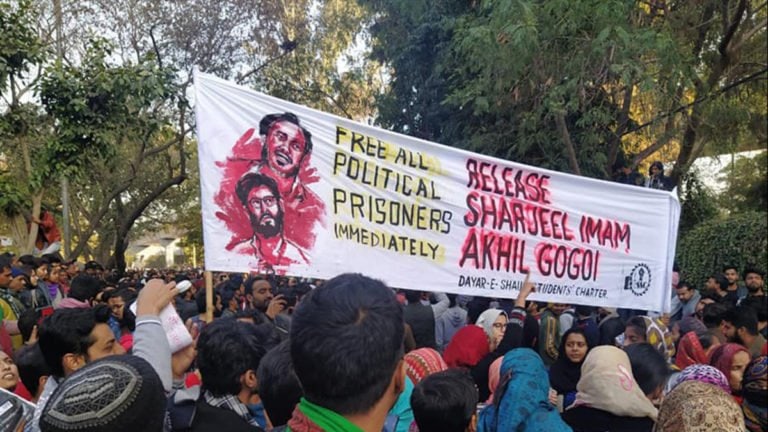
Students with burning eyes and chests chanted slogans even as police fired obsolete tear gas shells. They did not even hesitate to cross campuses and open fire. The police violence in JNU and Jamia has passed one long year of time. Sharjeel imam, umar khalid and numerous others have been in fascist prisons for about one year. The JNU student sharjeel imam is a real fighter who set up the idea of Shaheen Bagh to India. The 930 page charge sheet failed by the police against them includes serious offenses including treason. Police alleges that umar khalid, a former student leader of JNU, is a terrorist who conspired to build a Muslim nation.
Numerous students including safoora zargar, sharjeel usmani, asif iqbal, devangana kalita, Dr, Khafeel Khan are all portrayed as enemies and traitors in the eyes of the fascist media. While the truth remains hidden, the media is trying to make the lies told by the fascist government, come true, again and again. Media did not see the protests against the government in all major cities of the country like Delhi and Shaheen Bagh. The news anchors acted everywhere as if such incidents were not happening anywhere in the country. Many journalists who spoke out against the government are still in prisons. Because they are Muslims and raised their voice for minorities, which is the biggest offence they have done in India.
The Delhi riot was a highly planned and horrific incident. The whole city was set on to fire. Even then , the media remained silent! Listen to the experience of Muhammad Chotu, who is staying in a refugee camp organized by the Delhi government in Mustafabad. On Feb.24, the rioters set fire to the Muslim streets and shot dead his elder brother, 58 years old Anwar. When Anwar tried to raise his head despite the gunfire, they beat him again and threw him into the fire. Chotu, who had taken refuge in the house of a nearby non-Muslim friend, could do nothing but watch his brother burn into death. Anwar had only two legs on his burnt body. This atrocity took place at Shiv Vihar in East Delhi. In the meantime, they tried to contact Law enforcers, but to no avail. The media was not ready even to write a column for them.
In fact, the media in India is going through some crucial stages. The current situation of the media is more complicated than the crisis of 1975 and 1977. At that time the media mustered the courage to move forward against the fascist tendencies of Indira Gandhi. But today the picture is different. Here at the same time the media is gaining government favor and dominance in the market. The current prime time debates are works to support the government’s political dream, ‘Hindu Rashtra’.
Now look at the ideologies of the media. Technically media companies run capital based businesses. In addition to publishing news honestly, it also has a market obligation to keep more demand and raise the profit line. Media mainly depends on advertising revenue. When it comes to public speaking, hate speech against Muslims and other minorities, it invites the attention of the majority community. So, they share more concerns about three talaq, Halal branding, kashmir, cow murder, Pakistan terrorism and introlance of five times adaans from the mosques. It will be transmitted far and wide without questioning the authenticity. People are injected with toxins every day without their consent.
Prime times on the anxiety of Love Jihad will have tens of thousands of spectators. Readers will run to taste it when the Indian Muslims appear on the screen who are consistently referred as extremist and ‘pakistani’. It portrays Muslims as a public enemy, accusing them with anti nationalism and Pakistan relations, thereby increasing the abundance of spectators.There will also be a natural growth in advertising revenue. Channels like Zee News, Republic TV, News 18 and Aaj Tak all are teaching people to hate Muslims and minorities. Arnab Goswami, Anjana om kasyap, sudheer choudari, Rohit Sardana who played the lead roles, have been making allegations day and night in the news rooms against them. Media will not discuss the plight of Muslims who have to live as helpless in society with the face of all these allegations.
Such plans of the media are not for just Muslims. Recently, Rhea chakraborty was hunted by the media in connection with the death of sushant singh. But when arnab goswami was arrested, the same media blamed the police system and the state government. The all ministers of Sangh parivar Condemned in that arrest. We have seen how 83 years old Father Stan Swami and The Human Activist VaraVara Ravu, who were jailed in Bhimag- Koragave case, were treated by the media. Stan swami is an old Jesuit Christian with Parkinson’s disability. He cannot even drink water without anyone’s help. The court was not willing to provide him with a straw. Media will not represent him. Because, this media manifesto is written for all those who pointed fingers against the injustice of rulers.
Not all Hindus are hostile to Muslims. That is what they want to be ‘secular’. The scene of unity in Indian democracy can be seen in all the films from the freedom struggle to citizen struggle. Not all media outlets are justifying the misdeeds of the Sangh Parivar or Modi government. This is a time when people are trusting the media at least a little more than ever before. Soul of democracy remains only in such media which promotes the contemporary freedom struggles for the return of india. This remains a hope for Indian.
It’s been one year of brutal and painful injustice to Sharjeel Imam.
The times we are living in is historic. This uprising is the largest that this country and subcontinent has seen and this is not to reduce an agitation to what happened yesterday or the farmer protest. People have been connected via the internet in ways that has changed the dynamics of how social movements and revolutions happen.
A friend I was talking to had a question for me few weeks ago, when the farmer protests had begun. He hasn’t witnessed any movement at this scale in his life, owing also to the privileges that his community provides. He asked, ‘what is going to happen with this protest? Where is this going?’. I didn’t have to search for words that could explain where this would lead, as we have just begun, but I said, “Mr. D, you cannot even imagine the solidarities that we have been able to make in these past few months and years. Friends and folks are steadily looking beyond all the barriers they have been raised with and listening to what other people have to say. We are learning to step back and for the first time in our lives, hear what historical oppression is from the people who are suffering.” An acquaintance which is turning into a friendship told me yesterday, “the State and society has cornered my community to the extent that every day I wake up with the anxiety of not knowing what will happen that day. I can no longer breathe at ease without this anxiety. Community is vilified, men are picked up on random and arrested not because they have done something but because of the identity they come from. Social interactions from all sides are forced to be ceased. My body and mind is tired. With what is happening, I see myself going back to my roots to understand my existence, role of my community in building this country – conomically, sociologically and politically. My history is embodied and is asserting itself, loudly. ” Which is why, an individual can never be secular in its existence.
If we are to say that caste, religion and gender walk together as an entity, that complexity is spilled over every day – from the language they speak to the articulation of bottled up anger of betrayal and discrimination. It is like saying that sexuality can or will spill over only during a pride. Our identities shed and mark their lives every day/every moment we take a new breath.
Photo by : Sreekanth Sivadasan
If a community is vilified for what they practice and killed, the identities will brim. From La Illa Illala to Nishan Sahib, if these are making your liberal sweet spots uncomfortable, that is the purpose of a protest. A revolution was and will never be to make the privileged feel cushiony. To deterritorialise at important points, claiming new spaces in whatever way, is a step to make their voices heard. Which is why what happened yesterday was historic. A persecuted minority community’s (persecuted by the Brahmanical-Baniya structure) assertion is what the nation witnessed. A Ram temple in a tax payed tableaux on Republic Day while money is being collected from places where the 2020 pogrom happened (on the same day) is a war cry. Guru Tej Bahadur on a tableaux is an assertion of a religion that came out of Hinduism and its slave system called caste which is the foundation of the majority religion. Guru Tej Bahadur in New Delhi on a Republic Day also stands as a symbol reminding the rest of the country of an explanation it owes to the bloodshed and systemic socio-economic and political violence meted on the entire community. Disjunct understanding of relativity to symbols is privilege, nudging the many wounds is violence.
The promulgation of the Uttar Pradesh Prohibition of Unlawful Conversion of Religion Ordinance 2020 on November 27, 2020 has sent deep jitters amongst people of the Indian subcontinent. The ordinance makes religious conversion a cognizable and non-bailable offence. It also penalises the accused of up to 10 years of imprisonment and fine. Along with carceral punishment, the accused is bound by law to pay the victim 5 lac INR. The Ordinance recognises an act as conversion as illegal, if there is misrepresentation, force, influence, coercion, allurement or by marriage. An individual who has decided to convert a religion has to apply for the same in front of the District Magistrate and their details (name, address, etc) will be declared to the public for 3 weeks.
The Ordinance further declares that the burden to prove that a conversion was not done through misrepresentation, force, influence, coercion, allurement or by marriage etc would be on the person who caused the conversion or the person who facilitated it. Considering that Muslims form only about 14% of India’s total population, it is in fact delirious and laughable if the brutality of the carceral nature of the intent to target a minority community who are already persecuted by zealots and vigilantes was overlooked. The Ordinance lays out the terms and conditions of who would be considered guilty. Much like the language of POCSO, any person who is said to abet the act will be considered guilty and thus penalized (in few cases double penalized with no exemptions on forms of penalties).
Policemen tries to stop farmers marching towards Delhi from Ghazipur border during their ‘Kisan Gantantra Parade’, amid the 72nd Republic Day celebrations, in New Delhi, Tuesday, Jan. 26, 2021. (PTI Photo/Vijay Verma)(PTI01_26_2021_000215B)
The condemned body which relates to the disciplinary power is a body which is marked by a form of civility. Here perhaps it isn’t the brute force which is essentially physical but a production of docile population of female that does as it is told, unquestioning any societal or familial directives. The State is of course involved in nullifying the agency of an adult woman but any family member (recognised by blood) can legally question the legitimacy of the marriage. It must be noted, again, that the burden of proof to justify the legality rests on the man which prima facie strikes out the consent of the woman. The Ordinance (read alongside similar laws like CAA and UAPA) violates the right of an individual to be deemed innocent (until proves otherwise). This biopolitical scheme of governance makes it easier to persecute Muslim men and alongside that pushes women under parental and community control. This trafficking of women from one custody to another is deeply unsettling and disturbing for, it elicits a deep sense of indignity to practice a constitutional right. Institution of marriage in South Asia is a contractual embodiment of caste lineage. A communal ordinance which criminalises acts does little to free women from oppressive structures and adds more to their curtailment of social interactions, freedom of choice and mobility. The anticonversion law through its ambiguities provides the State enough opportunities to practice institutional and systemic apartheid. This apartheid includes State abortion, but one mustn’t be surprised by it and buy into the liberality of the emotion. In continuance to what is mentioned above, fabric of India rests on marital rape. The moment women seek pleasure of any form, they are kidnapped and beaten, fetuses aborted. The Acts have gotten impunity.
One must of course be cautious while writing about this Ordinance in order to avoid stepping over the fear and anxiety of Muslim men/community. A period which is marked by the presence of a genocidal citizenship Act and the socialities the resistance it was able to create – this biopolitique of subjugation and movement to freedom has complex manifestations on Muslim men and their anxieties. The response to these inconsequentially yet ordered and planned move by a majority community requires a deeper understanding of lives, lived experiences and most of all owning up to one’s complicity.
RSS
Let me remind you that it is only form of secularism which has changed in the last 7 years. It is only a State in its functioning which can act secular and for the record Indian State has hardly been secular in the past 71 years. 1947 partition, massacres of Nellie, Bhiwandi, Bombay, Hashimpura, Muzzafarnagar, fake encounters in Batla House, genocides in Gujarat, Delhi (1984 and 2020), and every lynching and hate crime has been about Indian State and its direct involvement in them. To deny the fear communities feel is to take away that portion of their lives and place a hegemonic narrative. If this isn’t violence, then one wonders what else is. This also pushes family, family-child complex as a State machinery into the background as though identity creation is an external phenomenon divorced from various forms of capital(s). Family is the smallest yet the most powerful pedagogical apparatus and throughout acts as an agent. I wonder if one should even respond to the flimsiness of the liberal argument of, “Red Fort is a national monument and placing religious symbol is turning the movement nonsecular.” Little did they know that The Fort has been adopted by the Dalmia groups, a corporate entity. The Fort in one sense does not belong to the State. So, whose sovereignty has been destabilised with a Nishan Sahib flag on a post in the Fort? The placing of a religious flag then isn’t an attack on a nation and its integrity but on your idea of a nation. Your idea of a nation in saffron which is why you had to cry hoarse when the protest route changed. A rehearsed parade wouldn’t unsettle your gaze, a deroute would. The unsettling you see is caste. This is what nationalism does to a country – reduce emotions to symbols and make lives abstract.
Sarah Ather Kashmiri writes – Any criticism of the current political scenario lacking a critique of the neo-liberal structure that enables it, amounts to nothing more than liberal cancel culture. You might think you are well intentioned but even your anger is being commodified and getting recycled into the system as clickbait articles, social media content, woke stand-up comedy and a pop culture that again only serves to expand the hegemonic ideas of the ruling class. Do not reject philosophers and political thinkers on account of your experience with people who came off as elitist or snobbish to you. Political theory and philosophy is for our own emancipation.
Narendra Modi and Amit Shah
It is imperative (while difficult) to have these important conversations and not forget that the farmer agitation has managed to foreground Brahmin-Baniya-State nexus in its barest form. People and martyrs of Thoothukudi, Mollem & hinterlands of this country for years have been trying to talk about this and it is about time we see this uprising as a continuum. What is happening now is only the beginning. All rots are bare open. As a post-colonial country having a past of governance dictated by feudalism and a present that carries the baggage of its remnants, India as a country has had little to do with revolutions. Bhima Koregaon, Telangana Armed Struggle, Naxalbari struggle and every people’s movement were instances. One can take inspiration but to imagine them as cultural revolution would be too far-fetched a claim to make. It is overwhelming to see young people break, critique and build new ideas of what peace and justice would mean with clarity and thus it is our responsibility to not only keep up the momentum but move milestones to ensure that this revolution is here to stay. It is this lucidity of young people like Sharjeel Imam, Umar Khalid, Devangna Kalita, Natasha Narwal, Gulfisha Fathima, Meeran Haider, Khalid Saifi, and hundreds of people behind bars (our collective that lives are reduced to numbers) that the State fears. Sharjeel Imam paved way for an entire community to rethink its form and place of protest. From Shaheen Bagh which is outside of a museum-ised place like Jantar Mantar to the birth of Bagh(s) should be, as intended, unsettling for the privileged. Keeping all the experiences and knowledge as a postcolonial nation, it is imperative that we reimagine how we will redefine Constitution for our movement to liberation – to engage, dissent, amend so that power to the people is maintained. This is not the time for someone to feel apologetic to speak up. Make our voices heard – on dinner tables, classrooms, bedrooms, streets. Destabilise the status-quo and eventually overturn it.
You are entering history and this shall be televised.
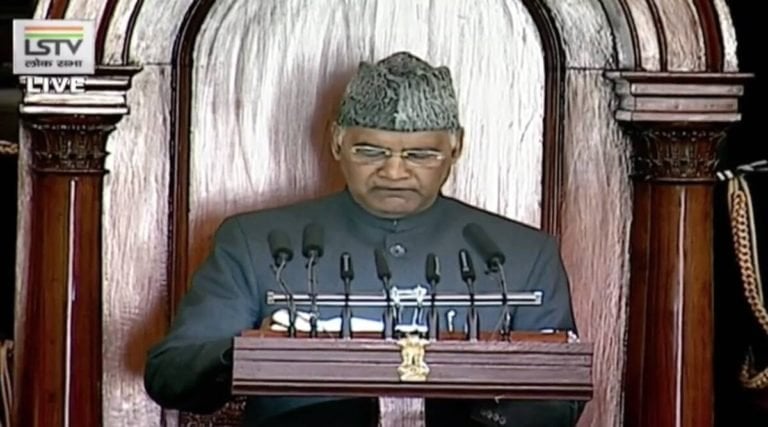
Addressing a joint sitting of both houses of Parliament today, President Ram Nath Kovind said holding joint session of Parliament amid coronavirus pandemic is essential.
“It’s a new year and a new decade and we’re also entering into the 75th year of independence. Today all MPs are present here with message and trust that however tough be the challenge neither we nor India will stop,” he added.
The opposition boycotted the President’s address and organised a silent protest at Vijay Chowk in solidarity with protesting farmers.
Meanwhile, the BJP launched a scathing attack on the opposition parties for their decision to boycott the President’s address to Parliament accusing them of “constitutional and moral bankruptcy”.
16 opposition parties led by the Congress, NCP, Shiv Sena and the TMC decided to boycott the President’s address to the joint sitting of Parliament. The decision was taken to express solidarity with the farmers protesting against the new farm laws.
The Supreme Court Thursday sought the Centre’s reply on a plea by TN Prathapan, Congress MP from Kerala, challenging the Constitutional validity of three contentious farm laws.
A bench comprising Chief Justice SA Bobde and Justices AS Bopanna and V Ramasubramanian issued notice to the central government on the plea and ordered tagging it with the ones pending on the issue.
Prathapan, who represents Thrissur Lok Sabha constituency in Kerala, has alleged that the laws are violative of Article 14 (right to equality), 15 (prohibition of discrimination) and 21 (right to life and liberty) of the Constitution.
He said the laws are “liable to be struck down as unconstitutional, illegal and void”.
Prathapan, in the plea filed through lawyer James P Thomas, said: “Indian Agriculture is characterised by fragmentation due to small holdings and has certain inherent weaknesses beyond control such as dependence on weather, uncertainties in production and an unpredictable market. This makes agriculture risky and inefficient in respect of both input and output management.”
It said the challenges faced by farmers such as dependence on weather, cannot be addressed by monetisation of the produce to increase their income, instead strengthening the Agricultural Produce Market Committee (APMC) system by infusing more capital and effective management of Minimum Support Price.
“The number of farmers that the Centre assumed for calculating the cost of PM-Kisan scheme is from the Agriculture Census of 2015-16, which had put the number of operational agriculture land holdings in the country at 14.5 crore.
“The matter is of substantial public interest and is emergent as there is need for striking down laws which violate the rights of the 14.5 crore citizens who are engaged in farming before serious financial damage is caused to them and the families of such persons,” it said.
During the course of the hearing, the CJI asked, the petitioner, “are you a farmer?”
To it, Prathapan’s lawyer replied: “Yes, I’m a farmer too.”
The Supreme Court on January 12, stayed the implementation of three farm laws and asked the committee formed by it concerning the three farm laws to submit it reports within two months.
Prior to this, the court on September 28 last year, had issued notice to the Centre on similar pleas filed by Rashtriya Janta Dal lawmaker from Rajya Sabha, Manoj Jha and Dravida Munnetra Kazhagam (DMK) Rajya Sabha MP from Tamil Nadu, Tiruchi Siva, and a petition filed by Rakesh Vaishnav.
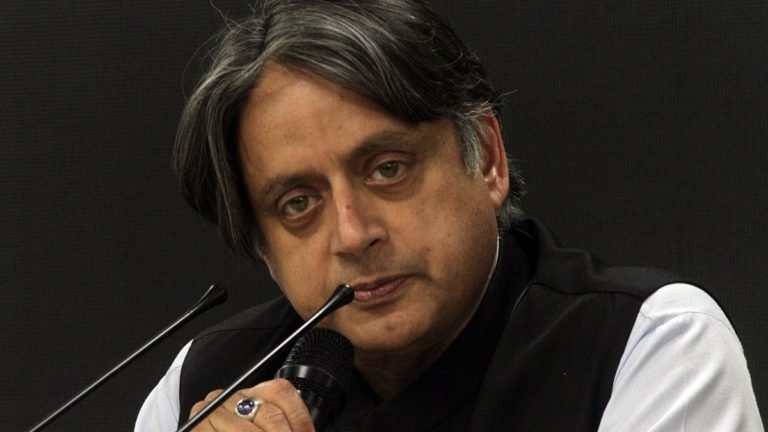
The Noida police booked Member of Parliament Shashi Tharoor, journalists Rajdeep Sardesai, Vinod K Jose (Caravan), Mrinal Pande and others for sedition on Thursday. An FIR lodged at the Sector-20 police station stated that they were booked for tweeting and spreading fake news pertaining to the death of a farmer during the tractor rally on January 26, 2021.
The complainant accused them of inciting riots through their social media posts on Tuesday. They sought an inquiry into the matter and demanded that the social media posts be removed.
As per the FIR, the police registered a case against them based on a complaint by Arpit Mishra, 35. The FIR also names Zafar Agha, the Group Editor-in-Chief of National Herald, and Ananth Nath, the Editor of Caravan.
Interestingly, the case has been filed in UP, although the jurisdiction for the case would be Delhi. A legal expert told TNM that since the sections used are cognizable offences, the UP police may be trying to show that the case can be filed anywhere and will then be transferred to the jurisdictional police.
The journalists and politicians have been booked under sections 153A [Promoting enmity between different groups on grounds of religion, race, place of birth, residence, language, etc., and doing acts prejudicial to maintenance of harmony], 153B [Imputations, assertions prejudicial to national-integration], 295A [Deliberate and malicious acts, intended to outrage religious feelings of any class by insulting its religion or religious beliefs], 298 [Uttering, words, etc., with deliberate intent to wound the religious feelings of any person], 504 [Intentional insult with intent to provoke breach of the peace], 506 [Criminal Intimidation], 505(2) [Statements conducing to public mischief], 124-A [Sedition], 34 [Acts done by several persons in furtherance of common intention] and 120-B [Punishment of criminal conspiracy] of the Indian Penal Code and section 66 of the Information Technology Act, 2000.
“There were many important personalities during the Republic Day parade,” the FIR said. “But the accused tweeted to malign the image of the police and the security forces.” It claimed that the accused have carried out such actions to affect the country’s peace and security earlier as well.