Home Blog Page 22

‘Will not allow NRC and NPR in West Bengal’: Mamata Banerjee

0

West Bengal Chief Minister Mamata Banerjee on Wednesday asserted that her government will not allow implementation of National Register of Citizens (NRC) or National Population Register (NPR) in the state.

Maintaining that all the residents of the state are citizens of the country and no one can change that, Mr Banerjee accused the BJP of trying to play divisive politics using the Citizenship Amendment Act (CAA).

Addressing a public meeting here in North 24 Parganas district bordering Bangladesh, she said, “I, as the chief minister, say that you are citizens and no one can change that. We will not allow NRC or NPR.”

Ms Banerjee also claimed that these are the BJP’s ploy to throw people out of the state.

BJP national general secretary and in-charge of West Bengal, Kailash Vijayvargiya, last week said the CAA is likely to be implemented from January next year, as the Centre is keen to grant citizenship to the large refugee population in West Bengal.

Wooing the Matua community who hold considerable sway over a number of Assembly constituencies in North 24 Parganas and neighbouring Nadia district, Ms Banerjee said that a slew of development programmes has been taken up for the community.

“We will not allow Bengal to be turned into Gujarat,” the TMC chief said, claiming the BJP has destroyed the country through its “divisive politics.”

Prime Minister Narendra Modi has brought three laws against the interests of farmers to enable corporates to take away their produce at will, Ms Banerjee alleged.

The Chief Minister accused the BJP of making false allegations over providing monetary relief to the victims of cyclone Amphan.

“Just because one or two elements did some mischief, you (BJP) are seeking the accounts of Amphan relief. How much money have you given that you are asking for it?” she said.

Protesting farmers observe Human Rights Day, demand release of political prisoners

0

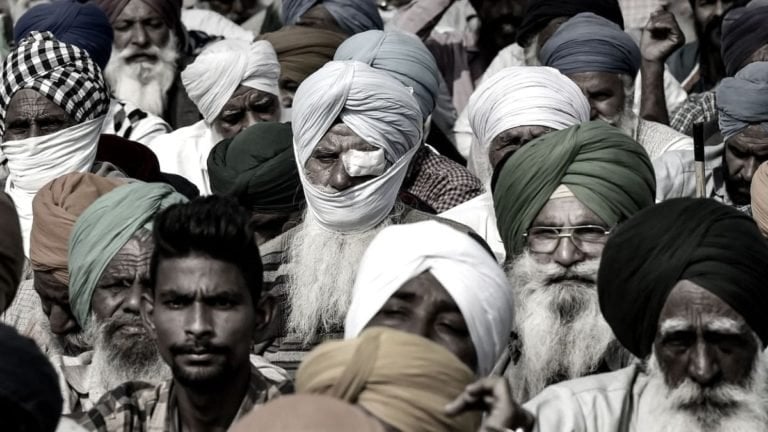
BKU Ekta Ugrahan observing human rights day at Tikri border demanded the release of writers, intellectuals, rationalists mainly arrested in Elgar Parishad case Gautam Navlakha, Sudha Bhardwaj, Varvara Rao, Anand Teltumbde and many others held in Delhi Riots case such as Umar Khalid, Sharjeel Imam, etc.

Protesting farmers were seen holding posters in support of these activists, expressing solidarity with them and demanding their release.

Jhanda Singh Jethuke, senior vice-president of BKU (Ekta-Ugrahan) said, “We will celebrate International Human Rights Day at Baba Banda Singh Nagar, near Tikri border, to raise our voices for the release of intellectuals and human rights activists. Demand for the release of these prisoners has been raised constantly throughout the agitation. Modi government is running a Fascist agenda. On one hand, it is promoting Adani and Ambani and on the other hand, it is pushing intellectuals and activities into jail. Around two dozen activists have been booked under UAPA allegedly for Bhima Koregaon and Delhi riots”.

Opposition meets President Kovind on farmers’ issue

0

A team of opposition leaders — mostly Congress and the Left parties — met President Ram Nath Kovind this evening to submit a memorandum on the farmers’ issue. “We decided to approach the President with the request to repeal  the farm laws and the Electricity Amendment Bill that were passed in anti-democratic manner without proper discussions and consultations,” said Left leader Sitaram Yechury after the meeting.

“For the last 13 days, they are sitting in the cold peacefully, expressing unhappiness. The manner in which these bills were passed, without any discussion with the opposition or with farmers who have built this country, the way the bills were imposed, we see it as an insult to farmers,” said Congress’s Rahul Gandhi.

The meeting came amid talks of a rift within the opposition.  A section of Trinamool Congress leaders said the party decided to stay away from the meeting with the President, owing to the impression that only the Left parties and the Congress were “dominating the show”.

In all, 24 opposition parties are backing the farmers’ protest and were supposed to submit a memorandum to President Kovind today. But the Rashtrapati Bhavan has decided to allow representatives of only five parties, citing Covid-related restrictions.

The delegation that finally met the President included Congress’s Rahul Gandhi, Nationalist Congress Party chief Sharad Pawar, CPM’s Sitaram Yechury, CPI’s D Raja, and DMK’s TKS Elangovan.

There was a change of plan — that only those attending the meeting with President Kovind will sign the memorandum, since other political parties have already shown support for the farmers’ demand to scrap the Centre’s new farm laws.

Sources in Trinamool Congress indicated that the party was miffed at the decision. The party was considering sending an MP with the delegation but finally decided against it.

“We don’t need any certificate about our commitment to farmers. Mamata Banerjee doesn’t need any certificate,” a leader said, reflecting the mood in the party.

Another senior leader brushed away talks of any divide. “Everyone knows Mamata Banerjee is at the forefront of the farmers’ cause and this is just Sitaram Yechury playing games,” he said.

Opposition parties, which tried to block the farm bills in parliament, had earlier requested the President not to sign on the bills. The bills, they had said, were passed in the Rajya Sabha in an undemocratic manner. The President, however, had given his assent to all three bills.

Yesterday’s countrywide shutdown called by the farmers, had the support of most opposition parties, including the Congress, Aam Aadmi Party, DMK and the Telangana Rashtra Samithi.

Agri scientist refuses award from Union Minister, says “for the sake of professional benefit would be a betrayal”

0

Agricultural scientist Dr Varinderpal Singh refused to accept an award from a Union minister on Monday, in solidarity with farmers protesting against the new laws.

Singh is the principal soil chemist at the Punjab Agricultural University in Ludhiana. At an event in New Delhi on Monday, the Fertiliser Association of India awarded him for his contributions on plant nutrition. The awards were being handed out by Union chemicals and fertilisers minister D.V. Sadananda Gowda.

When Singh’s name was announced, he came up on stage, but refused to accept the award – saying his conscience would not allow it.

“I wish that we shall work together for the nation and the government shall listen to our dear farmers. The work I did is only for the farmers and our nation, so I feel I would be guilty if at this moment I receive this award,” he said.

Gowda urged Singh to accept the award several times, but he refused. Later, he wrote a letter to Prime Minister Narendra Modi explaining his decision.

“My conscious [conscience] does not allow me to receive this award from any government official, because of unnecessary pains given by the GOI [Government of India] to the peacefully protesting Indian farmers (sic),” Singh’s letter to Modi said.

While slamming the new laws, Singh lauded protesting farmers for their continuing peaceful protest. “It is highly heartbroken [heartbreaking] that national media is rating the Ann Datta [food provider] or his supporters as terrorists,” he wrote.

The scientist also wrote to Gowda. Accepting a farmer “for the sake of professional benefit would be a betrayal” to the farmers and the country, Singh said in that letter.

“Too much democracy” in India brings difficult towards reforms, says Niti Aayog CEO

0

Niti Aayog CEO Amitabh Kant had said at a virtual event on Tuesday that it was difficult to bring tough reforms in India as there was “too much of democracy” in the country.

“Tough reforms are very difficult in the Indian context, we have too much of democracy… You needed political will to carry out these reforms (mining, coal, labour, agriculture) and many more reforms still need to be done,” Kant was quoted as saying by PTI.

However, the report was updated by the news agency after Swarajya magazine, which hosted the event issued a clarification that Kant’s remarks were made in the context of “spreading resources too thin” and not on India’s political system.

Twitterati slammed the Niti Aayog CEO as a video of his remarks began circulating on social media. English daily Hindustan Times, which had shared the remarks on Twitter, deleted it from the social media platform after Kant tweeted that he didn’t say it.

As per the PTI report, Kant further asserted that is not easy for India to compete against China without hard reforms, and that the next wave of reforms must come from states.

“This government has demonstrated (the) political will to carry out hard reforms,” he said.

“If 10 to 12 states will grow at higher rates, then there is no reason why Indian won’t grow at higher rates. We have asked Union territories to privatise discoms. Discoms must become far more competitive and provide cheap power,” he added.

Replying to a question on protests by farmers against the Centre’s new farm laws, Kant said the agriculture sector needs reforms.

“It is very important to understand this that MSPs (minimum support price) will be there, mandis will remain… farmers must have a choice to sell their products as they benefit out of this,” he noted.

On sourcing of raw material for manufacturing electric batteries in India, Kant pointed out that lithium (which is used for manufacturing batteries) is available in large quantities across the world, including Australia.

“We don’t anticipate any shortage of lithium,” he said.

On Modi government’s “Aatmanirbhar Bharat” initiative, he said it is not about looking inwards, but unleashing the potential of Indian companies.

The government has identified 10 champion sectors for production-linked incentives (PLI) scheme and these sectors will play a major role in making India a manufacturing hub, and give the country economies of scale, Kant said.

“The PLI scheme is going to provide a huge opportunity to these sectors for four to five years to export,” he added.

Noting that India must technologically leapfrog, Kant said it is also important for the country to get into sunrise industries.

With inputs from PTI

PSG- Istanbul Basaksehir match postponed as players walked off over an official’s racial slur

0

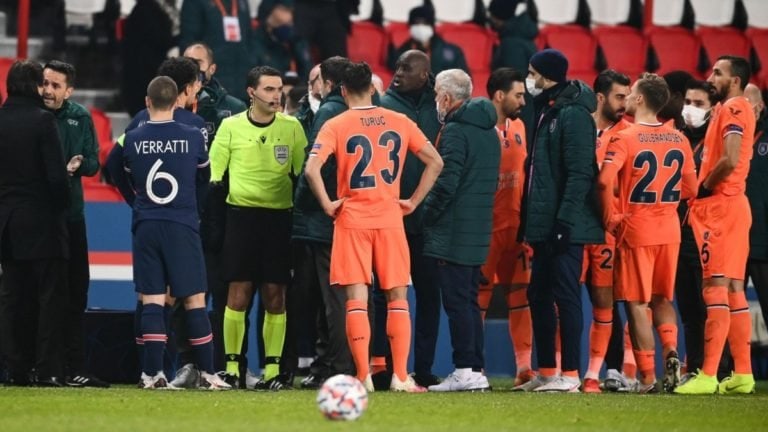
The Champions League game between Paris Saint-Germain and Basaksehir was postponed when players walked off the field on Tuesday after alleging that fourth official Sebastian Coltescu of Romania used a racial term when identifying a Black assistant coach.

Players from the Turkish team were furious after assistant coach Pierre Webo was shown a red card by referee Ovidiu Hategan of Romania at Parc des Princes, saying Coltescu had used a racial term to describe Webo, who is from Cameroon, before he was sent off.

Basaksehir substitute Demba Ba demanded that the fourth official explain himself, while PSG players Neymar and Kylian Mbappe also demanded an explanation. Basaksehir coach Okan Buruk said “you are racist” to Coltescu.

The score was 0-0 when the incident took place about 14 minutes into the match.

UEFA said the match would resume on Wednesday evening with new officials.

“Following an incident at tonight’s UEFA Champions League match between Paris Saint-Germain FC and Istanbul Basaksehir FK, UEFA has — after discussion with both clubs — decided on an exceptional basis to have the remaining minutes of the match played tomorrow with a new team of match officials,” UEFA said late Tuesday.

“A thorough investigation on the incident that took place will be opened immediately,” it added.

Television footage captured the exchange between the fourth official and the referee, with Coltescu telling Hategan that Webo should be reprimanded for his behaviour on the sidelines:

“Go and give it (the red card) to the Black one, this is not possible (tolerable), go and identify him, go verify, the Black one over there,” Coltescu allegedly said, in Romanian, about Webo.

Webo was enraged and was heard to repeat at least six times “Why you say negro?” as he sought an explanation from Coltescu.

Webo, who was visibly distressed, then added: “He can’t say negro, he can’t say negro.”

At this point, Ba could be heard also questioning what Coltescu had said.

“Why is the fourth official saying ‘negro?’” Ba said twice.

Moments later, Ba then came off the bench and stood in front of Coltescu and said: “Why when you mention a Black guy, you have to say ‘This Black guy?’”

During the interruption, Basaksehir posted a message on Twitter against a UEFA backdrop with the message “NO TO RACISM.”

PSG defender Presnel Kimpembe, who was on the field during the game, also posted that message on his Twitter account.

Mbappe expressed his support for Webo on Twitter.

“SAY NO TO RACISM,” he wrote. “WEBO WE ARE WITH YOU.”

Former Manchester United defender Rio Ferdinand, who played 81 times for England, said it was crucial that UEFA now responds strongly.

“We’re at a disturbing tipping point, not a week goes by without an incident involving race,” he told broadcaster BT Sport. “The players walking off is a step in the right direction, but it can’t just be left to them.”

Piara Powar, executive director of the anti-discrimination Fare network — which helps UEFA investigate cases — told The Associated Press there was no excuse for Coltescu’s language.

“Unintentional racism is still racism,” Powar said in a text message to The AP. “If officials cannot set the standards by their own behaviour, they cannot be relied on to deal with racism on the pitch or in the stands.”

Like Ferdinand, he also thinks more has to be done by those running the game.

“The walk off by both Basaksehir and PSG together lays down a marker in Europe,” Powar said. “Many players are fed up with half measures to tackle racism, and are more prepared than ever before to exercise their right to stop a match.”

The 38-year-old Webo is a former Cameroon striker who made more than 50 appearances for his country’s national team. He played for Basaksehir from 2011-13.

Seven years ago, Hategan was in charge of a match between CSKA Moscow and Manchester City when City’s Black players were racially abused.

City captain Yaya Toure directed referee Hategan toward fans making monkey noises at the English club’s Black players.

Michel Platini, UEFA’s president at the time, requested an internal inquiry involving the referee to examine why guidelines were not followed to respond to discrimination incidents during matches.

UEFA has designated Dutch referee Danny Makkelie to take charge on Wednesday along with different assistant referees and a new fourth official.

Talk of Amit Shah with farmers failed, today’s meeting cancelled

Union Home Minister Amit Shah’s meeting with protesting farmers on Tuesday evening – indicating the involvement of the government’s highest level to resolve the deadlock over the contentious farm laws – failed, with both sides remaining firm on their positions. The farmers refused to accept the government’s offer of amendment in the laws, sticking to their demand for a complete scrapping. The big meeting scheduled for today with Agriculture Minister Narendra Singh Tomar – the sixth since the protests started – has been called off.

Sources said farmers’ unions were given a presentation on the bills on Tuesday and a proposal will be sent to farm leaders today with written amendments that the government intends to carry out.

“No meeting will be held between farmers and the government tomorrow (Wednesday). The minister has said a proposal will be given to farmer leaders tomorrow (Wednesday). Farmer leaders will hold a meeting to discuss the proposal,” Hannan Mollah, the general secretary of the All India Kisan Sabha, told reporters after the meeting on Tuesday.

“I would say that the meeting was positive. The government has taken cognizance of our demands and will give a draft to us tomorrow (Wednesday), which we will deliberate upon,”  Rakesh Tikait, spokesperson of the Bhartiya Kisan Union, was quoted as saying by news agency ANI after the meeting.

The farmers’ meeting will be held at noon at the Singhu border, where thousands have been camping for more than 10 days, demanding scrapping of the three new laws which they fear will shrink their income and leave them at the mercy of corporates.

The offer of amendment in the laws was made at the last couple of meetings between the centre and the farmers, which was turned down by the farmers. There was expectation that the government might be making a fresh proposal. The government, however, made it clear that there has been no rethink on its last stated position.

The Home Minister’s invite came earlier on Tuesday amid a nationwide shutdown called by protesting farmers. The protest, which had the support of most opposition parties, trade and transport unions and a wide section of organisations, had hit road and rail traffic in parts of the country and shut down markets.

Eight farmer leaders were called for the meeting, which started around 9 pm at Pusa Institute, located in a secluded corner of the national capital to keep out the media glare. The biggest farmers’ union of Punjab, the Bharatiya Kisan Union Ugrahan, was not invited for the meeting.

Sources said the government is keen that the farmers accept the offer of amendments to the new farm laws. An acceptance would be a face-saver for the government, which has been under huge criticism over the issue.

On Monday, former BJP ally and NDA founder-member Parkash Singh Badal wrote to Prime Minister Narendra Modi and advised him stay away from confrontation with the farmers. In a letter, he had cited the days of Emergency and said an amicable solution through consensus among the stakeholders was the hallmark of democracy.

Farmers’ protest: An uprising for a necessary negotiation

It feels quite disastrous to have an uninterrupted tradition in developing countries of governments using price and tax policies to benefit the urban sector at the cost of rural. Nobel laureate Abhijit V Banarjee and Esther Duflo introduced the agricultural marketing boards in Africa during the 1970s as a cruel joke since many of the boards pretended to serve the rich at the cost of the poor(Good Economics For Bad Times,2019).

In India, we are similarly facing a vicious circle, but in a more dangerous way, as it targets the utterly rich, which is a small percentage of the total population. As what we call crony capitalism or Musolian fascism, India is seeing a great fusion amid power and corporates. The new farmer’s law is the latest version of corporate slavery that completely negates the basic cause of farmer’s distress and puts them in a severe vicious circle of poverty.

It was just two years ago, where one lakh farmers from 200 organizations marched towards Delhi, seeking the help of the government to write off the bad debts and ensure a minimum price for the agricultural products. It was in 2006, a committee headed by MS Swaminathan, popularly known as the father of the green revolution submitted five reports, mainly concentrating on the importance of land reforms. It was the same committee that introduced the C2 formula for calculating the minimum price. It included all expenses like interest and rent. It also requested to ensure 150 percent of the minimum price to total expenditure. Moreover, the commission warned the intervention of corporates in the agricultural sector. Interestingly, one of the main offers forwarded by NDA during the 2014 election was the implementation of Swaminathan committee’s instructions. Six years have passed, the nation has not witnessed any agricultural policies that firmly follow Swaminathan committee instructions.

In the book ’What economy needs now?’, edited by Nobel laureate Abhijit V Banarjee, Professor Neelkanth Mishra forwards 14 points that needed to be implemented in the agricultural sector. It clearly explains the problem created by APMC (Agricultural produce market committee), which has now turned as a monopoly in the agricultural market.

What makes the new bills more controversial is its negation over the needs of farmers, Swaminathan committee reports, and the research studies forwarded by prominent economists. Then to whom, the government is addressing the new farmers bill. Let us take the three bills in detail.

  1. The farmers produce trade and commerce (promotion and facilitation) act, 2020: In the British period itself India was familiar with APMC’s. It ensured the farmers to have minimum prices even when the market faces a demand shortage. Those intermediaries were given wages and the state government earned tax from it. As usual in all government forms, this system was then negatively used by the officials and it resulted in low prices for the farmers. Yashvant Sinha, the finance minister of Vajpayee government points out this problem by exemplifying the realities of cauliflower farmers from Ranchi district(The Unmade India,2018). As a remedy for this problem, new law allows agricultural markets in and outside APMC’s. It conveys that farmers will definitely get profited with good prices but how? How much opening of the market will ensure good prices to poor farmers? Actually, it was demanded to have the APMC’s with no corruption and with good E-platforms and rules. As per the new law, the market will definitely get stolen by the corporates.
  2. The Farmers (Empowerment and Projection) Agreement on Price Assurance and Farm Services Act, 2020: it empowers direct agreement between farmers and traders. But it feels terrible when it reveals that farmers are not even aware of the market price that their goods have. Neelkanth Mishra points out that around 60 percent of Indian farmers are not aware of the actual market rates of their goods. Dealing with a problem without knowing or hiding its basis will vividly destruct the economy and the nation itself.
  3. The essentials commodities (Amendment) Act, 2020: This was a law even demanded by Abhijit Banerjee to open a market for certain agricultural goods for boosting the market and to control the monopoly in it. But unfortunately, the new law has used this loophole to open the market even in essential goods which may negatively affect the farmers. Excluding potatoes, onions, oil, and other essential goods from the list triggers utter shock and anxiety among commons.

Theoretically, here we can see a competition between the independent market and closed market. Independent market, which seems to be a great failure in the agriculture sector all around the world, is somewhat re-thinkable and quite examined. The new law allows private firms to hoard essential goods and speculate on the market.

As per Pradhanamanthri Kisan Yojana, it is believed that in India, there are 15 crore farmers which is actually bigger in numbers in terms of real calculation. From this 15 crore, 85 percent of farmers belong to low-class families. It is horrible while calculating the numbers of suicide in the agriculture sector which may count to ten thousand per year in India. Moreover, the agricultural sector is the biggest sector that Indian people seek for employment. Without acknowledging these realities, implementing a corporate favor law will have to definitely pay in the future.

Derogatory remarks against Khwaja Moinuddin Chisti: SC refuses to quash FIRs against TV news anchor

0

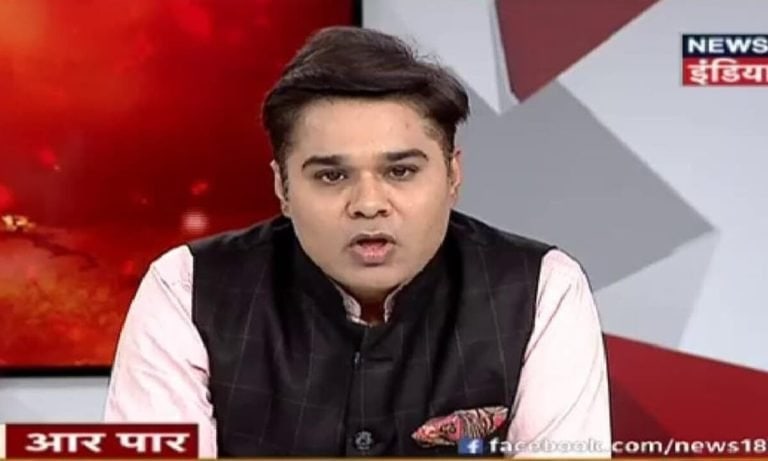
The Supreme Court Monday refused to quash multiple FIRs against News 18 TV anchor Amish Devgan for his alleged defamatory remark against Sufi saint Khwaja Moinuddin Chisti during a show on June 15.

The Court, however, transferred all FIRs to Ajmer and directed that its interim order giving him protection from any coercive action would continue subject to his joining and cooperating in the investigation till the completion of the investigation.

A bench led by Justice AM Khanwaliker was ruling over a petition filed by Devgan challenging the FIRs against him for his alleged derogatory remarks against Pir Hazrat Moinuddin Chishti. As many as seven FIRs were filed against him in different states.

The bench also asked the concerned states to examine the threat perception of the petitioner and family members and take appropriate steps as may be necessary.

Writing the judgment for the court, Justice Sanjiv Khanna observed that in a polity committed to pluralism, hate speech cannot conceivably contribute in any legitimate way to democracy and, in fact, repudiates the right to equality.

“We must act with the objective of promoting social harmony and tolerance by proscribing hateful and inappropriate behaviour. This can be achieved by self-restraint, institutional checks and correction, as well as self-regulation or through the mechanism of statutory regulations, if applicable”, the bench said.

It added that it is not penal threat alone which can help us achieve and ensure equality between groups.

Dignity of citizens of all castes, creed, religion and region, the Court said, is best protected by fellow citizens belonging to non-targeted groups and even targeted groups.

The bench noted that the transcript of the show, including the offending portion, would form a part of the ‘content’, but any evaluation would require examination and consideration of the variable ‘context’ as well as the ‘intent’ and the ‘harm/impact’.

These, according to the Court, had to be evaluated before the court could form an opinion on whether an offence was made out. The evaluative judgment on these aspects would be based upon facts, which had to be inquired into and ascertained by a police investigation.

Devgan argued that multiple FIRs arising out of the same incident was an abuse of law, and violated his fundamental rights and the freedom of press, causing a chilling effect on the freedom of speech and expression. He also alleged that the FIRs were meant to harass and intimidate him.

Devgan is facing charges under Sections 153A(Promoting enmity between different groups on grounds of religion, race, place of birth, residence, language, etc., and doing acts prejudicial to maintenance of harmony), 295A (Deliberate and malicious acts, intended to outrage religious feelings of any class by insulting its religion or religious beliefs) and 505(2) (Statements creating or promoting enmity, hatred or ill-will between classes) of the Indian Penal Code (IPC).

Devgan while hosting the debate, had described Pir Hazrat Moinuddin Chishti, also known as Pir Hazrat Khwaja Gareeb Nawaz, as “aakrantak Chishti aya… aakrantak Chishti aya… lootera Chishti aya… uske baad dharam badle”(sic).

Devgan had later regretted his remarks and said they were uttered inadvertently. He claimed that he wanted to refer to Alauddin Khilji and not Gareeb Nawaz Khwaja Moinuddin Chishti.

No construction, demolition and felling of trees: SC slams Govt on Central Vista

0

The Supreme Court on Monday pulled up the Centre for ‘moving forward aggressively’ with the construction work of Central Vista project. While hearing a bunch of petitions, the top court clearly stated that the foundation stone can be laid but no construction, demolition or felling of trees should take place at the Central Vista project till it ‘decides the pending pleas on the issue’.

According to the reports of Bar and Bench, the court further observed, “We never thought you will go ahead so aggressively with construction. The fact that there is no stay does not mean you can go ahead with everything.”

“You can lay the foundation stone, you can carry on paperwork but no construction or demolition, no cutting down any trees,” a three-judge bench comprising Justices AM Khanwilkar, Dinesh Maheshwari and Sanjiv Khanna told Solicitor General Tushar Mehta.

On November 5, the apex court had reserved its verdict on a batch of pleas which have raised questions over the Centre’s ambitious Central Vista project, which covers three km stretch from Rashtrapati Bhavan to India Gate in Lutyens’ Delhi.

Mehta had earlier argued in the apex court that the project would “save money” which is paid as rent for housing central government ministries in the national capital.

Mehta had submitted that the decision to have a new parliament building has not been taken in a haste and no law or norms have been violated in any manner for the project.

The Centre had also said there was no arbitrariness or favouritism in selecting a consultant for the project and the argument that the government could have adopted a better process cannot be a ground to scrap the project.

Gujarat-based architecture firm HCP Designs has won the consultancy bid for the project to redevelop the Central Vista.

The top court is hearing several pleas on the issue, including the one filed by activist Rajeev Suri, against various permissions given to the project by authorities including the nod to change of land use.

Earlier, the apex court had said that any change at the ground level made by authorities for the Central Vista project will be “at their own risk”.

It had made it clear that the fate of the project, which includes several new government buildings and a new Parliament House, will depend on its decision.

The pleas have also challenged the grant of a no-objection certificate by the Central Vista Committee (CVC) and also the environmental clearances for the construction of a new parliament house building.

The revamp, which was announced in September last year, envisages a new triangular Parliament building, with seating capacity for 900 to 1,200 MPs, that is targeted to be constructed by August, 2022 when the country will be celebrating its 75th Independence Day. The common Central Secretariat is likely to be built by 2024.

Prime Minister Narendra Modi will lay the foundation stone on December 10 for the new Parliament building and the construction is expected to be completed by 2022 at an estimated cost of Rs 971 crore, Lok Sabha Speaker Om Birla had said on December 5.