Joe Biden has won the US presidency over Donald Trump, TV networks projected Saturday — a victory sealed after the Democrat claimed several key battleground states won by the Republican incumbent in 2016. CNN, NBC News and CBS News called the race in his favor, after projecting he had won the decisive state of Pennsylvania.
Trump remained defiant, vowing to press unfounded claims of fraud as a weary, anxious nation waited for clarity in an election that only intensified the country’s deep polarization.
He told Joe Biden not to “wrongfully claim” the White House as incomplete returns from the presidential election showed the Democrat close to an insurmountable lead. “Joe Biden should not wrongfully claim the office of the President. I could make that claim also. Legal proceedings are just now beginning!” Trump tweeted.
On the fourth day of vote counting, Joe Biden had a 253 to 214 lead in the state by state Electoral College vote that determines the winner, according to Edison Research. Securing Pennsylvania’s 20 electoral votes would put Biden over the 270 he needs to win the presidency after a political career stretching back nearly five decades.
Joe Biden would also win if he prevails in two of the three other key states where he was narrowly ahead on Friday: Georgia, Arizona and Nevada. Like Pennsylvania, all three were still processing ballots on Friday.
Nationwide, Joe Biden led Trump by 4.1 million votes out of a record 147 million cast.
UFC Lightweight champion Khabib Nurmagomedov has announced his resignation from MMA after he choked Justin Gaethje unconscious in the second round to successfully defend his UFC lightweight title at UFC 254.
The undefeated 32-year-old Dagestani collapsed in the centre of the octagon and sobbed following his defeat of Gaethje in Abu Dhabi on Saturday.
On getting up he took off his gloves and said: “This is my last fight in the UFC.”
“There’s no way I’m going to be back without my father. I spoke to my mother. She don’t know how I fight without father, but I promised it’s going to be my last fight, and if I give my word, I have to follow it.”
His father and coach Abdulmanap passed away in July of this year due to complications caused by Covid-19, and Nurmagomedov said that he talked to his mother for three days before deciding to accept the fight against Gaethje.
The American troubled the champion with leg kicks but succumbed to a triangle choke in the second round as Nurmagomedov cemented his claim to be the most dominant MMA fighter of all time with a 29-0 record.
Nurmagomedov was active with strikes and with grappling against Gaethje (22-3), the dangerous brawler who had knocked out four consecutive elite opponents while winning the UFC’s interim lightweight title.
After spending the first round largely trading punches and kicks with the aggressive Gaethje, Nurmagomedov used his unparalleled wrestling skills to take down Gaethje early in the second round and then worked into position for the finishing choke.
Gaethje appeared to tap out at least twice before the referee noticed and stopped the bout, by which time Gaethje was unconscious. He bounced up quickly and shared a moment of mutual respect with the dominant Russian champion.
“I know he was in a bad spot, but whether he was or not, he did what he needed to do,” Gaethje said. “I know his father is so proud.”
Also at UFC 254, former middleweight champion Robert Whittaker made his case for another title shot with a solid unanimous decision over fellow contender Jared Cannonier in the penultimate bout on Fight Island.
Nurmagomedov’s first fight in 13 months would be an appropriate farewell for one of the most dynamic competitors in recent MMA history. The Dagestan-born grappling specialist developed a well-rounded game under the tutelage of his father and a Bay Area-based MMA gym, culminating in his ascent to the UFC title in 2018.
Nurmagomedov stopped Conor McGregor and Dustin Poirier in his next two bouts before his yearlong absence from competition.
His victory over McGregor made him one of the world’s most famous combat sports athletes, and the UFC scheduled this pay-per-view show at an earlier-than-normal time to cater to his vast fan base in Russia and Europe.
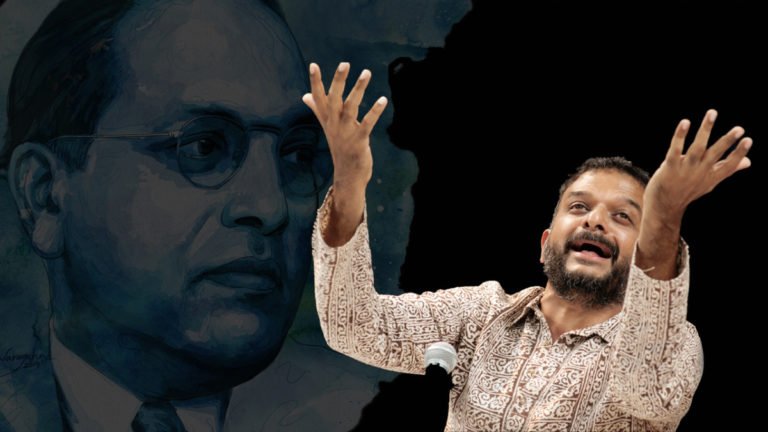
The Edict Project by TM Krishna, in collaboration with Ashoka University.
Historic it was! On October 14, 1956, India’s first law minister and the architect of the Indian constitution, Bhimrao Ambedkar, alongside more than 3 lakh of his adherents, accepted Buddhism as a protest against the caste system that was prevalent and still continues to swallow the indian population at large. This day is commemorated as Dhammachakra Pravartan Day and today is its 64th commemoration.
It was on this day, Ambedkar made 22 pledges, when he revoked Hinduism. According to him, “I thereby reject my old religion, Hinduism, which is detrimental to the prosperity of humankind and which discriminates between man and man and which treats me as inferior.”
Ambedkar strongly fought against the caste discrimination towards Dalits and wrote extensively against the caste system in Hinduism and dedicated his entire life for the upliftment of the Dalit community.
Through this project, Krishna hopes to reimagine Ashoka’s edicts in musical form. The project aims at creating vibrant academic, socio-political and aesthetic conversations around the edicts.
What are Ashoka’s Edicts?
Ashoka, Emperor of the Mauryan empire, reigned from 268 BCE to 232 BCE. After the violent annexing of Kalinga, King Ashoka underwent a transformation and dharma became the pivot of his royal policy and personal belief. He disseminated these ideas through a novel medium: a series of inscriptions incised on natural rock-faces and on pillars. These are to be seen across India from ‘up-north’ to ‘down-south’, and also in modern-day Bangladesh, Nepal, Pakistan and Afghanistan. Known as ‘Edicts’, the inscriptions are, in the central and eastern parts of India, in Prakrit using the Brahmi script and in the north-west, In Kharoshthi, Greek and Aramaic.
The edicts are addressed to his subjects who, he says in his edict in Kalinga, are to him as his own children.
Why Ashoka’s Edicts?
Ashoka’s edicts are simple, brief, personal. And yet are profound, abiding and universal. They have been translated, published, quoted as signals of the soul. Sung in the original Prakrit in a garland of raga-s drawn from the Karnatik tradition, with their meaning given in English sub-titles, they now carry the philosopher-emperor’s vision of a humane society into the realm of the arts.
The first set of 4 edicts taken from different locations have been set to music and shared on October 14th, the day Babasaheb Ambedkar embraced Buddhism.
7 months after an FIR was registered against 14 students from Hyderabad Central University (HCU) for protesting against Citizenship Amendment Act (CAA) and National Population Register (NPR), just one student, Manikanta, member of Bahujan Students’ Front (BSF) received a notice on 10th October to appear at a Hyderabad police station on 6th October. Which is when the rest of the 13 students as well became aware of the FIR registered against them.
On 21st February, a joint protest against CAA-NRC-NPR was held by MANUU Students’ Union and HCU Coordination Committee, where student organisations such as the NSUI (National Students’ Union of India), MSF (Muslim Students’ Federation), BSF and other smaller student groups walked from a coffee shop a 100mtrs away from Maulana Azad National Urdu University (MANUU) into the campus for which an FIR has been registered on the same date against 14 students from HCU university by Cyberabad Police of Raidurgam station.
The notice which was served to Manikanta as per section 41 (police may arrest without warrant) of the Code of Criminal Procedure (CrPC) comes as a shocker to the students, firstly because it came 7 months after the FIR has been registered, secondly as they all hail from different states and travelling during a pandemic to report at the police station is difficult for everybody.
All the 14 students have been booked under 143 (unlawful assembly ), 188 (disobedience to public servants order) read with 34 (Acts done by several persons in furtherance of common intention) of the Indian Penal Code.
The complaint was made by the Sub-Inspector of Police Raidurgam, who was performing duties at MANUU at the time of the joint protest. The FIR states
“Brief facts of the case are that on 21.02.2020 at about 18:15 hours the complainant has while performing duties at MANUU university meantime he noticed that, about 20 to 30 students of Hyderabad Central University(HCU) were illegally gathered at Coffee day shop and conducted rally from Coffee day shop to inside of MANUU University with showing placard, slogans against the central government, and gave lectured there as too provocative the students to break tranquillity at the university, the said rally was conducted without taking permission from either MANNU University authority or from Police, on enquire he came to know names of HCU student i.e. 1) Sourab Kumar, 2)Hadif, 3)Ashiquel Rasool, 4)Thahir Jamal, 5)Manikanta, 6)Amol Jose, 7)Akash Rathore, 8)Sneha Gorge, 9)Basker Sarkar, 10)Ananthu Rajagopal, 11)Mansi Chowdary, 12) Jehad, 13) Akram, 14) Sonal and others. Hence the requests necessary action against the accused persons who have conducted a rally without permission and trying to break tranquillity at the university.”
Responding to the content of the FIR, Umar Faruq, MANUU Students’ Union President says, “We had taken permission from the college authorities for the protest, it’s a baseless allegation by local police. The college authorities allowed us to go ahead with the joint protest, otherwise why would the security also allow us all inside the campus”
He adds, “Even students from MANUU were there at the protest, then why are they selectively targeting students from HCU in this?”
In a letter to the Chief Minister KCR and Home Minister Mohammed Mahmood Ali of Telangana, TN Prathapan, MP from Kerala expressed his disappointment with the Telangana State government for this move. He went on to request the State government to intervene and repeal the charges against the students immediately. The letter says “The FIR should be dispersed in order to protect the Fundamental rights of the students to protest. If we cannot tolerate students’ dissent in our society, it means we are no more Democratic.”
Manikanta says, “We are happy (that TN Prathapan wrote to the HM) because it’s the time for extending solidarity and also standing beside each other. Which was also the main motto of the CAA and NRC joint protest.”
Upon asking what he intends to do next, he says,“I have been trying to reach out to the Investigation Officer of this case, but after his first call, I haven’t been able to reach out to him. I have no idea what exactly they want to do. It is suspicious that they hadn’t informed us about this for this long.”
“It is also shocking that our own university(HCU) gave away our information to the police without informing us”.
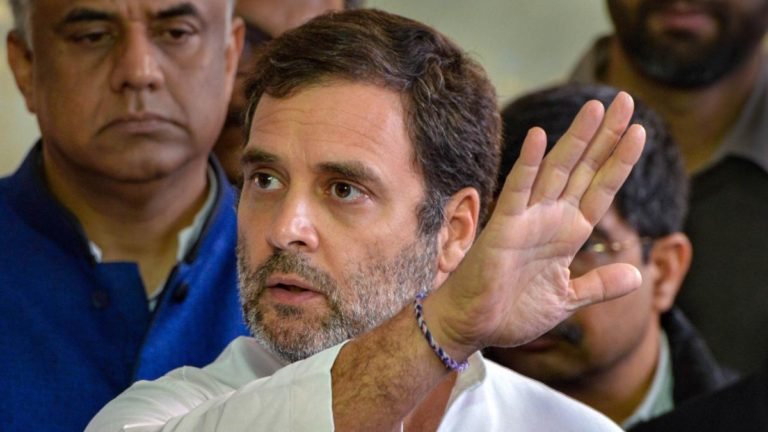
After a long time, Rahul Gandhi is more visible on news channels in the wake of his bravest action marching towards Hathras and his leading presence in the farmers’ protest in Punjab. Rahul has recently spoken about the UP chief minister and the state police authorities who have been claiming that the Dalit woman was not raped because for them she was “no one.” Rahul Gandhi alleged that for most Indians Dalit, Muslim and tribal lives do not matter, “The shameful truth is many Indians don’t consider Dalits, Muslims, and Tribals to be human”. He has interfered in the issues that affected the common people due to the central government’s unpopular stands on recent political, social, and economic matters. The visibility of Rahul Gandhi in the media has, day by day, been increasing, and that way he is at the forefront of the political fights for the common citizens of the nation. He has brought the Hathras incident into the limelight of media coverage and it has been in the headlines in the international media as well.
Rahul Gandhi has faced multiple attacks and severe criticisms from the Indian media as no politician in the recent history of the nation has addressed. Most of the time, Rahul has negatively been covered in the news channels – especially in the English and Hindi media – due to the pre-planned agenda set in the newsrooms influenced and controlled by the BJP and the RSS. Rahul Gandhi has been brought in to the headlines and prime time discussions by manipulating facts and false claims by the major news channels in India. The news programmes on Rahul Gandhi by the news channels and news coverage by the dailies in the period of 2017-2019 have allegedly been recognized as the worst ‘attacking’ time so far when he has been the president of Indian National Congress. It is very interesting to check how Rahul Gandhi has successfully survived the media trails and grown as a promising political leader.
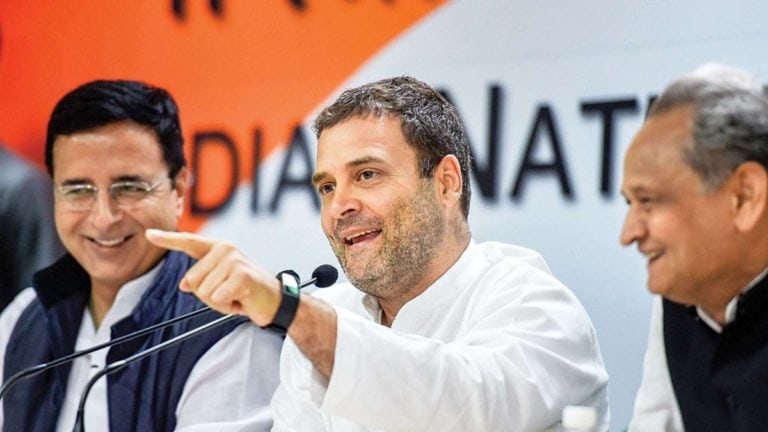
It was on 23rd May 2019; Rahul Gandhi has called for a media conference in Delhi in the aftermath of assembly elections result in the five states- Chhattisgarh, Madhya Pradesh, Mizoram, Rajasthan, and Telangana. He thanked his party workers for their support after trends indicated massive gains for his party in Rajasthan, Chhattisgarh, and Madhya Pradesh. He has also launched a sharp attack on Prime Minister Narendra Modi, saying he didn’t fulfill the promises he made to the people of the country. Congress has gained a good result in the assembly polls and there are unique features for that press meet. Rahul Gandhi expressed the body language of a charismatic political leader; and he has chosen the smart way of communication. His words in the press meet were of maturity and dignity. He never insulted the failed candidates of the opponents as a part of celebrating the success. He has expressed the credit of election results to the party workers in each state and the voters. He also ensured that the Congress-led state governments will work for the common people. He never spoke about him- and that may be the best thing that a true leader can do. In the press meet, Rahul never forgot to appreciate those who defeated the Congress candidates.
The major news channels and newspapers in English and Hindi languages have positively covered Rahul Gandhi’s media conference well. Till then, they all come together to call him ‘Amul baby’, a phrase created to defame his importance in national politics. But the media surprisingly have covered him well at that time. Some of the media have appreciated his leadership too. “This is the true achievement of the farmers and youth.” Instead of mentioning the “Rahul effect”, he has given credits to the people and concluded the media conference by proclaiming that the Indian people will resume the true values of democracy.
Since 2010, the news media in India have been talking that Rahul Gandhi has no leadership quality at every moment they get to use attacking him. But, after the assembly elections in the five states, even the BJP has given up calling Rahul Gandhi an unskilled political leader; so did the media. Even Rahul faced non-stop allegations and defamation online, by the RSS made propaganda supported by the BJP IT Cell; he has successfully managed his importance in the national political scenario by his popular stand and honesty. He has been in politics for many decades and his leadership is never being spontaneous to be recognized in a single media conference in 2019. At the same time, the media which had been supporting the central government and associated with the RSS agenda have then shown the courage to cover Rahul Gandhi positively.
There have been several cartoons published in major dailies- Times of India, Hindustan Times, Indian Express, The Hindu, and what else- for diminishing and kidding Rahul Gandhi. Not one or two times; instead for many years so many cartoons poured and it has widely been circulated online as well. It all aimed at people’s opinion about Rahul as their leader and to generate public opinion to denounce him as their leader. But nothing stopped him to spend his time for the people of India and he traveled across the nation to be with the people. A good number of fake news in the name of Rahul Gandhi has also aired in the leading news channels such as Rebuplic TV, Times Now, and Zee News, etc. Arnab Goswami, the managing director and editor-in-chief of the Republic Media Network called him ‘Anti-national’, ‘Amul baby’, ‘Pakistan Agent’, and ‘Prince’ who does not understand the people. The BJP IT cell has circulated hundreds of trolls and fake content online attacking Rahul Gandhi. And no wonder how the Sangh Parivar social media pages and groups have multiplied the reach of such attacks. And several verbal cases of abuse from many opponents have come in different situations as well. In the middle of this critical situation, Rahul Gandhi has raised as a popular leader of the nation. He registered his stand and value in the minds of millions across the globe. After the Hathras incident, Rahul Gandhi’s acceptance in social media has crossed over that of Prime Minister Narendra Modi.
When all major media have stood for building PM Narendra Modi’s image for the last decade, Rahul Gandhi has emerged as a political brand by himself claiming no branding agency. The major difference between the images of Prime Minister Narendra Modi and Rahul Gandhi in the media is the originality in leadership and that the very element the PM misses out. From the Ram Janmabhoomi Puja to the inauguration of the Atal Tunnel at Rohtang at an altitude of above 3,000 metres in Himachal Pradesh, the appearance of Narendra Modi miss the originality, and in my personal opinion the majority of Indian people who see all these pre-planned image creations as fake attempts.
Rahul Gandhi always expected an attack from the media. Because he has grown and survived in the middle of such allegations and false claims and no media has stopped him. He has openly criticized the central government many times and the media manipulated it as anti-government opinion is anti-national. And media never recognized his growth has come true not in a single day; as he has been facing and experiencing political challenges from childhood. He has learned politics and its meaning from the true politicians in his own family. He has kept his political tradition well. Therefore, he has shown extraordinary political leader on some occasions and the opponents especially the BJP has never expected his political move. In 2018, when the BJP tried ‘Operation Kamala’ to catch the Congress MLAs in Karnataka, Rahul Gandhi has successfully managed to take down the BJP led Karnataka government. He has hugged PM Narendra Modi in the parliament and on many such moments he has been the central point of news coverage.
Not for political shows off, Rahul Gandhi has traveled in the local train in Mumbai in 2010 even ten years before Delhi CM Aravind Kejriwal has traveled in the Delhi metro in the time of the assembly polls. Rahul has reached Ajmer Darga even at a time the BJP led propaganda of communal divide has reached across the nation. Every myth, created and circulated in the media has started failing and the public who listen to the media have started reacting online about the fake news and manipulating facts. It seems that Rahul Gandhi never fought for media misrepresentation; instead, he fought for the people to get their rights and justice. He has successfully managed the courage to defend communal attempts and dividing people as per the religion and caste. And no threat, even the central government registered many cases against him recently, stopped him.
In any critical situation, Rahul Gandhi has never gone for polarizing society by promoting communal elements. When the media have dominantly managed the RSS agenda based on communal hatred to divide people, especially for the last ten years, Rahul firmly stood for communal harmony and national integrity. He has shaped himself by addressing every allegation made on news media screens and newspaper columns breaking all odds that normally a politician goes for; counter-attack or justifying or new allegations. He is never afraid of the media agenda which is always meant to defame his political career. That is why when Arnab Goswami roars at his Republic TV’s newsroom attacking Rahul Gandhi, he is always busy outside in the middle of people to serve the nation. As an idealist politician, he never goes to the safe zone; even it is an easy way for him. Rahul takes challenges and addresses it; even it is from media that are aligned to the extreme right-wing Hindutva politics. Media trails go on, but Indian people have started thinking of Rahul Gandhi as their next promising Prime Minister by his powerful stand for the nation and its citizens.
Congress leader Rahul Gandhi, who had visited Hathras in UP last week amid outrage over the alleged gang rape of a 20-year-old woman, this morning attacked Chief Minister Yogi Adityanath in a tweet. The brutal torture of the 20-year-old Dalit woman has triggered nationwide outrage; she died at a hospital in Delhi last month.
“The shameful truth is many Indians don’t consider Dalits, Muslims and Tribals to be human. The CM & his police say no one was raped because for them, and many other Indians, she was NO ONE (sic),” the ex-Congress chief wrote in a tweet this morning, along with a news report that said the police had been denying the rape charges.
The 20-year-old woman was allegedly assaulted by four men of her village on September 14. She died two weeks later after sustaining horrific injuries in a savage assault that many have compared to the 2012 gang rape in the national capital.
The UP government has been criticised for the handling on the case and a late-night cremation where her family was allegedly not allowed. The police, meanwhile, have filed 19 FIRs (First Information Reports) – not against the accused – but against “unknown people” for a conspiracy to defame the state government.
Last week, Mr Gandhi had visited the victim’s family, two days after he was stopped by the UP Police while marching to Hathras. Dramatic visuals showed him in a tussle with UP cops; he was pushed and he fell to the ground.
The central government, meanwhile, on Saturday reminded state and UT governments of existing laws for “mandatory action by police in cases of crimes against women”.
CPI(M) leader Brinda Karat has approached the Delhi High Court challenging a trial court order which had dismissed her plea seeking an FIR against Union Minister Anurag Thakur and his BJP colleague and MP Pravesh Verma for their alleged hate speeches in relation to anti-CAA protest at Shaheen Bagh here. The petition is likely to come up for hearing on Thursday.
Karat has challenged the trial court’s August 26 order by which her plea was rejected on the ground that the
requisite sanction from the competent authority, the central government, was not obtained which was required under the law.
CPI (M) leaders Brinda Karat and KM Tewari had filed the complaint before the trial court seeking a direction to the Parliament Street Police Station to register an FIR against Thakur and Verma.
However, the trial court said that the complaint was not sustainable without the prior sanction.
Karat, in her petition in the high court, sought quashing of the trial court’s order and also a direction for expeditious disposal of applications under Section 156(3) CrPC (power of a magistrate to direct the police to conduct investigation in respect of a cognisable offence) and that technical objections and maintainability be decided at the threshold to avoid prejudice to the complainant and wastage of judicial time.
The plea, filed through advocate Tara Narula, said the relevant provision of CrPC demonstrates that the sanction to be taken thereunder is a sanction for taking cognisance.
“It is settled law that the stage of cognisance does not arise at a time when directions under Section 156(3) CrPC are given, and as such, no sanction is required under either Section 195 or 196 CrPC for the registration of an FIR and/or for investigation,” the plea said.
It contended when the State and the police have pointedly excused the speeches of the accused and other persons, the petitioners submit that the only recourse available to them is judicial.
“The petitioners’ judicial recourse has been barred by the ACMM without considering that the very State that is supportive of the accused persons (who are sitting Members of Parliament) would function as the Sanctioning Authority.
“Public policy and the interest of justice demand that this court forms a view on the content of the speeches given by the accused on the basis of settled law and opine whether cognisable offence is made out thereupon,” it said and sought lodging of an FIR on the complaint.
The plea said they had filed the complaint over 9 months ago and the registration of FIR is already extremely delayed despite cognisable offences being made out.
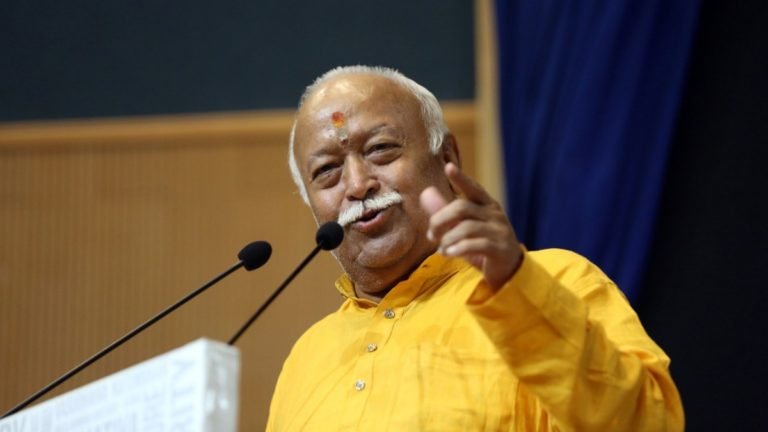
Rashtriya Swayamsevak Sangh chief Mohan Bhagwat on Saturday claimed Muslims in India are the “most content in the world”, PTI reported. Bhagwat said this was because India, whose “inherent nature was Hindu”, had created a safe space for the members of the minority community.
The RSS chief wondered if there was any other example in the world, wherein a “foreign religion” that ruled over a country continues to exists there, even after their rule ended. He was making an indirect reference to the Mughal empire. “Nowhere. It is only in India,” he said in an interview to Vivek, a Hindi magazine based in Maharashtra. “Most content Muslims are only in India.”
His comments came days after the European Parliament’s Subcommittee on Human Rights cautioned India against targeting religious minorities in the country, particularly Muslims.
Bhagwat claimed that many Muslims had fought in Mewar king Maharana Pratap’s army against Mughal emperor Akbar, adding that India’s history was testament to how people from all faiths stood together whenever there was “an attack on the country’s culture”.
He also criticised Pakistan and said that unlike India, Islamabad did not give any rights to followers of any other religion but Islam as it chose to identify itself as a Muslim country. “Our Constitution did not say that only Hindus can stay here; hereafter only Hindus will be heard here; if you want to stay here, then you have to accept the superiority of Hindus,” Bhagwat added. “We created a space for them. This is the nature of our nation, and that inherent nature is called Hindu.”
The head of the Rashtriya Swayamsevak Sangh, the ideological mentor of the ruling Bharatiya Janata Party, said that the Hindu identity has nothing to do with an individual’s choice of worship. “Religion should be connecting, uplifting, uniting everyone in one single thread,” he said. “Whenever the devotion for India and its culture awakens and feeling of pride arises for the ancestors, the distinctions between all religions disappear and people from all faiths stand together.”
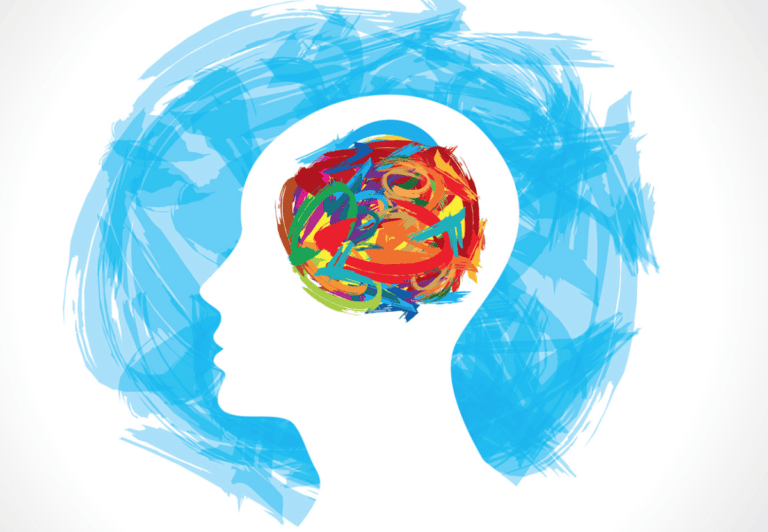
10 October 2020, world mental health day comes in an unfortunate situation the whole world is facing, when the world is stuck with a virus that killed more than 1 million people on the planet. When our normal routines and day to day life is not normal anymore, when people are working from home for the last 7 months, where students are still at home, no physical contact with friends, no plays and no celebrations. World mental health day comes when youth are uncertain and anxious about their career and future, when many people are fighting for even food and shelter and for the basic rights. downfall of the economy and loss of jobs, uncertainty, and emotional distress cloud almost the entire global population.
During this hard time, “Bereavement, isolation, loss of income and fear are triggering mental health conditions or exacerbating existing ones,” says the WHO.
According to the World Federation for Mental Health (WFMH) the theme for World Mental Health Day 2020 is ‘Mental Health for All: Greater Investment – Greater Access’.
WHO director-general Dr Tedros Adhanom Ghebreyesus stated the world is accepting the concept of universal health coverage and that mental health must be an integral part of UHC. “Nobody should be denied access to mental health care because she or he is poor or lives in a remote place,”
Here, read what students and professionals say about mental health:
“About 50 million people are affected by mental health problems in India. Although to cater to this huge number of people suffering from mental health issue we have only approximately 5000 mental health professionals. The theme for this world mental health day 2020 is “Mental Health for All”, which means that we need to adopt a task shifting model, wherein, in order to fill this gap of huge number of people suffering from mental health issues and less number of professionals, we use whoever is available in the community and train them to provide a range of health care interventions. The strategies to address mental healthcare need to rely on alternative human resources if the country is to meet more than a tiny fraction of the needs of people affected by mental health problems. So in order to implement “Mental Health for All” we need to involve all in this effort.”
Sumaiya Khan (Registered Clinical psychologist, Research Scholar, Jamia Millia Islamia New Delhi)
“We need to keep reminding ourselves that no one expects perfection from us, but what counts is a mind that constantly strives to improve itself. Just as Alvin Toffler said, “The illiterate of the 21st century will not be those who cannot read and write, but those who cannot learn, unlearn and relearn.”
Fedwa Nafeesa ( Post graduate student of Psychology, Pondicherry University)
“The official theme for World Mental Health Day 2020, chosen by the World Health Organisation this year is ‘Mental Health for All: Greater Investment- Greater Access.’ So let’s join hands and come together. Let’s work together and invest to build a mentally healthy society. Let’s realize our responsibility and our duty towards our own self and other’s psychological well-being. It won’t take much time and effort. We all need to be a little more patient, more acceptable, a bit more tolerant and kinder towards ourselves and towards others. There is a beauty in simplicity. We can do wonders for ours as well as other’s mental health, by simply “being there” for ourselves and others. Just by “listening to one another” we can lighten the burden they are carrying, maybe since long time. We can soften our tone, make use of kinder and more gentle words while interacting with not only others but also with ourselves. So let’s be more tolerant, more inclusive, more acceptable, and make the world a happy and kinder place to live. :)”
Aarushi Khan ( Student, MA Applied Psychology, Jamia Millia Islamia New Delhi)
“Covid 19 came. People suddenly started caring about their health. We realized only health matters not money and fame. Wait! Ever thought about the “mental” aspect in health. No, literally no one. People are way too far from the fact that mental health also matters. On this mental health day ,where covid 19 is making awareness about the importance of a healthy body, let’s too talk about, care about and think about our mental health.”
“World Mental Health Day 2020 has arrived but Mental health is still a far fetched idea in India. According to NIMHANS, nearly 150 million Indians needed active intervention while fewer than 30 million were getting it in 2020. Out of 528 billion rupees (roughly $7 billion) which was India’s healthcare budget in 2018, 500 million rupees (about $6.6 million) was allocated to mental health, which was reduced to 400 million (approximately $5.7 million) in the following year while only 50 million rupees (roughly $650,000) was annually spent on mental health in India. According to New York Times, Kashmir is witnessing an alarming rate of anxiety and depression and every 9 in 10 people are suffering from conflict related trauma.We have a long way to go in the fight against mental health but perhaps the consideration that mental health requires attention is a step in the right direction.”
Shafaq Ihtesham (Student, MA Applied Psychology, Jamia Millia Islamia)
“For the one’s whose thought ain’t no song, for the one’s for which it’s hard to see the light at the end of the tunnel, I hope this day will hum with you and share a little light to see the tunnel.”
Tom Johnson ( MSC Psychology, Union Christian College, Aluva, Kerala)
“World mental health day 2020: theme- Mental Health for All-Greater Investment – Greater Access.Everyone, everywhere. With regard to the theme for this year, I believe that as responsible citizens it the responsibility of each of us to ensure that we reduce the stigma attached with seeking treatment for mental ill-health and people should be able to approach a mental health professional as easily as they approach a physician in a case of medical needs, lets join hands to make mental health services accessible to each and everyone.”
Jasar Khan (Student, MA Applied Psychology, Jamia Millia Islamia, New Delhi)
“Mental Health”, are we all really giving importance to it nowadays? May be it is a “yes” or “no”. Mental health have the same importance physical health have. If we notice we can know that if we are not okay, if our minds are disturbed, frustrsted or irritated and even if we are depressed it will somehow affects our physical health as well, both are correlated. It may be in different forms. We will be both physical and mentally tired and unknowingly we will withdraw from everything. Will it make us happy? Definitely No. Even then I used to see many of my friends hesitating to speak about their problems because of the stigma they have. I just need to tell that, if you are not feeling okay talk about it to anyone whom you feel comfortable, may be friends, parents, relatives, counselors or any others.Or if we are able to be aware about it we can do the little things that can make us happy or distract us from that.Acknowledging our feelings at that time and talking it out and if there is person to listen to it, that itself can make a difference to you or it can help to get up at that moment. Your mental health is important. Don’t hesitate to speak about it.”
Maryam Tayyiba ( Student, MBA HR, CMS B School, Jain University, Bangalore)
“I personally believe that mental health is purely subjective and social in nature. Attitudes,choices, experiences preferences, ,way of responding to the matters vary person to person,culture to culture,etc and so that we cannot define it ! Social in the sense, society or even nation’s developments ,expectation ,wealth and nature of ruling of the government have large impact on the mental health of each and every citizen of the nation or society.And,positive mental health can be achieved basically by having accepting,caring, loving ,trust worthy and valuing relationship ( even if it is a small number doesnt matter )and living in a mentally stable and healthy community and society at large.Self-love and compassion also play a pivotal role for it and it can be facilitated by having those relationship with others besides one’s inherent nature.In a nutshell,mental health doesnt stand or occur in vacuum!”
Hasna c (Student, MA Applied Psychology, Jamia Millia Islamia, New Delhi)
During the COVID 19 pandemic lockdown, pictures from all over the world began surfacing on the inter- net where animals were seen occupying the urban spaces. Many people were enthralled by this idea of wild animals occupying the urban spaces as it was giving wildlife the opportunity to reinhabit a space which was historically entirely theirs. But in reality wild animals were always there in those urban spaces even before the COVID 19 lockdown and are hugely dependent on the humans for their survival. They can’t be sent back because they have no-where else to go.
In India, strolling through the streets of old Delhi one can see how many animals in the streets. Pigeons, cows, stray dogs and monkeys are the most common animals seen over here. Monkeys often scrambling over the rooftops and searching the leftovers from the trash bin, are mostly harmless but they do occasionally snatch food items from humans. Animal rights activists are always vocal in India about accommodating animals into these urban spaces and are most visible for the rights of stray dogs in urban spaces.
“In their book Zoopolis, Sue Donaldson and Will Kymlicka stress on various points about the impor- tance to accommodate these animals acknowledg- ing the fact that they have no-where else to go as their territories have been violated/occupied by the humans. According to Donaldson and Kymlicka, not only should humans respect wild animals’ universal rights (by not killing them, for example), but also should better accommodate these animals by acknowledging that they are not obliged to cooperate with humans or demonstrate human-like self-control. “ quotes Alyson Fortowsky in his article What Do Humans Owe to Wildlife in Urban Spaces.
Something easier said than done. In rural India, the situation and the conflict between animals and humans are more grim and tough. The threat posed by animals are often fatal to their lives and livelihood.
Wild animals like boar, elephant, tigers and leopards have ventured out of their territories and attacked the livelihood and lives of the people living in the forest fringes.
Two types of monkeys frequent my house. One is the Rhesus Macaques, which is more aggressive and mostly seen monkeys in India. These monkeys are tougher to scare away as they know how the humans behave and have been acquainted with the human habitats. The other one is the black languor which are rare to be seen. They are easily scared by the humans and are more shy and less aggressive. Monkeys come to my house thrice in a week, more so during this lockdown, from a nearby hill and eat whatever they can from my house and the adjacent plantation.
That includes, Zapota (chikoo), coconuts, mangoes, pumpkin, jackfruit and tender leaves of almost all the plants. Coconuts are inevitable for traditional Kerala cuishine. So, losing a large share of coconuts to monkeys is economically draining for the middle-class families. During the lockdown, I have documented monkeys that are frequenting my house. Earlier I was trying to scare them away and at some point I planned to photograph them.
NB: I haven’t included the photos of black languar yet. All these were shot using a 18-105mm, as these happenings were near to me. Myself and my family have not hurt any monkey yet, and neither have they hurt us, physically.
A monkey climbing to the roof of the house through a adjacent tree.Monkeys hopping at my balcony is a common sight now.They eat jackfruits, tender leaves, mangoes and everything we cultivate.During summers they break the water tanks and drink water from it. In order to prevent such damages people put grills on the top of the tanks. But yet, monkeys find ways, often breaking the pipes connected to get water. Keeping a bucket filled with water helps, but it gets tiring when the monkeys come on a frequent basis and they always come in a group of 10 or more, carrying children along with them.As the monsoon begins, the food drains, making them dependable on the leftovers.But when left with no option, they often eat the food grains left outside to dry.My mother, Kallyanikutty, shooing away the monkeys.People use crackers to scare the monkeys away.My mother has a peculiar way for firing crackers.A monkey peeping into my room from the roof.As days passed by, monkeys were acquainted with the sound of crackers and they no longer got scared. Sometimes, they pose, waiting for me to click them.