The Ministry of Home Affairs (MHA) has issued an advisory that Zoom video conference is not a safe platform. Zoom is an online video-conferencing application/software
The Cyber Coordination Centre (CCC) of the Ministry of Home Affairs has warned in an advisory issued last week.
Government put out a set of guidelines for the safety of individual private users who “still would like to use Zoom for private purpose”. Zoom bombing has apparently become a favourite past time of people during the lockdown.
U.S. based Zoom video communication has seen an exponential rise in usage in India as office-goers remain at home owing to the lockdown triggered by the COVID-19 pandemic. The software used in the online platform is said to be made in China and some calls were also being routed through servers in China.
The Cyber Coordination Centre of the MHA issued a set of guidelines for safe usage by private individuals. It was not for use by government offices and government officials, the Ministry noted.
The March 30 note posted on the CERT-In website said, “Zoom is a popular video conferencing platform. Insecure usage of the platform may allow cyber criminals to access sensitive information such as meeting details and conversations.”
It asked users to set strong passwords and enable “waiting room” feature so that call managers could have a better control over the participants.
Google has reportedly banned the Zoom app from all employees’ computers over security vulnerabilities and Singapore has banned teachers using Zoom after hackers posted obscene images on screens. The app has also been banned for usage in Germany, Singapore and Taiwan.
A nationwide lockdown will only pause the deadly coronavirus, but not defeat it, Congress leader Rahul Gandhi said today, recommending that the government go for testing “aggressively and strategically”. He also suggested that there should be two zones in India – hotspot and non-hotspot.
“In no way does a lockdown defeat the virus. It helps only to stop the virus for a short while. The only way to do this is to increase testing,” the Congress MP said, addressing the media through a video app.
“If we don’t take measures, we will be forced to go into lockdown again.” Right now, he said, the government was chasing the virus, which would never give the correct picture of the pandemic in India.
“Currently testing levels are too low. I am proposing scaling up testing. Maximise testing and use testing strategically, to assist states in their fight,” Mr Gandhi, an MP from Kerala’s Wayanad, said, adding, “Don’t take it as criticism.”
All other nations had started procuring testing kits but in India, they were miniscule, according to the former Congress chief. “It’s a reality that there is a shortage of rapid COVID Testing Kits. We have to find out a way forward,” he said.
“But this is not the time to discuss where the government has failed. We are only offering constructive suggestions that the government can act on.”
Mr Gandhi said the government should prepare a minimum financial net, predicting a massive financial backlash. The first wave of unemployment was already on its way, he warned.
“We must ensure that in protecting lives, we don’t destroy our economy completely.” He suggested a package for smaller industries, for migrants and for farmers.
Wrapping up the meet with a message to the nation, Mr Gandhi said if India overcame the virus, it would be in a much better place. “I want to tell the people of India, you have nothing to fear. This country is bigger than any disease, it knows how to deal with much bigger challenges. As a member of the opposition, I want to give support to the government. The virus is giving a message – if we are divided, it will win,” he said.
For the eight month old coalition government of Thailand, led by ex-army commander Prayut Chan-o-cha, the year 2020 was going to be a crucial one, owing to the country’s current turbulent political and economic state after their first election held last year in the shadow of 2014s coup d’état, toppling the Pheu Thai government.
It now appears to be an exceptionally difficult time for the Thai government to steer its country through as it faces the global Covid19 pandemic, severe droughts, and raging wildfires.
With the first recorded confirmed case of COVID-19 outside China was in Thailand, the government lapsed in taking restrictive measures, thereby recording one of the highest cases of Covid19 from the region. Thailand has been hit hard after suspension of world travel, where it is mainly dependent on exports, which accounts for more than two-thirds of the country’s GDP and tourism sector accounts for one fifth of its national income.
An aerial view of a fire ravaging a forest in Chiang Mai last month. Picture courtesy of Chiang Mai Volunteer Drone Team
Thailand is facing one of the worst droughts in decades, adding more stress to the country’s already struggling economy and to its agricultural sector.
According to Alan Basist, and American climatologist, who co-wrote a report for Eyes on Earth, a water resources monitor, one of the major reasons for the drought is due to China limiting Mekong River’s flow downstream to the country. He says, “The satellite data doesn’t lie, and there was plenty of water in the Tibetan Plateau, even as countries like Cambodia and Thailand were under extreme duress. There was just a huge volume of water that was being held back in China”.
The nation is also facing one of their worst wildfires in decades. The government has deployed 80 army men and several firefighters who have been risking their lives amidst the pandemic to contain the fires which has been raging since the middle of March in Northern region of the country.
This aerial handout photo taken on March 18, 2020 and released by Thai volunteer group Jit Arsa shows smoke rising from fires in Mae Rim district in northern Chiang Mai province, where the blazes have severely impacted air quality. (AFP PHOTO / JIT ARSA)
So far, 4 people have died and many tribal and forest dwellers displaced. Apart from this, the fire has also destroyed native flora and fauna, including indigenous endangered species, as it rages through national parks and sanctuaries near Chiang Mai.
While the government and people in the cities blame the local tribal and agricultural farmers for starting the wildfires with traditional slash and burn techniques, which is deemed punishable as per their zero burning policy, the farmers and forest dwellers disagree.
According to Bangkok Post, the village community leaders and representatives said that their livelihood comes from the forest, and that they would never destroy their homes. They also blame the government and authorities for these forest fires, which they say is due to excessive fuel from dead trees and foliage which piles up on forest floor ever since the zero burning policy has come into place.
Thai soldiers in the forest to detect fires. IMAGE: Chiang Mai One.
Nonetheless, air quality has reached “critical levels” across the North of the country for weeks now, which has further deepened the rift between city and forest dwellers.
In the thick of this grave global pandemic, the drought, fires and the terrible air quality, it has become quite the challenge for Prayut Chan-o-cha’s government to maintain its economy and political situation under control all the more now.
Efficient supervision, stringent measures, timely decisions and the readiness of the public to work together for one another – this is Kerala, a tiny segment of land in the south western part of India which is now nationally and internationally praised for its relative success in containing the spread of the global pandemic, Covid-19 , through valiant efforts.Kerala was the first state in the country to report a corona virus infection in late January.On Saturday, the state government reported a total of 373 informed cases in which 228 under treatment, 123 cured and only 2 deaths .
The governmental measures, including extensive testing and efforts to trace people who came in contact with Corona virus infected persons, have helped in curbing a community outbreak. A great round of applause must be given to the left government of Kerala for all those proactive efforts in flattening the curve. Plans to address and protect all the sections of people like; maintaining supply Chains of essential goods, prohibition of religious congregations and the coordination mechanism to support other states truly deserve appreciation.
Preparation of route maps to trace the places where the infected people have visited before being identified as positive provided to be highly successful, when such maps got widely circulated on social media.Ensuring the protection of migrant workers by naming them as guest workers, providing Mid day meals at home for 3.7 lakh children, production of 10 lakh bottle of sanitizers within 10 days and the launch of Gok app for daily updates must be taken into valuable consideration.
Now, let’s take a moment to re-examine the fact that whether the efficiency of Kerala in fighting covid-19 is just because of the Communist government in Kerala or is it a collective struggle of all governments in the state?
Let me point out some things:1. Recently Frontline magazine reported that from the late 1990s, with decentralization becoming a reality in Kerala, as 25 to 35 percentage of the plan funds become available for local bodies and planning and resource mobilization began at the local level, facilities in many grassroot level hospitals in the state has improved drastically.Adding further to it the same magazine in 2017 also reported that;In the past decade Kerala also invested heavily to reorient its chain of nearly 900 rural Primary Health centres, to train grass root level health workers to monitor the health status of rural households, to provide quality treatment services including speciality care facilities at the Taluk district and general hospitals in addition to the medical college hospitals, and to create a patient friendly environment in all government hospitals.
2. Kerala is the most literate state in India, the people of Kerala having unique quality of all time readiness to work together for one another – An educated section of the country which always analyses and responds reasonably to circumstances. Example being Kerala, successfully fighting Nipah virus and the floods.
3. Kerala has witnessed, the Congress lead opposition coalition joining hands with the left Democratic Front at the time of crisis to work together more effectively and fruitfully. Here also the picture is same. We have seen that the chief minister of Kerala, Pinarayi Vijayan and the opposition leader Ramesh Chennithala at a video conference together with ward level members of all local bodies in the state urging them to forget political indifferences and to work together energetically and proactively against the pandemic.
Of all by the fact, that even from the beginning, the state by all the ruling governments from time to time has invested in its education and health very effectively. One can conclude that fighting a pandemic or a natural disaster is not just the struggle of a ruling party alone; it is the result of the entire land in creating a better system in all these years. Of course, the government does deserve heartfelt appreciation for this struggle but mention is to be given to all the workers, officials, the system and the people.
A joint statement condemning the arrests of Jamia Research Scholars, Meeran Haider and Safoora Zargar has been released by a group of human rights watchers, civil societies and university communities including Teachers’ Association of Jamia Millia Islamia and Jawaharlal Nehru university. Statement slams Delhi Police on their ‘retaliatory revengeful action’ agaisnt the active faces of Anti-CAA protests in Jamia. Meanwhile Meeran Haider has been sent in 14 days judicial custody.
Read the statement:
“We the undersigned would like to draw the attention of all compatriots who believe in democracy and secularism towards a very important issue. You are quite aware of the anti CAA movement. This was an historic movement in which Jamia students and community women had come forward in defence of their constitutional rights. This movement had a major impact and significance all through our country.
After the peaceful withdrawal of this movement in the wake of the global Corona Virus pandemic, the Delhi Police has begun a retaliatory revengeful action against those who were active in this movement. In this process the Delhi Police has arrested the media coordinator of the Joint Coordination Committee (JCC) for movement against CAA, Shrimati Safoora Zargar, and another active member Meeran Haider on trumped up charges relating to the North east Delhi riots and other baseless allegations. What is particularly worrying in this entire context is that Shrimati Safoora Zargar is pregnant and in this condition she requires proper care and medical supervision.
This kind of action during the lockdown due to the Corona virus is a violation of their constitutional rights. We register our strong protest in this context and demand that the constitutional rights of the two arrested leaders, Shrimati Safoora Zargar, and Meeran Haider be respected and they be released forthwith.”
1. President, Federation of Central Universities Teachers’ Associations FEDCUTA 2. President, Jawaharlal Nehru University Teachers’ Association JNUTA 3. Secretary, Jamia Teachers’ Association JTA 4. Jamia Teachers’ Solidarity Association JTSA 5. Prof. Nandita Narain. Former President DUTA and Federation of Central Universities Teachers’ Associations FEDCUTA 6. Progressive Democratic Student Union 7. President/Secretary, All India Democratic Women’s Association AIDWA 8. Annie Raja, General Secretary, National Federation of Indian Women NFIW 9. Rushda Siddiqui, Working President, National Federation of Indian Women NFIW, Delhi Unit 10. Justice Seekers Group 11. Poonam Kaushik, General Secretary, Pragatisheel Mahila Sangathan, Delhi 12. General Secretary, Indian Peoples’ Theatre Association IPTA 13. Safdar Hashmi Memorial Trust SAHMAT 14. Jan Natya Manch JANAM 15. Secretary, Nishant Natya Manch 16. General Secretary, All India Progressive Writers’ Association AIPWA 17. General Secretary, Janwadi Lekhak Sangh JLeS 18. General Secretary, Jan Sanskriti Manch JSM 19. General Secretary, Kendari Punjabi Lekhak Sabha (Regd) 20. President, People’s Union for Civil Liberties (PUCL), Delhi 21. President, Association for Rights, Punjab 22. People’s Union for Civil Liberties (PUCL), Rajasthan 23. Citizens Against Hate 24. Not In My Name Campaign 25. Karwan-e-Mohabbat 26. ANHAD 27. Dr Vikas Bajpai, Progressive Medicos and Scientists Forum PMSF 28. Dr. Soma KP, Researcher and Policy Analyst 29. Uma Chakravarti, Feminist Historian 30. Pamela Philipose, Journalist, New Delhi 31. Dr. Anjali Mehta, Ophthalmologist, N.D. 32. Shambhu Ghatak, Independent Researcher 33. Dr. Shaweta Anand, Researcher 34. Padmini Kumar, Activist, NOIDA 35. Sherna Dastur, Independent Activist 36. Vice President, Indian Society of Labour Economics 37. General Secretary, All India Union of Forest Working People 38. Kalyani Menon-Sen, Feminist Learning Partnerships 39. Dr. N. Indira Rani, Researcher & Activist, Hyderabad 40. National President and National Secretary, All India Students’ Association AISA 41. Dunu Roy, Hazards Centre 42. Sanjeev Kumar Danda, Dalit Adivasi Shakti Adhikar Manch (DASAM) 43. Dr.Beulah Shekhar Director, Center for Empowerment & Women’s Studies, Manonmaniam Sundaranar University 44. Julie George, Women’s Right Lawyer 45. Saheli 46. President, Jawaharlal Nehru University Students Union JNUSU 47. HAQ Centre for Child Rights 48. Ramkumar Krishak, Writer and Editor”
Around 400 districts in India are free from coronavirus, however, the next 2-3 weeks are going to be most crucial in handling the COVID-19 pandemic, said Union Health Minister Dr Harsh Vardhan on Wednesday. “There are around 400 districts of India where coronavirus has not entered. We have been able to pinpoint where the virus is,” said Vardhan here in a video conference.
“The next 2-3 weeks are going to be the most crucial in handling the COVID-19 pandemic particularly in India,” he said. The Union Minister further said that India is among the first countries in the world to have responded to the news of the first coronavirus case being diagnosed in China on January 7. The experts in the country started working on COVID-19 and health advisories in this regard were issued on January 17.
“India is among the first countries in the world to have responded to the news of the first coronavirus case being diagnosed in China on January 7. We started working on January 8 in our expert group meeting. On Jan 17, we issued health advisories,” he said. India’s tally of coronavirus cases has risen to 11,933, said the Union Ministry of Health and Family Welfare on Wednesday.
Out of the total tally, 10197 cases are active while 1344 patients have been cured/discharged and migrated and 392 people have succumbed to the virus.
The south Indian state Kerala is showing the world, the best approach to tackle the deadly covid 19 pandemic- #TheKeralaModel. The credits must be entitled to the Health workers, volunteers, Ministry of health, health department, Chief Minister and the entire political leadership which includes the opposition. Compared to most of the world nations and our union govt, Kerala Government has worked extraordinarily to combat with this pandemic.
But it is impossible to pretend that we have not seen any false thoughts propagated by some groups intentionally just for the sake of creating smoke in the eyes of people. Some groups have wrongly attributed the historic progress of the health and the educational sector of Kerala, achieved over the past-long years to be the success of communism. It’s high time to think about whether the Kerala model(KM) is a communist model. Can the success of the Kerala model be attributed to communist policies alone. KM is a modernity model, where renaissance, religion, progressivenes, science, art, communism all played efficient roles.
It is very frustrating to forget what the MPs of Kerala have contributed in this particular scenario. The timely relevant action Taken by our MPs including Shashi Tharoor, Rahul Gandhi, Hibi Eden, T.N. Prathapan, Srikandan are admirable. Shashi Tharoor is the Captain of Kerala Model in rapid test. The actions taken by them for the establishment of Corona care centre, as a part of the preventive measures, procurement of adequate medical supplies for health workers, and the effective utilization of their local development fund in a timely way is appreciable. The socio religious cultural political organizations that have rendered meritorious services through events such as community kitchen and the vital role by youth should not be forgotten in this occasion.
As said, “Rome was not built in a day’. If we resist corona today, it is the foresight of a group of rulers. The advancement of kerala on the enlightened educational and public health arena long precedes the Pinarayi era, starting from the period of erstwhile princely states. Prior to the birth of kerala, kerala was one of the best places for public health in India, even when the country was at its worst. This is due to prolonged public health activities, government involvement including the royal government, health care facilities and literacy from the lower level of society.
Kerala has a long history of organised health care. In the 19th century, the princely rulers of erstwhile states of Travancore and Cochin took the initiative in making the western system of care available to their subjects. A royal proclamation of 1879 made vaccination compulsory and the Parasite survey undertook in 1928 with Rockfelle foundation seems to be extra ordinary. The general hospitals in Trivandrum and Cochin are about 150 years old. A health unit incorporating many of the concepts of primary health care was also started in rural area. Under the rule of princely state in 1935, the then rulers, aware of the importance of public health, sent a malayali doctor to practice at the John Hopkins university, he came back and established a PHC in Neyyattinkara(TVM), the forerunner of all PHC s in India. Sri Vishakam Thirunal and Moolam Thirunal Maharajas introduced further advancement in allopathic practices in the state by allowing grant -in-aid to private medical institutions also. In 1896 a hospital for women and children was opened and placed under the charge of a lady doctor from England. The first medical college in Kerala, Thiruvananthapuram medical college was also established by them in 1951.
Investment in education and health infrastructure has been a consistent policy of all elected governments in Kerala, whatever the political leaning is. The traditional government support for health care has been a catalyst for the advancement of health care in the state. Allopathic facilities of the public sectors are systematically organised in rural areas. Where 74 percentage of the population resides, so that each facility with different functional capacities can meet the needs of the people. It range from CHC to PHC -it contributed less of an urban rural disparity. We have 14 medical college’s of which 11 were set up congress led govt and 2 by communist led govt and 1 by travancore govt. This means kerala is leading in the field of health care since ages.
It is very evident to talk about the golden era of administration of kerala government- the period between 2011-16, Ommen chandy led congress govt. This govt has elevated the health sector of kerala from 5 to 11 medical collges. Under the Karunya scheme Rs.1200crore has been provided to 1.42 lakh people. Taluk hospitals have been upgraded to district hospitals, the establishment of Karunya pharmacies for medicines on discount. Sukrutham has launched for free cancer treatment and so on are the works/projects done in the health sector during 2011-16.
Don’t you guys think that we can overcome this devastating situations without these medical colleges, free treatment, MPLADs, treatment insurance, education and progress? I hope the media won’t do injustice to many liberal, centrists, Gandhiyans, Nehruvians, royal families whose contributions are also indomitable.
On April 13th 2020, the Federation of Western India Cine Employees (FWICE) released their statement warning “Indian singers and musicians against collaborating with their Pakistani counterparts” which if they did, would end up having to face “strict action”. The warning came after the FWICE was informed about a deal between Indian artists and Pakistani singer Rahat Fateh Ali Khan. The letter also added that “One should also realise that while the entire world is fighting against the coronavirus, Pakistan is still busy killing our soldiers on the borders”.
I listen to Amir Khusrau’s verses of ‘Aadam’, as I write this. Khusrau writes:
“Aan Roz Ke Rooh-e Aadam, Aamad Bah Badan,
Guftand Dar Tan Dar Aa, Niyaamad Dar Tan,
Khooban-e Qudsiyaan, Bah Lahn-e Daood,
Guftand Dar Tan Dar Aa, Dar Aamad Dar Tan”.
Roughly translated to—
“On the day of the covenant, when Adam’s soul entered his earthly body, it was [first] ordered, ‘Enter the body’, but Adam’s soul refused to enter the body. Beautiful celestial beings, in the divine melody of David, [then] sang “Enter the body”, and moved by the celestial song, Adam’s soul entered his body”.
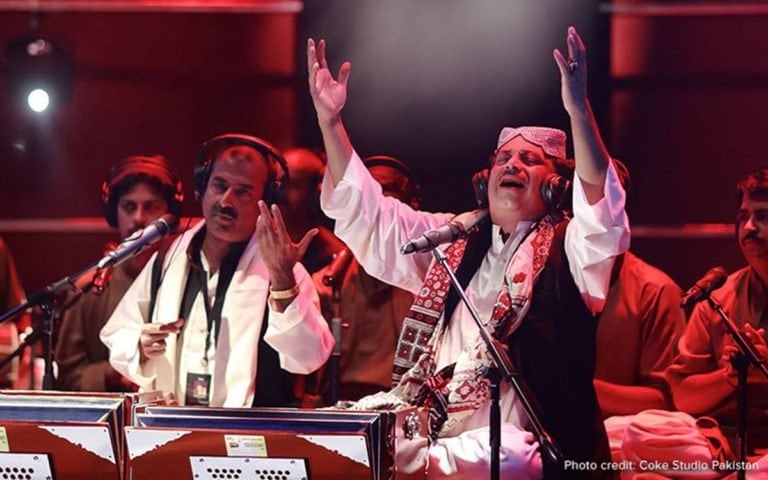
Rahat Fateh Ali Khan, CokeStudio Pakistan
After reading these verses, there is actually no need of me or my words to explain what music is or what music does, if only anybody else could have put it as well as Khusrau did. Yet, I will, as a being confined to an earthly life, searching for music in every nook and corner, in every wrinkle and teardrop, living in a world filled with nation-states, governments, armies and flags, try put it my way.
Post-Partition India breathes only because Pakistan shares a border with her. It is what the Indian State lives on and will certainly (if there is ever such a day) die of. The jingoism the State injects into a human mind through Cricket, Bollywood and the corporate-owned media is of an insane level. Such is the injection that it quietly even makes its way into the folklore told by Indian mothers to their children. ‘Hush, go to sleep or I’ll call the army from Pakistan over to our house’. While the imaginary nation-state attempts to create a fellow-feeling among its citizens (who will, in the future, probably never see each other or hear about each other), there will always a remain a socially and culturally oppressed people within its imagined frame-work. When the Muslim state of Pakistan became India’s arch rival, the Muslim population in India became the convenient scapegoat on which the State, until today, fuels up their anti-Muslim sentiment.
As a result, Indian Muslims end up trying to prove their “Indian-ness” in whatever they do and wherever they go. They are expected to cheer louder for the Indian cricket team, they are expected to “take sides” with India over the Kashmir conflict, to mourn over every dead soldier of the Indian Army, they are expected to stand straighter for the national anthem, all for a non-existent, lifeless nation which goes by the name “India”, which in the end only tells them to ‘Go to Pakistan’. The benchmark to be reached to pass off as Indian stoops higher every passing day. From the consumption of beef to the wearing of hijab and skull caps, to the chanting of La Ilaaha Ilallah, will all get you jailed, or killed in a milli-second. Indian Muslims walk on that thin thread which, if stepped on carelessly, will push them into the abyss where there are only nation-less identities.
And what about Pakistan? Their much-celebrated TV program ‘Coke Studio’ holds the tagline ‘The Sound of The Nation’ (only after the Pakistani band ‘Strings’ took over as producer replacing founder and producer Rohail Hyatt though). While they experiment with verses written by Amir Khusrau (born and lived in Delhi), who used to also write verses for his beloved, the Sufi saint Hazrat Nizamuddin Auliya (born in Delhi), whose shrine is located in the city of Delhi, and have the verses sung by qawwals Ustad Fareed Ayaz and Ustad Abu Muhammed (born Delhi); Coke Studio Pakistan carries the tagline ‘The Sound of The Nation’. The comments section on their YouTube page gets filled with various peace-makers from both countries that go, ‘Love from Pakistan, love from India’ and more notes on how “politicians brewed hatred while the people are lovable”.
Since the listeners found themselves loving the music, they couldn’t help but love those who evidently created it. It comes off as a profound revelation to some that people in either of these nations can even be “loved”, or even talked to. Yet, they love them only as Pakistani artists. They carry their peaceful flags and shower gratitude to the music of Coke Studio for “uniting” the rival nations and for waking them up from their nation bound hatred, yet remaining within their nation bound consciousness. Perhaps Ernest Gellner, the philosopher and social anthropologist puts it together perfectly, “Nationalism is not the awakening of the nations to self-consciousness, it invents nations where they do not exist”. Thus, the people of both countries run around in this imaginary circle (or whatever the shape is of the particular nation), believing in their nationality as strongly as they believe in their gender and then, view everything— literature, cinema, music and the other arts from this vantage point.
Music, and the culture from which the music comes from, travels as freely as light does. While the FWICE releases warnings against Pakistani and Indian artists collaborating with each other for music, Ali Sethi, quarantined in his home in Lahore, goes live with Shilpa Rao on social media to sing Paar Chanaa De and Umraan Langiyaan for their audience. So when the conditioned ignorance flows through the veins of the people who “turned on each other as though they’d never known each other, never been to each other’s weddings, never sung each other’s songs”, Music spreads from the southern tip of Kerala, as far as the west of Afghanistan, and even farther, to millions of hearts that secure a corner to welcome it.
Hazrat Nizamuddin Auliya Dargah, Delhi
Music remains hanging in the air, unseen, from the Dargahs of Delhi to ones in Lahore, not knowing how to acknowledge hatred, for it is only created from the divine, something that comes straight from the heart and goes to the heart, the melody of Love, waking the ones who have been in a deep slumber, whose dreams don’t go beyond a life within borders, imaginary lines and national flags. Music only knows how to present itself, and has no time for statements and bans. The borders we have now will take up all kinds of shapes, it might grow stronger, or weaker, or the wall might come crashing down, but Music only caresses the people on either side of it with its loving hands, holding them when it hurts and celebrating with them when it doesn’t,
Activist and scholar Anand Teltumbde was arrested today by the National Investigation Agency (NIA) office in Mumbai after he surrendered in connection with the Elgar Parishad-Maoist links case, his lawyer said. He will soon be produced in court.
Advocate Mihir Desai said Teltumbde reached the NIA office at Cumbala Hill in south Mumbai to surrender. Mr Teltumbde and several other civil liberties activists were booked under stringent provisions of the Unlawful Activities Prevention Act (UAPA) for allegedly having Maoist links and conspiring to overthrow the government.
Anand Teltumbde's "arrest on Ambedkar Jayanti is a blot on our nation. We demand his immediate release, and the release of all the activists, thinkers & advocates jailed in the Bhima Koregaon case," say @jigneshmevani80 & @meenakandasamyhttps://t.co/WhsFCwbZYQ via @thewire_in
The activists were booked initially by the Pune police following the violence that erupted at Koregaon-Bhima. As per the police, the activists had made inflammatory speeches and provocative statements at the Elgar Parishad meet held in Pune on December 31, 2017, which it said triggered violence the next day.
The police also said they were active members of banned Maoist groups. The case was later transferred to NIA. Mr Teltumbde and activist and co-accused Gautam Navlakha were given interim protection by the Bombay High Court while their pre-arrest bail pleas were being heard. After High Court rejected their applications, the two approached the Supreme Court. On March 17, 2020, the Supreme Court rejected their pleas and directed them to surrender within three weeks. On April 9, the top court granted the duo another week to surrender by way of last chance.
New Delhi: Congress leader Rahul Gandhi has suggested that the government should isolate virus hotspots and allow business to reopen in other areas.
Rahul Gandhi also criticized central government on shortage testing kits. He took Modi government responsible for the poor performance against Covid 19. In a tweet, Rahul said that India is one of the least testing countries in the world.
India delayed the purchase of testing kits & is now critically short of them.
With just 149 tests per million Indians, we are now in the company of Laos (157), Niger (182) & Honduras (162).
Mass testing is the key to fighting the virus. At present we are nowhere in the game.
He slammed the government for the blanket lockdown as the poor have suffered. In a tweet on Monday, he said, “The one-size-fit-all lockdown has brought untold misery and suffereing to millions of farmers, migrant labourers, daily wagers and business owners.”
After the PM’s announcement of the extension of nationawide lockdown, the Congress has questioned the government strategy to help the poor. It has also asked the centre to spell out the strategy with regards to testing people for coronavirus.
The one-size-fit-all lockdown has brought untold misery & suffering to millions of farmers, migrant labourers, daily wagers & business owners.
It needs a “smart” upgrade, using mass testing to isolate virus hotspots & allowing businesses in other areas to gradually reopen.
The Congress chief Sonia Gandhi said on Monday, “Ten kg grain per person may be provided free for six months to those who may be facing food insecurity but not having ration cards. I would like to bring to your notice that all migrant labourers may not be holding NFSA cards. In addition, many deserving people have been excluded from the NFSA lists.”