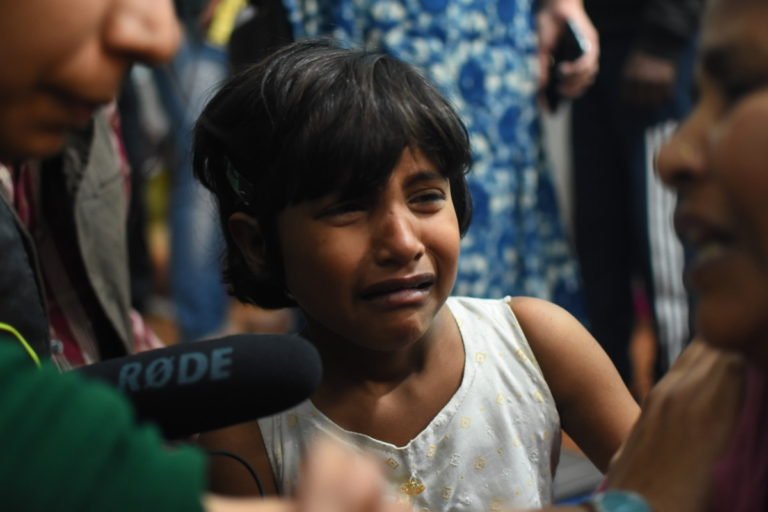
When Madina Masjid in Northeast Delhi was attacked, “People called police for help, but received abuses”. Umer recalls how his friends and him managed to escape the angry ‘Jai Shri Ram’ chanting mob by running on to the terrace of a mosque, he was visibly traumatized and in tears. “The police hurled abuses at us. They came here after three days.” Umer didn’t say anything more. Our team happened to meet a 14 year old local resident of the riot hit locality of North East Delhi, Umer on the terrace of one of the many mosques which were vandalized and burnt. He was playing with his friends on the street when the rioters reached his locality.
Between the night of 23 February 2020 until 26 February 2020, the capital of the nation saw one of the worst communal riots in decades while the US President, Donald Trump was on his first state visit to India. The police state that the riots claimed the lives of 53 people, with over 200 injured. Thousands of families forced to flee and are now living in makeshift relief camps.
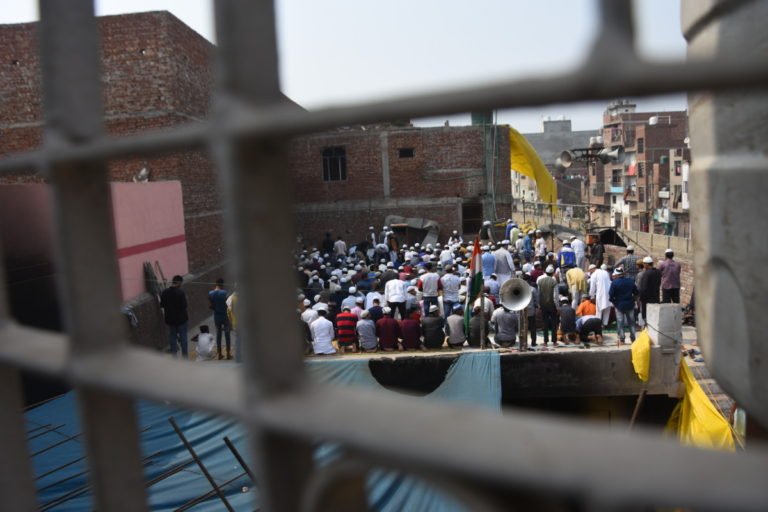
Para Military personnel guard outside of an attacked masjid; North East Delhi. Photo: Sreekanth SivadasanBurned copies of Holy Quran on a shelf inside Madina Masjid; North East Delhi. Photo: Sreekanth SivadasanMuslims offer the first Juma Namaz on the terrace of an attacked Masjid after the riots in North East Delhi. Photo: Sreekanth SivadasanA vandalised Masjid in North East Delhi. Photo: Sreekanth SivadasanPhoto: Sreekanth SivadasanPhoto: Sreekanth SivadasanPhoto: Sreekanth SivadasanPhoto: Sreekanth SivadasanShafeek in a conversation with Umer. Photo: Sreekanth Sivadasan
Many pictures and videos surfaced from the riots where Muslim houses and mosques were exclusively targeted and attacked by Hindutva mobs. In one such videos, a rioter is seen climbing on top of a mosque’s minaret, breaks the symbolic Islamic Crescent and replaces it with a saffron flag, which is synonymous with the extreme right wing Hindutva group. Empty liquor bottles have also been found, suggesting the use of petrol bombs. Leaders of the Sangh Parivar, a broad term used to refer to the Hindutva organisations, claim that no mosques were vandalized during the riots in North East Delhi.
On 6 March, the Muslim residents returned to their localities, many for the first time after fleeing, to offer the customary Friday prayer. The prayers were conducted on rooftops or the upper floors of different mosques. The lower floors have been rendered useless due to rampant looting, vandalism, and arson. Photos from Farooqiya Masjid, Auliya Masjid and Madina Masjid in Nortn East Delhi taken on 6 March 2020 by Sreekanth Sivdasan
“Blood, blood all around; Blood, blood on the ground,
Bang, bang and a cry; Blood, blood I don’t know why?”
After the demolition of Babri Masjid on 6th December, 1992 in Ayodhya, there were riots across the nation. One of the terrible riots wracked the Bombay city, leaving thousands fled in fear, roads filled dead bodies, hospitals flooded with injured people and homes looted and burnt down. After the riots some schools in Mumbai conducted a program to try to reduce the emotional trauma experienced by the students during riots. Students were asked to write essays and poems and one of the students wrote those lines, above mentioned. And that student was just 11 years old, who witnessed the brutality of the riots.
After 18 years of that, February of 2020, Delhi witnessed a deadliest communal riot in the history of Independent India. Records remains as 52 people lost their lives, hundreds of people injured, many are still missing, families have fled the city, houses were burnt down. Politics of hate made kids in North East Delhi to see in their eyes losing their fathers and brothers.
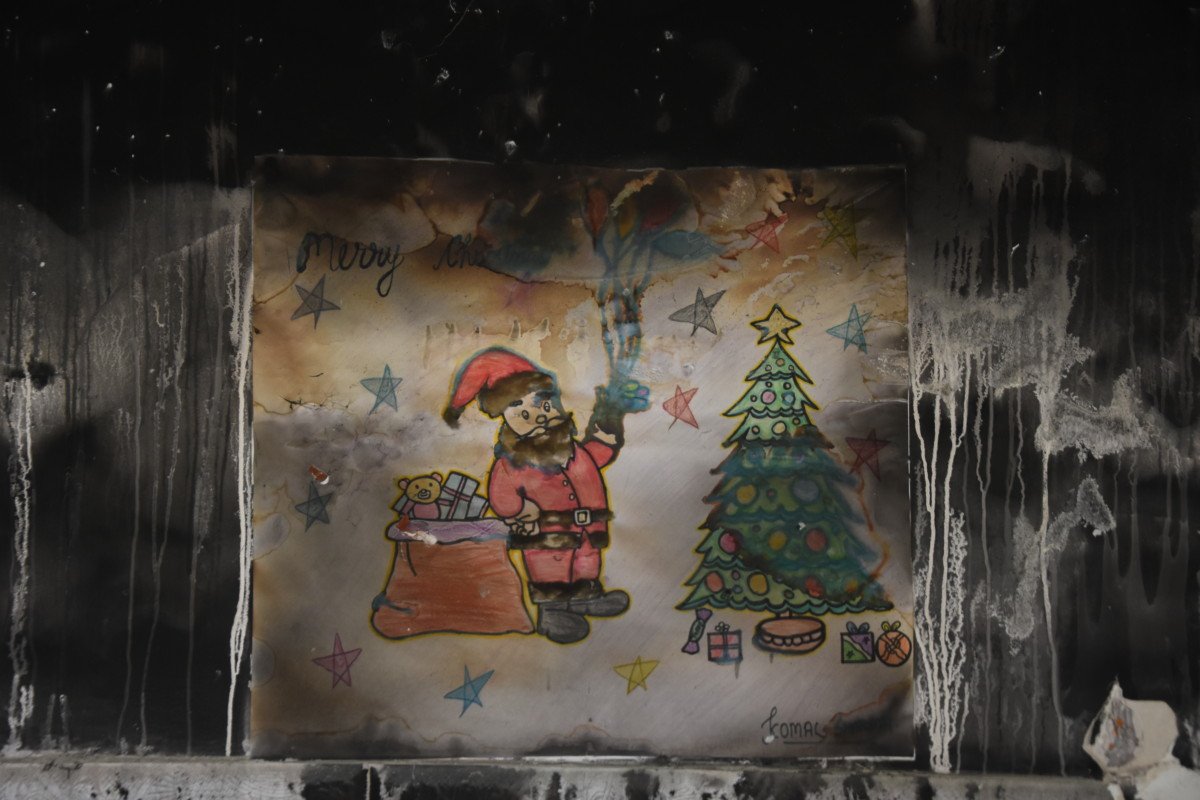
A defamed wall in a class room, Arun Public School; North East Delhi. Photo: Sreekanth Sivadasan
There are hundreds of children staying in relief camps in different parts of Delhi, away from their burnt home with people who lost eyes, hands and after all their favourite people. There are kids sharing food with others who lost their family. They are worrying about their books which they left behind in their homes when they ran away. There are kids who talked about their neighbors who burnt alive in their homes. There must have been children who saw rioters dragged out their friends and fathers outside and lynched. There are children who don’t know whether their homes (once they decorated with their crayon paintings) is still there or not. They don’t know whether their best friend in school will come to the same school or not.
Children in a relief camp for riots affected in North East Delhi. Photo: Sreekanth Sivadasan
May be after some days these kids in Delhi will also write some poems, same as that 11 years old kid in Mumbai wrote. They will talk about blood, pain and loss. They will carry these emotional traumas into their entire life. And we, the adults expect everything normal from them who is still there in some shelter camps silently crying.
Children are the most helpless, worst sufferers after every violence or calamities. Without their faults they are forced to live and see the terrific pain, blood, tears, insecurity and most importantly the adults who made these innocent kids to experience all of this. Children are compelled to live in place having communal tensions and political unrest.
H.S. Davale, Leena Damani, Jahnavi Kedare, Shanu Jethani and Sumit Sharma the researchers in Department of Psychiatry, B.Y.L. Nair Hospital, Mumbai explained, in their paper titled Impact of Riots on Children, that Young children may not be able to effectively verbalise their fears and concerns to others, but this does not mean that they are immune to the effects of violence.
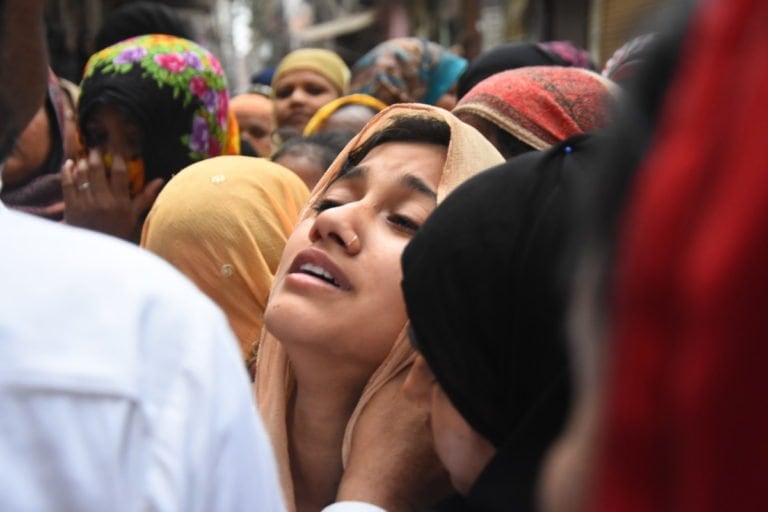
A daily wager with her kid, crying on her lost during riots; North East delhi. Photo: Sreekanth SivadasanA mother holds her baby who got injured during riots; North East Delhi. Photo: Sreekanth Sivadasan
They also stated that the children after the violence will display Post traumatic stress symptoms like repeatedly perceiving memories of the event through visualisation or ‘re-seeing’ aspects of the trauma; engagement in behavioral re-enactments and repetitive play related to aspects of the trauma, trauma-specific fears; and pessimistic attitudes about people, life, and the future, sense of hopelessness and difficulty forming close relationships, grow up having issues like emotional denial or psychic numbing, even separation anxiety.
A child sleeps in a relief camp; North East Delhi. Photo: Sreekanth Sivadasan
A single moment of violence will possibly influence their entire life. Who they will become have a profound influence in what they are seeing, knowing and feeling when they were kids. So the question is that who is responsible for these. The government? The police? The State structures? The parents? The society? Yes. the answer is the adults. We should make sure that our kids will have a healthy and peaceful life. The kids should write poems about butterflies, flowers, wind, and love, and love again.
Like Martin Luther King Jr said “Hate begets hate, violence begets violence”. Amidst of all this violence and sufferings tell your kids the story of love. Love them more. Reach out the kids in the riot affected places. Meet the kids who lost everything. And show your love. We must meet the forces of hate with the power of love. And there a generation of love sprouts and spreads.
That was close to neck! Yasmeen remembers their escape during the riots in Shiv Vihar on 24th February. Yasmeen and her husband Sakir knew that fleeing is the only way to save themselves and their four children. The elder kid is in 11th standard as second one was to appear for board exam of 10th. The younger two kids studies in 8th and 5th standards respectively.
They saw in their eyes a violent mob from Johri enclave side crosses the short bridge on drainage to Shiv vihar side. Their home was just 200 meters away from the bridge. Their ground floor was their small garments shop. Somehow they gathered children and closed both the home and shop. They just saved their lives as they could run from there. Mob set fire their home and shop after looting and vandaslising.
Yasmeen returned to their home on 6th March, Friday. After twelve days which seemed to her as 12 long years, she couldn’t help by crying to see broken and burned walls of her home. She found her shop is completely looted. Furniture in the house are theft, tiles on the floor broken and scattered, fire stains on the walls which were beautiful and decorated once. Some gas cylinders which rioters used to explode that home are left as they cursed in the middle of the hall. She was pointing us the places where she put her furniture, pots, plates, and so many other things that she was unable to tell as she was broken by heart and desperate for words.
A neighbor told us that this was the most beautiful home they had in Shiv Vihar neighborhood. Yasmeen looked very weak. She may be in her most vulnerable condition of realising that she has lost everything that she dreamt and achieved so far. We walked out of that home which is now just a heap of ashes of many dreams.
Haseena, Shiv Vihar
When we entered in to Gallies, the scenes and views were same; homes are burned, walls are stained and humans are with emotionless faces! In one galli near to Madeena Masjid, we met Haseena. Haseena’s home is in between her Hindu neighbors. But only her home is set burned. One entire storey has been crashed down due to the heaviness of explosion. Haseena shows gas cylinders and scooter which rioters used to explode her shelter where she spent almost all of her life so far.
Photo: Sreekanth Sivadasan
Her husband is a driver. But their taxi car also has been torched. Haseena and her husband escaped from rioters on 25th February to Mustafabad. She was crying when she said that books and study materials of their children who study in Delhi University were lost in fire during riots.
When we left that galli, Haseena was sitting on a narrow varandha with eyes full of tears.
Losing two brothers may be tougher than dying in this mess. Ikra, the sister of two Mustafabad brothers who were killed on their way back to home from Gokulpuri, remain as heart breaking image of the aftermath of North East Delhi riots.
Amir, 25 years old and Hashim, 16 years old are brothers of Nagma and they lost their lives in the bloody violence happened in this region on 24th February. “I asked them to come quickly as the situation was getting worse. They said that they are okay and I cut the call. Later, we got their bodies from a drainage. They had multiple wounds. They were stabbed and shot. Even their Kafan have blood stains” said Ikra, the sister of the two brothers.
The infamous case of death of KM Basheer, the Thiruvananthapuram bureau chief of Malayalam daily Siraj, involving IAS officer Sriram Venkitaraman has once again come to the limelight. Following the developments of the last one week, the special investigation team headed by SP A Shanvas has filed a chargesheet on February 1. The 66-page chargesheet names Venkitaraman as the first accused and his co-passenger at the time Wafa Firoze as the second accused. Details from over a hundred witnesses have been recorded and 84 material evidence too have been gathered. Basheer, who was all of 35 years old, is survived by his wife and two small children.
Alcohol, speed took away a promising life
On August 3, 2019, Basheer was returning home on his bike after attending an official meeting in Kolam, when he was hit by the speeding Volkswagen car driven by Venkitaraman about 1 am near the Public Office building in the capital city of Kerala. Venkitaraman was allegedly driving under the influence of alcohol and speeding at the time of the accident.
Following the accident, Basheer was taken to the Thiruvananthapuram Medical College hospital, where he was declared dead on arrival. Venkitaraman was also taken to the same hospital first as he had also sustained some injuries in the accident, but he later shifted to Kerala Institute of Medical Sciences (KIMS), a private hospital in the city.
Meanwhile, Saifudeen Haji, Director of Siraj newspaper, filed a First Information Report in the case with the Museum police station. A case was registered under section IPC 279 (rash driving on a public way) and 304A (punishment for culpable homicide not amounting to murder) against Venkitaraman and Wafa, who owns the car.
The police, in the FIR, didn’t make any mention if Venkitaraman was driving under the influence of alcohol. Venkitaraman, when questioned by the cops at KIMS, had claimed that it was Wafa and not him who was driving the car on the fateful night. The IAS officer remained in the private ward of the luxury hospital for a day after the accident. The police produced him before a local magistrate on August 4, only after journalists from the state put pressure on police and threatened to go on a strike if Venkitaraman was not shifted to a jail cell.
The magistrate remanded him to a 14-day judicial custody, after which he was shifted to the government hospital’s ‘prison cell’.
Sriram Venkitaraman; Wafa (File images)
They saw it all
The incident took a curious turn after four eyewitnesses claimed that Venkitaraman drove the car, even as the police claimed that Wafa was driving when the accident took place. The police, in the beginning of the investigation, had claimed that the lady travelling with Venkitaraman was driving the car. A parallel narrative propagated by the Facebook page of D Dhanasumod, a man claiming to be an eyewitness to the crash, stated that he saw a man in his 30s coming out of the car after the accident.
“Around 12:55 at night, when I saw people, police vehicles and a van crowded near the museum public office, I parked my cycle and went to see what was happening. There was a bike that stood leaning against the wall of the building. Suddenly, I saw the man who was lying down. He was bleeding. The police were waiting for an ambulance as it was too risky to take him in the police jeep due to his critical condition,” he wrote.
Another eye-witness K. Jithu, working at Rings By Annie Hotel at Kowdiar, said he is an eyewitness of the accident. “I was on my bike going home and suddenly the car came from behind. It was all of a sudden that I could hear a loud noise of the car and it kept honking continuously. I just rode my bike away from the road and I saw the car hit Basheer. He was only 20-25 metres away from me. The car rammed the backside of his bike and it hit an electric post. The frontside of the car was also damaged. I thought all of them were killed. When I checked the car Venkitaraman and Wafa were alive and came out of the car,” he told Newslaundry.
“The lady came out of the car from the passenger’s seat and the man was driving the car,” he stated.
He added that they waited for over 20 minutes for help to arrive.
Another witness Jobi Joseph said Venkitaraman looked drunk when he came out of the car. “I was returning from a movie,” he said. “Venkitaraman’s legs were wobbly. He told the police that Wafa was driving the car,” he told Newslaundry.
The police initially claimed that the car was driven by its owner, Wafa of Marappalam, while Venkitaraman sat on the passenger seat. However, two auto-rickshaw drivers—Shafeeq and Manikuttan at Thiruvananthapuram city, who claimed to have witnessed the incident—told mediapersons that it was the IAS official who was driving the vehicle at the time of the accident. They also claimed that he was under the influence of alcohol at the time of the incident.
Delayed alcohol test became ground for bail
On August 6, 2019, Venkitaraman’s lawyer filed a bail plea in the court on the basis of the IAS officer’s blood alcohol report which was taken almost after nine hours of the accident. The Judicial First Class Magistrate – III granted bail after going through the blood reported of Venkitaraman; it tested negative.
The magistrate, A Aneesa, prevented Venkitaraman from leaving Kerala. The court said it would revoke his bail if he tampered with evidence, interfered with the investigation, or swayed witnesses. The next day, Venkitaraman was suspended from government service over the accident. Questions were raised over the police’s handling of the case.
The Kerala government (prosecution) moved the High Court twice, on August 7 and August 13, with a plea to stay the bail granted to the IAS officer. The court rejected the plea and also pointed out some serious lapses in the investigation done by Kerala police.
The state government in its petition to the High Court said that the delay (in taking blood samples) was because they couldn’t trace the IAS officer–who had by then left the hospital. It was only at 9.45 am that they found out he was at KIMS–a private hospital in the city–where they then went to get his blood sample.
Khasida Kalam, a reporter with Media One news channel, said, “Even though the accident took place a short distance away from the Museum police station, the police acted to save the IAS officer from the very beginning.”
Kassim A Khadar, a journalist with Siraj and Basheer’s friend, believes there was a cover-up in the case. “Just after the incident—it was all of a sudden—all officials including police officers, doctors, civil servants, politicians and many others joined hands on a single night to save Venkitaraman,” Khadar alleged.
The biggest lapse in the case came as the delay in taking the blood sample of the accused. Additional Commissioner of Police of Thiruvananthapuram, Sanjay Kumar Gurudin, in the defence stated that there were certain legal formalities to be followed when a person refuses to undergo medical tests.
However, the cops failed to consider section 204 (2) (b) of the Motor Vehicles Act, which gives the police the authority to take blood samples if the person refuses consent. Apart from this, the cops didn’t subject Venkitaraman to a breathalyzer test in the initial hours or a urine test if the blood samples were taken after a long gap.
According to Dr Sheeja, the Resident Medical Officer of Thiruvananthapuram General Hospital, Venkitaraman was brought there just before 2 am (an hour after the accident). At 2.07 am, Dr Rakesh Kumar, the duty doctor, inspected him and noted in his report: ‘Alcohol smell – Positive’. However, despite the accident and the doctor’s preliminary noting, Venkitaraman’s blood test was not taken at this hospital. The doctor told KG Kamalesh, an Asianet News reporter that since the IAS officer was neither an accused nor had an FIR against him, he did not ask for a blood test. According to the doctor, the SI Jayaprakash, too, did not insist on a blood test.
A blood test taken later and analysed at the Chemical Examiner’s Laboratory in the city showed that Venkitaraman’s blood did not have any trace of ethyl alcohol. However, the blood was drawn only after 10 am, nine hours after the accident.The alcohol in the blood metabolizes completely in about four to six hours, and becomes difficult to trace. The traceability becomes tougher as time lapses. A urine test is a better gauge to test alcohol traces in the body since it is not eliminated immediately; however, there is no indication that a urine sample was taken from Venkitaraman.
After outrage from the journalist fraternity over the botched up investigation, the sub-inspector at the Museum police station Jayaprakash was suspended for failing to conduct a proper investigation and Station House Officer Santhosh Kumar of Museum Police Station was transferred to Kasaragod.
KUWJ’s letter to CM of Kerala
Journalists put pressure for fair probe
After the incident, the Kerala Union of Working Journalists (KUWJ) demanded a proper and truthful investigation in the case to bring the guilty to book.
The Chief Minister of Kerala Pinarayi Vijayan took to social media to express his condolences. All media including print, electronic and online news portals together came with reports against the IAS officer’s mistakes and the political game. Many eyewitnesses responded. However, the police found no CCTV visual during the investigation. Many protests led by the journalist community demanded justice for Basheer.
The failure of the police to subject the passengers to medical tests soon after the accident has also been questioned. Initially, Wafa was purportedly sent home in a taxi by the police from the accident scene, said Nizar Mohammed, another Thiruvananthapuram-based journalist. “She was later summoned by the police and subjected to a medical test. Venkitaraman, who was admitted to the General Hospital with a minor hand injury, allegedly refused to undergo tests. Later, while he was referred to the Government Medical College Hospital by the police, he chose to seek treatment in KIMS, a private hospital in the city.”
Even CM Vijayan in a press meet held later raised the issue “of Venkitaraman using medicine to prove that he had no alcohol in his body should be investigated”, but hasn’t been investigated.
Siraj fighting for justice
Saifuddin Haji, Saifudeen Haji, Director of Siraj newspaper, said that the police from the very beginning of the investigation ensured that no evidence could be produced against Venkitaraman in the court. “I am sure that many people who tried to save Venkitaraman, are involved in the case and influenced the investigation.”
“When we realised that the police investigation is being influenced, we requested the Kerala government through the Siraj Daily management to change the investigation team,” said Abdul Khadir, Basheer’s relative. “That is how a special investigation team headed by Additional Director-General of Police Dr Sheikh Darvesh, has taken charge,” he added.
“The investigation team heads on the right way to find the truth and no culprit is going to escape from the case,” the Superintendent of Police and coordinator of the investigation A Shanvas pointed out.
Abdul Gafur, the Managing Director of Siraj, said, “The Kerala government supports the victim and we expect the accused will be caught. We still wonder how easily a killing changes into a normal road accident,” Gafur added.
Suspension extended to 90 more days
When the news of ‘Kerala journalists killer to join service soon’ came out in the last week of January as the suspension of the IAS officer by the Kerala government was going to end, the journalists from the state were not surprised. A recommendation to this effect was made by an officials’ committee chaired by Kerala Chief Secretary Tom Jose to Chief Minister Vijayan. In his explanation to the Chief Secretary, Venkitaraman stated that his friend Wafa was behind the steering wheel when the accident happened and alcohol was not found in his blood during the subsequent test. In his seven-page letter, Venkitaraman had rejected the allegations, especially of drunk-driving, against him.
The KUWJ acted quickly and requested CM Vijayan not to revoke the suspension of Venkitaraman. The organisation alleged that Basheer’s death had happened due to Venkitaraman drinking beyond permissible limits and driving the car. Basheer’s family is also sure that this is a case of drunken driving, the journalists wrote in their letter. The case is currently being investigated by the Kerala Police. If the accused is pressed back into service, then there are concerns that this could influence the investigation in a negative way as the accused is a powerful IAS officer, the letter stated.
Acting on the KUWJ request, the government extended Venkitaraman’s suspension for another 90 days on January 30.
A charge sheet filed, finally
The chargesheet filed on February 1, 2020, has named Venkitaraman and Wafa. According to the chargesheet, Venkitaraman invited Wafa to a party to celebrate his return to service at a Kowdiar flat around midnight on the night before the accident. The young IAS officer had been on leave for over a year for higher studies at Harvard University. Wafa came to the place in her Volkswagen car. However, she couldn’t find the IAS officer at his flat. She tried to contact him on his mobile phone but all her attempts went in vain. Later, she drove around Vallayambalam-Kowdiar road twice until she found Venkitaraman sitting on a bench at a nearby park. She stopped the car near a coffee shop opposite Raj Bhavan, after which Venkitaraman got into the driver’s seat.
According to the police, Venkitaraman wanted something to eat from Palayam and took to the wheels by himself. While they were on their way to Palayam, the car rammed Basheer’s bike at 12.55 am. According to Wafa’s reported confession before a magistrate, Venkitaraman attended a party and was under the influence of alcohol. She also confirmed that Sriram was driving the vehicle from Kowdiar.
Many lies by the IAS Officer, Charge sheet details
The major findings disclosed in the charge sheet clearly underline that the IAS officer Sriram Venitaraman tried to hide what actually happened on the day of accident. Even Sriram has got no serious injuries in the accident, he has recommended to the doctors at the General Hospital that he has to be referred into the Medical College Hospital. The museum police crime SI confirmed “a smell of alcohol” with the consulting report of Dr. Rakesh S Kumar who has consulted him first at the General Hospital. Instead of going to Medical College Hospital, Sriram called his friend Dr. Anish Raj and went to KIMS, a private hospital in the city, all the way without any communication with police and got admission in there. And at KIMS, Sriram has hidden the fact that he has hit KM Basheer and he lied to doctors and medical staff that the car hit a compound wall.
According to charge sheet, the doctors at KIMS have confirmed that Sriram has deliberately hidden about his crime. He also said to doctors at KIMS that his friend has driven the car. Dr. Masel Gladiolus and Dr. Srijith, doctors on duty in the casualty of KIMS have said that Sriram has denied the nurse to take blood sample. According to the charge sheet, it was Sriram who deliberately tried to have a delay not to get blood sample to metabolize alcohol in the blood completely. Wafa Firoze has given her car to Sriram to drive even after she has known that Sriram is drunk. The charges under the IPC 304, 201 and Motor Vehicle Act 184,185,188 have been filed against Venkitaraman and Wafa. The charge sheet also confirmed that Sriram has driven the car in 100 km/hr speed which is the prime reason for the accident. In the charge sheet, here are 100 witnesses, 84 documents, 72 mainours and many statements along with scientific evidences have been included by the police.
(The author is a Kozhikode-based freelance reporter and Chief Creative Director at Epistemic Breaks)
The Revenant is the film adaptation of Michael Punke’s 2002 novel of the same name. It won three Golden Globe Awards, five BAFTA Awards and at the 88th Academy awards, Alejandro G Inarritu, Leonardo DiCaprio, Emmanuel Lubezki won the awards for Best Director, Best Actor and Best Cinematography respectively. ‘The Revenant’ is a film which features the revenge of a frontiersman, Hugh Glass, on the death of his only son. DiCaprio play the lead character of Hugh Glass.
Events in the movie take place in 1820s, encompassing the tail end of the fur and pelt trade that took place in the United States and Canada for almost 250 years. Both Canada’s Indian Act of 1876 and the American General Allotment Act of 1887 developed as a long process of shifting from agreed treaties of previous centuries to the formal colonialism of the 19th century. Hugh Glass, who is a White American, married a native Pawnee woman, they have a half-Pawnee son, Hawk, unravels the story of the suppressed past of the native Red Indian tribes. Settler colonialism portrayed in the film shows the bad invested in the greedy, French and American Pelt trader.
The uncharted territory that was North America was harsh and unforgiving and required a particular form of robust masculinity to be successfully tamed. This was seized by the ruthless quelling of local populations. The depiction of the French trappers as one of greedy, rapists and hateful racism against the native population provides spectators with the very less told Western oppression over the colonies in Hollywood films.
Revenant is the most remarkable and appreciable movie from a group of ‘White and Western’ film makers to illustrate the white man’s savior complex. From the very opening scene of The Revenant, the infiltration led by the white men to the lives of the native people is portrayed on the screen. Set in an indeterminate year of the 1820s, the opening scene shows Hugh Glass speaking to his son, Hawk, in Pawnee Red Indian language, telling him that even though he is scared and wants his trouble to be over, he must fight as long as he can grab a breath. Glass’ only son, Hawk, is seen kneeling on the ground ,in the background , a white man setting fire in Glass’ home and walking away. The half of the boy’s face is burnt in the fire. The next scene is that of the Red Indian village destroyed, burnt into ash , corpses lying on the ground, focusing Hugh Glass with his son lying on his laps, Glass helplessly looking Hawk. Hence the politics of the film is very evident from the opening scene itself.
The sequence that follows is that, Glass and Hawk are walking through a river with other men from their hunting party as they stalk elk for their stay in the wild. The team of fur-trappers is camped by a river in rural Missouri, led by their captain, Andrew Henry. The hunting party is attacked by a tribe of local natives who are the ‘Arikara Indians’, also known as ‘Ree’. The Arikara themselves are looking for the chief’s daughter, Powaqa, kidnapped by unknown white men. The white men leave the place attacking back the Ree. The bank of the river Missouri is left with the Arikaras who are mourning on the death of their kin. It is a tragic sight that the chief of the Ree wanders hopefully in search of his daughter, Powaqa, saying to the rest, ‘My daughter, Powaqa, is not here, collect all the pelts we can carry, we’ll trade pelts with French for horses and we will keep searching for her”. The Arikaras attacked the settler for the inhuman deeds they did towards their clan. They snatched away women from Rees.
The white man’s saviour complex is rendered as one among Glass own crew members, a white man, Fitzgerald call the half Pawnee son, Hawk, the son of a savage from mother side. He is not pointing out the race of Glass since Wars is a white American. The attitude of the settlers towards the native is portrayed. The frustrated white man, Fitzgerald, would be considered as a substitute of the racist colonizer. He stresses on his statement that ‘savage is savage’. Fitzgerald mocks at Glass asking how he managed to live with those savage. Fitzgerald recalls an incident he got to know that Glass shot a lieutenant, who with his soldiers, assaulting the red India Village. Fitzgerald asks furiously “shot one of your own to save this little dog, right here”. The life of the Pawnee has no value in accordance to Fitzgerald. He enrages to Glass for killing ‘one of his own’ to save the little ‘dog’, his Pawnee son. Glass does not respond towards Fitzgerald’s provoking arguments. He quickly defends his son and tells him not to retaliate against Fitzgerald. He says “They don’t hear your voice, they just see the colour of your face, son”.
While hunting in the woods, Glass comes across a grizzly bear and cubs, and he is quickly attacked by the largest bear. The bear claws and bites Glass, throwing him around as Glass tries to defend himself. He manages to shoot the bear, but it does not kill her. She attacks again and Glass stabs it several times as they both tumble down a hill. Glass lands in a gully and the dead bear land on top of him. The men later find Glass and try to tend to his deep wounds. The scene that follows is the most remarkable scene which clearly portrays the materialistic and psychological annihilation the settlers had inflicted on the colonies.
The head of the Ree come to meet the French fur traders who are enjoying their leisure time drinking and smoking. The leader of the Arikaras asks for horse and rifles. He says that he had bought many pelts, so the French can exchange horses with pelts. The chief of the French fur traders, Toussaint, rejects the need of the Ree. The Ree requests them to take all the pelts they need in exchange of horses and rifles. The response from Toussaint is an outraging one. He says “I need a woman with big tits, who cook”. The head of the Ree keep on asking horses. Toussaint says if he asks about horses again, there is no deal”, he checks the pelts that Ree had bought and alleges that they are already branded and would only able to pay half price for them. When the Ree walks towards the horses to take them, not listening to the refusal, Toussaint says “They aren’t part of the deal, tell your man to step away; we had an agreement, go have to honor it”.
The chief of the Ree replies: “You stand there and talk to me about honor? You all have stolen everything from us, Everything! The land. The animals. Two white men snack into our village, and took my daughter, Powaqa. We leave you the pelts because honor demands it. I take your horses to find my daughter. You are free to try and stop me.”
This scene depicts the agony of the native red Indians of America towards the looting mentality of the Whites. The chief of Ree laments that everything has been stolen from them. Their land, their animals. He also speaks about his daughter, Powaqa, who was taken by two white men by infiltrating to the native’s village. Ree asks horses and rifles for searching and finding Powaqa. Toussaint responds indecently to him. He asks for woman for fulfilling his sexual desire and cooking. The Ree could easily take horses and rifles from the Whites without any talks; since Ree is the native and has men with him. But, since Ree values honor, they leave the pelts they bought for the French.
The men in the hunting party carry Glass on a makeshift stretcher, but he only slows them down. They attempt to carry him up a hill, only for him to slide and bring the other men down. Fitzgerald suggests they need to just kill Glass and put him out of his misery. Henry covers Glass’ eyes and almost shoots him in the head, but he cannot bring himself to do it. Henry offers payment of $75 to anyone who will stay behind with Glass. Hawk and Jim Bridger volunteer, though Fitzgerald points out that they and Glass would to die. Henry raises the payment offer to $100 so that even Fitzgerald decides to stay with them until Glass expires.
Glass is still in great pain and continues to have dreams of his wife and the day his home was burnt down. Glass’ have the vision of his past in his unconscious state of mind. He is seen embracing his wife. The destruction that the Whites caused to the native village is once again illustrated in its full terror. Glass’ son, Hawk, is seen running out of their house which is caught in fire. Glass is consoling his son telling that “I will be right here, I am right here”. The entire Pawnee tribe is obliterated by the colonizers. The whole village is set in fire. Many White Men are seen carrying guns with them, burning huts ruthlessly. Hawk witness the murder of his mother, he is seen standing at the door of their house. His mother falls on the ground getting shot by a settler in front of their hut. She tries to remain on her knees, but couldn’t hold off and falls down. The White man who shot the mother is seen walking towards Hawk, he run away frightened. Glass finds his wife dead in great shock. A sparrow comes out of her heart and flies away. Hawk is seen helplessly watching the dead body of his mother. Glass is seen with his son clasping his motherless child to his chest.
Glass lost his wife in the assail led by the White Men. They came in large numbers, carrying weapons and ammunitions. They wipe off an entire tribe. The furious White Men ruthlessly kill tribe people. For them, the tribe was merely a bunch of uncivilized, black humans. There was no value for the lives of natives. Women and children were taken away for different needs. Daughters of the tribe were brutally raped, murdered and left for jackals. One’s own right to exist in their own land was denied. Farms, fields and cultivated lands were demolished. Civilization that existed from ancient times was devalued.
I wouldn’t live in a colony like that, myself, for a thousand dollars an hour. I wouldn’t want it next door. I’m not too happy it’s within ten miles. Why? Because their soft-headedness irritates me. Because their beautiful thinking ignores both history and human nature. Because they’d spoil my thing with their thing. Because I don’t think any of them is wise enough to play God and create a human society (Stegner 372).
Glass is seen walking towards a huge heap of bison skull. He stares at the heap in great shock. It is the skulls of bison and other wild animals that the White men slaughtered and dragged to death. They ate the meat, peeled off the skin, and carried away the carcass for different needs. As a symbol of the White men’s hegemony, he gathered the skulls, made it a heap and at its top, put a flag of their mother country.
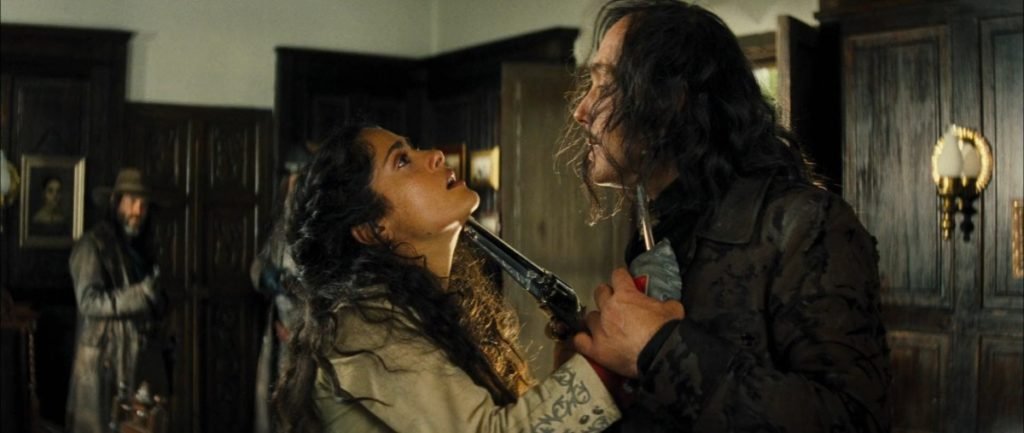
Fitzgerald gets a moment alone with Glass and tries to convince him to let him put him out of his misery so that no one else is slowed down or left waiting to die, including Hawk. As Glass is unable to talk, Fitzgerald suggests Glass should blink if he agrees, knowing that Glass would eventually have to blink, with or without intention to agree to Fitzgerald’s offer. Glass holds his eyes open for a long time before closing them, instead of blinking. Fitzgerald intentionally interprets this as blinking and starts to smother Glass. Hawk shows up, seeing Fitzgerald smothering his father. Hawk starts to call Bridger for help, leading to a struggle with Fitzgerald in which the man stabs Hawk in the abdomen, letting him bleed out as Glass watches helplessly. Fitzgerald gets rid of Hawk’s body and tells Bridger he doesn’t know where he went. Later that night, Fitzgerald urges Bridger to move on with him, claiming to have seen Ree Indians by the creek. Already having dug a grave for Glass, Fitzgerald forcefully drags him into the hole and partially buries him alive under a pile of dirt as Bridger reluctantly lets him do so.
Meanwhile, Henry and the rest of the hunting party have a difficult march as they head towards Fort Kiowa. As Fitzgerald and Bridger head to meet them, Bridger realizes Fitzgerald was lying about having seen the Ree by the creek. He turns his rifle on Fitzgerald, who takes it from Bridger and turns it on him. He pulls the trigger, but the unloaded rifle clicks on an empty chamber. They continue to move.
Glass awakens and weakly struggles to rise from out of the dirt. He starts crawling his way through the woods to find food and warmth. He finds Hawk’s body freezing up from the cold. Glass vows to stay by his son’s side. He finds a thick bear pelt to take with him to keep warm. As he continues to move through the woods, he feeds off of roots and old bone marrow. He attempts to build a fire for added warmth and uses some of his leftover gunpowder to seal the wound in his throat. Nearby, the Indians were getting closer, so Glass rides down the rapids to escape them.
Fitzgerald and Bridger continue to walk. They come across a burnt-down settlement with bodies sprawled across the ground. A pregnant native Red Indian woman is seen dead among the other people. The entire village has been destroyed. Fitzgerald asks Bridger, who might have done this. Bridger replies he doesn’t know about it. Then Fitzgerald says, “It could be Captain Leavenworth’s boys”. They are another group of fur trappers like Fitzgerald and his companions. They might have done this brutal act to the inhabitants. They not only took away their lives, but seized away their assets, belongings and women. Fitzgerald makes a statement of hatred that, “Look at them, they are always stinking of shit” pointing at the dead Indians. The pathetic sight of the corpse of the pregnant tribal woman invokes sense of empathy to spectators. One woman emerges from her burnt hut and sees the men. She is out of hope, has lost everything she possessed. She has a cold look in her face. Fitzgerald takes some leftovers of the tribe men from the ground and puts it in his pocket. Even at the place of a brutal massacre, he shows no mercy towards his fellow human beings. He snatches away the properties of the natives. He takes away the horses which belong to the clan and resume his journey to the White men’s camp with Bridger. Getting away on the horse, Fitzgerald tells Bridger, “Lord is on our side, kid”. It is an ironical situation as we find the woman, who narrowly escaped from death, is seen on the screen at Fitzgerald’s statement which is audible in the background.
Glass gets colder and hungrier. He walks into the river and eats a live fish. He walks up a hill and sees a Pawnee Indian feeding off the carcass of a bison. Glass approaches him cautiously and gestures for food. The Indian throws him an organ, which Glass eats ravenously. In the morning, the Indian observes the bear wounds on Glass’ body, which are starting to rot. Glass says his men left him for dead and killed his son. The Indian states that his own family was killed by a rival Sioux tribe. He is seeking out more Pawnee for his revenge.
By this time Fitzgerald and Bridger finally make it to reach the outpost. They are on their horses, seen moving towards the camp. Many native children and women, finding Fitzgerald and Bridger, rushes towards them. They are holding something in their hands, begging the White men to purchase it. They continue riding their horses ignoring these people. They never even consider their presence. The settlers had gained control over the area, the Red Indian’s native place. They had set up their camp and established their dominance over the inhabitants and nature. The Whites tamed the innocent tribal people, kept them as slaves, humiliated their lives, exploited the natural resources and made huge profit out of it. Fitzgerald tells Henry that they couldn’t save Glass or Hawk, and he collects his payment. Bridger remains quiet but is upset and refuses a bonus pay.
Glass and the Indian move forward. They spend the evening sitting and catching snow in their mouths, the first time Glass has looked peaceful in a while. The Indian gathers materials for a quick sweat lodge and places a feverish Glass inside. Glass starts hearing his wife’s voice, and then sees himself walking towards Hawk before they embrace in an old church. The Pawnee performs a healing ritual for Glass’ wounds. When Glass wakes up, the Pawnee is gone. Glass walks in search of the Pawnee. He witnesses the tragic sight of the dead Red Indian. The Pawnee is seen hanged to death by the French fur trappers. The hanged some wooden log in his chest with the tag, “We are all wild”, written in French. Glass is in great shock to see the murder of his dear friend.
Glass comes to hear the talking, loud laughs and noise of the French men nearby. The next scene portrays the poor father, the Arikara head, resting with his group members after the tiresome journey in search of his daughter. A messenger suddenly arrives and tells him about the traces of a camp. He asks others to move quickly and tells Powaqa could be with them. Glass cannot tolerate the celebrations and laughs of the murderers. They are seen drinking liquor, singing songs and enjoying the leisure time. A girl is seen lying on the ground. It is Powaqa, the daughter of Arikara tribe, kidnapped by the White men. It was to this group of invaders the Arikaras came to trade pelts in exchange of horses and guns to search for Powaqa. But they hid the news of Powaqa’s kidnap to the tribe men. They played treacherous tricks on the Red Indians to trade pelts. The head of the French group, Toussaint, asks one of his subordinates to bring the girl. He beastly laughs and says “Those five horses weren’t for free.” Hence the White men had kidnapped the woman and they themselves trade with Arikaras pelts in exchange for horses to search for the woman who they kept in secret. Toussaint drags Powaqa, she resists, and in brutal force starts to rape her. Glass holds the rapist at gunpoint and frees Powaqa, he hands over a knife to Powaqa .She holds Toussaint at the Knife tip and kills him taking her revenge. Glass then takes a horse, letting the other horses loose. He rides to a spot in the woods where he builds himself a fire. Powaqa too escapes on a horse from the place. In the morning, the tribe searching for Powaqa starts to attack. Glass holds them off with his rifle before he mounts his horse and rides away. The tribe follows him on their horses up to a cliff where Glass and his horse fall over the edge. The horse dies, and Glass is injured again. As the night falls and the cold intensifies, he cuts the horse open, removes its organs, and bunks inside its carcass for warmth. When he wakes up, he gets out of the carcass and moves to a snow cave. In there, he carves “Fitzgerald killed my son.”
Meanwhile, at Fort Kiowa, a party takes place. White men drink and dance, they embrace the Pawnee women with lust. Many Red Indian girls and women are kept in force by the settlers. It is very evident from those poor creatures’ body language, how humiliating are these White men towards them. Fitzgerald talks to Captain Andrew Henry about the payment left for the pelts that are safe in the woods and need to be carried to the camp. The captain replies, “I’m waiting for Captain Leaven worth to arrive with his army, to get back out there and shoot some civilization into those Arikara, get back our pelts”.
Sometime later at the outpost, one of the French hunters arrives with Glass’ canteen, which Bridger left on the dirt pile after Fitzgerald buried him. Thinking he took it from Hawk, Henry leads a search party through the woods. There, they find Glass, limping towards them. They bring him back to the outpost. Henry finds that Fitzgerald is gone. The French hunter tells him that he heard Fitzgerald was headed to Texas. Fitzgerald looted the entire party’s payroll. Henry then confronts Bridger with his rifle and beats the young man to the ground and puts him in the stockade. Glass vouches for Bridger’s innocence to Henry, stating that he was only following orders. He also tells Henry how he saw Fitzgerald kill his son. Hearing that Fitzgerald is heading for Texas, Glass requests that he will seek the man out himself. Henry reluctantly agrees to have Glass join him in the hunt. The two encounter Fitzgerald and split up to get him from opposite sides. Henry finds Fitzgerald first and plans to bring him back to be tried for murder. The two men draw their guns on each other, with Fitzgerald killing Henry. Glass finds Henry’s body and puts him back on top of his horse using a branch as a prop. They ride on in view of Fitzgerald, who fires his rifle from a distance. He thinks he has killed Glass, but he just shot Henry’s body. Glass gets a shot off and wounds Fitzgerald who runs while Glass pursues. They corner each other in the woods, and Fitzgerald shoots at Glass. Fitzgerald runs down by the creek where Glass finds him and they begin to fight. Fitzgerald nearly stabs Glass, but Glass turns the knife on him. Fitzgerald impales Glass’ hand, but Glass overpowers him and nearly finishes him off until Fitzgerald states that killing him won’t bring his boy back. On the other side of the creek, Glass sees the Indians that have been pursuing him, now with Powaqa. He decides that revenge is in God’s hands, so he pushes Fitzgerald into the water and lets him float over to the Indians. The chief grabs Fitzgerald and kills him with his knife. They spare Glass since Powaqa tells them that Glass freed her.
Although he has gotten his revenge, Glass is alone once again, wandering through the cold land. He falls on his knees and sees a vision of his wife once again walking into the light. The final shot is of Glass’ eyes filling up with tears.
After Second World War, and particularly by the 1970s and 1980s, Western filmmakers began to portray colonial encounters in more complex and subtle ways. In the first decade of the twenty-first century, cinema around the world, from the perspective of both filmmakers and audiences, remained drawn to the themes of Western colonialism and, particularly, the difficult issues and problems created by the colonial encounters between Europeans and non-Europeans.
Colonialism at the movies began at the dawn of the motion picture industry in the late 1900s. A fifty-second reel about the French colony of central Vietnam in Indochina was made by Gabriel Veyre, a collaborator of the Lumière Brothers in 1897. This short, shows two French women giving money to a group of Vietnamese children who scramble and fight for every coin. Only a small fraction of French films made in the 1920s and 1930s were colonial in subject or made in exotic locations. French filmmakers, however, made their share of colonial adventure stories that shored up the idea of empire and idealized the Foreign Legion as the “thin white line” defending civilization from the Arabs.
David Henry Slavin counts fifty such films set in North Africa in the 1920s and 1930s that “legitimated the racial privileges of European workers, diverted attention from their own exploitation, and disabled impulses to solidarity with women and colonial peoples” (Henry 3). Justification of colonialism and White men’s savior complex was executed through films in early years of the 20th century. The Four Feathers was such an attempt from the western film makers.
The Four Feathers (1939)
One of the favourite colonial stories, a 1902 novel by the British author A. E. W. Mason, about the courage of a former British soldier during the Sudan campaign of 1898, The Four Feathers was first made into a film during World War I and was remade by ZoltanKorda in 1939. The 1939 film presented the Sudanese enemy, the Arab dervishes, and the African men as mindless warriors in the service of a madman. These and other British films with colonial themes of the 1930s offered little justification for empire other than, writes Jeffrey Richards quoting Nowell-Smith’s words, “the apparent moral superiority of the British, demonstrated by their adherence to the code of gentlemanly conduct and the maintenance of a disinterested system of law and justice” (Richards 364). The Four Feathers is a Technicolor spectacle which examines imperial, masculine codes of honour and chivalry. The film relates to the themes of other 1930s British films in the empire genre by suggesting that although the empire is profoundly unstable and dangerous, British military intervention and the endorsement of particular codes of masculine chivalry are necessary to keep order.
Mason’s 1902 novel has appeared on film seven times, including a 2002 version by the Indian director Shekhar Kapur. Kapur’s film The Four Feathers, unlike the previous ones, injected a dose of anti-imperialism in its double perspective of how British imperialism affected the subordinate native people and the British and native soldiers who enforce foreign rule.
American filmmakers, and apparently American audiences, were not interested in any American “Empire” other than the “Wild West” and cowboys and Indians. “The western” dominated the American cinema from the silent period through the 1950s. Not unlike French and British colonial films, American westerns contrasted white civilization and Indian “savagery,” as well as the conflicts within newly settled colonial societies. Apocalypto, a Hollywood movie which features the struggles of Mayan Empire can be chosen as an example to identify the White men’s propaganda to indigenous people.
Apocalypto (2006)
Apocalypto is a Hollywood movie produced in the year 2006 which evidently portrays the Mayan kingdom as inherently blood-thirsty savages. The film is directed by Mel Gibson with a racist propaganda, depicts the story of a tribe under Mayan civilization. The Mayan kingdom is at the height of its wealth and power but the foundations of the empire are beginning to crumble. The leaders believe they must build more temples and sacrifice more people or their crops and citizens will die. Jaguar Paw, a peaceful hunter in a remote tribe, is captured along with his entire village in a raid. He is scheduled for a ritual sacrifice until he makes a daring escape and tries to make it back to his pregnant wife and son. This movie is a series of nightmares of the same old racist ignorance, distortions, exaggerations, stereotypes, and lies and omissions that present colonized as a violent and irrelevant savage people. Apocalypto is Gibson’s ignorant and criminal white supremacist vision of Mayan civilization. He is obsessed with downgrading Mayans as mere savage, lessening their accomplishments, showing Mayans as the worst of people committing human sacrifice; a people worthy of being destroyed by Europeans. They are portrayed as weird characters who are illiterate and uncivilized.
The movie Apocalypto masquerades as a historically accurate description of the Mayan civilization before colonization by the Catholic Spaniards. It has failed miserably in this endeavor. The city of Mayans is shown as blighted and filthy, and there are no re-creations of the stunning plazas filled with florid art. It was a culture with complex astronomy, a365-day calendar, and their own writing system, but none of these achievements is celebrated or acknowledged in the movie.
The film ends with the coming of Spanish missionaries to the Island. The Protagonist, Jaguar Paw, and his family walk away in satisfaction seeing the arrival of Spaniards. The dominant message of the climax is that the Mayans were corrupt and merciless without any redeeming values who required the arrival of the Christian Spaniards to save them. It is Mel Gibson’s own message of salvation through the European Christians.
As a supplicant before a deity, I am immensely attracted to Bhairav [Shiva]. And, as a lover, I am obsessed with Bhairavi [Parvati, Shiva’s consort]… The average Hindu is conditioned by the caricature of Bhairav. I wish I, a devout Moslem, could describe to him my vision of Bhairav’s infinite form and awesome power! I would say the same for Bhairavi. How many different facets of her persona I have experienced!
— Ustad Vilayat Khan, a famous sitar player of the 20th century, describing the ragas Bhairav and Bhairavi, which are named after Hindu deities
Of the Indian subcontinent’s numerous musical traditions, two in particular have been deemed as “classical”: Hindustani music in the north, and Carnatic music in the south. In both traditions, abstract improvisation is given great importance, but these traditions also are connected closely to Hindu devotion and philosophy, whether through religious song lyrics or emphasis on the sacred nature of the guru–disciplerelationship.
However, Muslim rule in north India began to alter the character of Hindustani music: its performance, “like its patronage, came to be dominated by Muslims—specifically, hereditary professionals,” and although Hindustani music retained its devotional song texts, it “came to be regarded less as a form of prayer and devotion than as one of the secular ‘fine arts’” (Manuel 122, 124).
I am a student of Carnatic violin, and throughout my childhood, I associated Carnatic music with devotional compositions and performances held in Hindu temples. Hindustani music, on the other hand, conjured up ideas of Persian and Afghan music and instruments and the magnificent Mughal courts. Yet, most of the Hindustani musicians I have seen in concerts have been Hindus. Many of these musicians, such as Pandit Jasraj, performed Hindu devotional songs alongside abstract “art music”. Even the Muslim musicians I listen to and read about seem to describe their music in an explicitly Hindu manner, making little reference to their personal faith:
He interlocked the notes of the Raga Yaman and when he came to the fourth note … he said, “See, this is the psychic form of Raga Yaman. In this form Saraswati Mata [goddess of knowledge and arts] is … bedecking herself in all her glory. She has put on her beautiful saree and jewellery, she combs her hair and adorns it with flowers. Finally, she puts kohl in her eyes and that is the [fourth note] in Yaman.”
— A biography of Ustad Bade Ghulam Ali Khan, a famous 20th-century Hindustani vocalist (Gilani 118)
Given the history of Hindustani music as an art form that was “secularized” in Muslim courts and further developed by Muslim musicians, why do so many contemporary Muslim performers of Hindustani music choose to publicly link their music to Hinduism?
This question can be answered by exploring the modern history of classical music in north India, beginning in the pre-colonial era, during which Hindustani music was dominated by Muslim hereditary musicians and their gharana system. This system was first challenged by intellectuals who sought to modify Hindustani music in accordance with British colonial ideas of modernity. The parallel emergence of Hindu nationalism in India posed another threat to Muslim musicians, as classical music became associated with Hindu devotional practices.
Upon the partition of the subcontinent in 1947, nation-building efforts in Pakistan renounced Hindustani music in favor of more explicitly Islamic alternatives such as qawwali, thus paving the way for Hindustani music to be explicitly linked to Hinduism in India. The world of Hindustani music has been shaped in the past century by colonialism and both Hindu and Islamic nationalism, with important consequences for how its Muslim performers present themselves today.
Historical background
By the nineteenth century in north India, “the field of music was dominated by Muslim musicians. That is not to say that there were no musicians who were not Muslim, but that there were conspicuously more Muslim musicians than non-Muslim” (Bakhle 81). Musical training was generally passed on from father to son through oral transmission, so that “hereditary musicianship [was] concentrated within families of Muslim performing artists” (Katz 280). Each family’s unique performative and aesthetic style was called a gharana, and the particularly great musicians of a gharana were called ustads. Many ustads saw each other as rivals; they “had erratic, self-protective, and sometimes capricious pedagogical habits. They also tended to be secretive about their art, tradition, and history” (Bakhle 6). This tendency towards secrecy and self-preservation would soon lead the ustads to come in conflict with the self-styled modernizers of Hindustani music.
Colonial encounters
One of the first major threats to the gharana system came from British colonial writers in the late nineteenth century who were both fascinated and perplexed by Indian music. According to the British, “music needed three things: nation, notation, and religion,” and these criteria were quickly internalized by Indian intellectuals (Bakhle 10). The burgeoning nationalist movement, reacting to these colonial observations, wanted to “declare triumphantly that Indian music was just as religious, and as easily textualized, or notated, as the more sophisticated music of the West” (Bakhle 94-95). Thus, although Hindustani music had previously undergone a process of secularization in Muslim courts, colonial writers caused it to “become irrevocably tied to ideas of nation and religion” (Bakhle 94).
From these encounters with colonial ideas about music and modernity, there emerged two connected movements. One movement thus sought to make Hindustani music “modern”, which meant to undertake a program of notation and standardization. The other movement sought to make Hindustani music Hindu; or, more accurately, it sought to “retake” Hindustani music from Muslim musicians and their courtly “debauchery”. Both movements directly targeted the ustads and their gharanas.
Making Hindustani music modern
The movement to modernize Hindustani music was led by the musicologist V.N. Bhatkhande, who operated under the assumption that the “families [in whom] music had resided and flourished for generations were the main problem confronting music” (Bakhle 131). He and his colleagues believed that the gharanas, with their system of oral transmission and tendencies toward secrecy, were responsible for stifling Hindustani music. Bhatkhande’s solution was to “impose on these practices a nationalized and textual solution” (Bakhle 131), through which he attempted to catalog and notate hundreds of Hindustani compositions.
Although notation of Indian classical music never quite took hold, partly because it relies heavily on melodic oscillations that cannot be easily notated, Bhatkhande’s efforts did have a significant impact on Indian musical scholarship. During Bhatkhande’s time, “Muslims [were] conspicuous by their absence … as organizers, lecturers, and authors” (Bakhle 81) and even today “Muslims have played a negligible role in modern Indian music scholarship, hampered as they have been by their traditional reliance on oral transmission” (Manuel 126).
For Bhatkhande and his colleagues, Muslim musicians were not necessarily excluded from modernization on the basis of their faith; rather, they were looked down upon for their perceived backwardness and illiteracy. This is made clear by one of the stated goals of the music college that Bhatkhande founded in 1926: “to collect and preserve the great master pieces of the art now in the possession of illiterates” (Katz 289). Indeed, ustads were constantly branded with the title of “illiterates” rather than “Muslims”.
Although Bhatkhande’s efforts resulted in Muslims being excluded from the modernization of music, these efforts were motivated by a secular nationalist desire to eliminate “elements of the colonial society that appeared archaic, outmoded, or pre-modern” (Katz 288). Thus, one could characterize the efforts to modernize Hindustani music as “[undermining] the tradition of Muslim hereditary musicians without … relying on personal prejudice” (Katz 292).
Making Hindustani music Hindu
While the religious faith of the ustads may have been largely irrelevant to modernization efforts, it became the basis of the Hindu nationalist movement to “reclaim” Hindustani music from Muslim musicians, a movement which was led by the musician V.D. Paluskar.
To the accusation that Muslim hereditary musicians were illiterate, Paluskar added “debauchery”. In his view, Hindustani music’s development in and patronage by Muslim courts “opened Hindustani music … to the accusation of being sensuous and decadent” (Manuel 125). A common claim made by Paluskar and his colleagues was that Hindustani music was founded by the rishis, ancient sages who are believed to have received the Vedas, and that over the course of time, “music [fell] in the hands of illiterate and debauched hands, [and] its foundation in purity and classicism is rapidly disappearing” (Bakhle 149).
To bring about a renaissance in which Hindus would “reclaim” their music, Paluskar founded musical academies across India known as Gandharva Mahavidyalayas. In these schools, Hindustani music was taught through an explicitly Hindu curriculum: the schools would be closed on Hindu festival days, each class began with Hindu prayers, and “students were repeatedly told that they were involved in a process of tapasya [penance] in service to the goddess of music” (Bakhle 151). It is telling that although Paluskar’s first academy was founded in Lahore, a city with a large Muslim population, it had no Muslim students; furthermore, Paluskar was praised for establishing his first school “[in] the belly of the beast—[in] Muslim north India” (Bakhle 170, 149).
This Hindu nationalist movement clearly undermined the authority of the gharanas and ustads. By establishing academies with standardized music curriculums, Paluskar’s project also aided the modernizers who sought to liberate Hindustani music from the illiterate ustads and old-fashioned gharanas. Paluskar’s academies were established in most major Indian cities by the mid-20thcentury; his greatest success, however, was in his linking of Hindustani music to Hindu devotional practices.
“By giving music’s performance and pedagogy an overtly religious tint, its previous reputation for disreputability could now be considered a thing of the past,” and “by placing religiosity at the forefront of his pedagogy, Paluskar institutionalized a Brahminic Hinduism as the modal cultural form of Indian music” (Bakhle 153, 173). Paluskar not only managed to disassociate Hindustani music from its perceived debauchery and decadence. He disassociated Hindustani music from its performers—the Muslim ustads—and, in doing so, fostered a cultural nationalism that even today seeks to prove that “all that is good in Indian culture is necessarily ancient Hindu rather than recent Muslim” (Bakhle 259).
Rejection in Pakistan
At this point, the ustads and the gharana system had been challenged by intellectual modernizers who saw the gharanas as outdated and impediments to progress. In addition, Hindu nationalists, who viewed the ustads as Muslims who had corrupted sacred Hindu music, had begun efforts to re-infuse Hindustani music with Hindu bhakti [devotion]. When India and Pakistan gained independence in 1947, the bloody partition of the subcontinent along religious lines saw “seven million Muslim migrants from Indian provinces … [bringing] to Pakistan their local dialects, culture, and, of course, classical music practices—including those from established gharanas of north India” (Saeed, “Fled” 240).
This represented a critical moment for Hindustani music and its traditional performers. Migration to Pakistan could have allowed the ustads to escape an increasingly critical atmosphere in India. Although Hindustani music was becoming “democratized”, meaning it was being taught to mostly middle-class Hindus through the schools established by Bhaktande and Paluskar, hereditary Muslim musicians still dominated the art form (Katz 280). As an indigenous tradition whose finest exponents were Muslims, Hindustani music could have flourished in Pakistan; it could have been embraced as the national music.
This was not to be the case. Before 1947, Hindustani music in what became Pakistan had largely flourished due to patronage from Hindu business communities. These communities overwhelmingly decided to move to India after Partition, making “this trend of the migration of musicians in one direction [to Pakistan] and their connoisseurs in the opposite direction [to India] … one of 1947’s most ironic developments (Saeed, “Fled” 240).
Unfortunately, this was only one of the many challenges Hindustani music faced in Pakistan. An important priority of the newly established Pakistani government was “to define its national identity, one that was very different from ‘Hindu’ India” (Saeed, “Fled” 238). In the process of creating a Pakistani cultural identity, Hindustani music was marginalized due to its associations with Hinduism, while the Pakistani government directed patronage towards more acceptably Islamic alternatives.
In the new state of Pakistan, musicians depended on the state-owned radio as their only means of sustenance; however, it soon proved to be hostile towards Hindustani music (Saeed, “Fled” 241). Radio Pakistan banned genres which were considered to be of Hindu origin, such as thumri and dhrupad, as well as ragas named after Hindu deities and any compositions that mentioned Hindu deities (Gilani 83). Some musicians worked to “de-Hinduize” their music by changing the names of ragas, so that Shiv Kalyan became Shab Kalyan, for example (Saeed, “Fled” 241). Others dropped the “Hindustani” label altogether, and called their music ahang-e-Khusravi, meaning “sound of Amir Khusrau”, the great Sufi poet-saint of Delhi (Manuel 127). In general, Hindustani music was regarded as too un-Islamic to receive government patronage.
The government turned to more explicitly Islamic forms of music, including ghazal but especially qawwali, in an attempt to replace Hindustani music with a “religiously acceptable, and distinctly Pakistani, substitute” (Qureshi 599). Soon, qawwali “became an icon of Muslim identity for the new Muslim state,” and “a musical form that had thus far been restricted to Sufi shrines or private soirees was not only brought onto the national stage, but eventually came to represent Pakistani culture outside the country” (Qureshi 598) (Saeed, “Jugalbandi”).
Thus, Pakistan could have provided the ustads with an opportunity to develop a modern Muslim identity for Hindustani music—or, at the very least, to pass on their music to the next generation in an environment insulated from the criticism they faced in India. Instead, due to the dictates of Islamic nationalism, this opportunity was lost.
Muslim musicians today
This understanding of how colonialism, Hindu nationalism, and Islamic nationalism shaped Hindustani music can help illuminate why many Muslim musicians today choose to publicly invoke Hindu deities or religious practices when talking about their music. The success of the Hindu nationalist movement to associate Hindustani music with Hinduism and the rejection of Hindustani music by Islamic nationalists in Pakistan irrevocably changed the way Muslim musicians presented themselves in India, and it soon became difficult for Muslim musicians to make a name in the Indian public sphere “without participating in Hindu forms of religiosity” (Bakhle 175).
Since India’s independence, “a handful of reputable Muslim musicians [have become] the advertisement for the secularism of Indian classical music” (Bakhle 175). Ustad Vilayat Khan is celebrated for his devotion to the goddess Bhairavi: “he never seemed to run out of fresh ideas for courting his mythical beloved.” The Muslim nadaswaram maestro Sheik Chinna Moulana’s Wikipedia page describes him as “an ardent devotee of Lord Ranganatha”, while Ustad Bade Ghulam Ali Khan’s biography says he “sang in the Baranagar Ashram [Hindu hermitage] with the same feeling of devotion and sense of sanctity with which he would sing at a Dargah [Sufi shrine]” (Gilani 115). The list goes on, with many great Muslim musicians seeming to have some connection to Hindu devotional practices.
To be fair, we have no right to question the personal faith of these musicians or their relationship to Hinduism, nor should a Muslim be viewed with suspicion for professing their love for another faith. What we can point out, however, is that “forms of religiosity particular to South Asian Islam do not seem quite as visible in the world of [Hindustani] music as do Brahmin chants and rituals at musical performances” (Bakhle 174). While the sitar player Anoushka Shankar sometimes performs in concerts with a large Aum (sacred Hindu syllable) and lotus flower projected behind her, few, if any, Hindu musicians recite verses from the Qur’an during their performances. On the contrary, when I saw the sarod maestro Ustad Amjad Ali Khan in concert, he greeted the audience with a namaskar, explained the importance of the teacher-disciple relationship using the Sanskrit terms guru-shishya instead of the Urdu ustad-shagird, and described how the alaap (slow introduction to a raga) was akin to Hindu meditation.
Perhaps the tendency of Muslim musicians to publicly link their music to Hinduism could be seen as strategic gestures necessary in order to exist in a cultural sphere that is neither completely secular nor totally Hindu. Hindustani music today can be described as “secular” in the sense that non-Hindu musicians are accepted and appreciated by the public, but it can also be called “Hindu” because non-Hindu musicians are expected to keep their own religious identities somewhat subdued during performances.
For example, how would a Muslim musician be received by the Indian public if they refused to perform ragas named after Hindu deities? This may seem like an unreasonable question, but it is not without precedent: the famous Hindu vocalist Pandit Kumar Gandharva allegedly refused to perform ragas associated with Muslims, such as Miyan-ki-Malhar (Bakhle 174). Simply put, the hypothetical Muslim musician would be seen as a “communal,” divisive figure, and would be unable to make a living. On the other hand, Hindu audiences or fellow Hindu musicians may have tolerated Kumar Gandharva’s refusal to sing Muslim ragas because they too may have viewed Hindustani music as another form of Hindu devotional practice.
Hindustani music may not be as explicitly Hindu as south Indian classical music, but stages are still often decorated before concerts “with the accoutrements of Hindu ritualism, such as incense holders, marigold garlands, and oil lamps,” for example (Bakhle 261). Paluskar’s successful association of Hindustani music with Hinduism is very much alive today, and I believe that Muslim musicians are quite aware of that.
Hindustani music today
How else has Hindustani music changed in contemporary India? The gharana system still exists, and “ustads, though diminished in number compared to the end of the nineteenth century, still train the high-level performers” (Bakhle 14). However, thanks to the efforts of the modernizers and nationalists who established music schools across the country, “more and more prominent Hindu musicians—often from bourgeois families—are emerging and may soon outnumber Muslim hereditary professionals” (Manuel 126).
Although the diminished role of the ustads may seem to be a cause for lamentation, this is complicated by the realization that women were by and large excluded from the gharana system. Although some women were able to learn from ustads, they were “hardly considered legitimate or true heirs to an ustadi tradition … [the] unintended consequences of modernizing projects, couched in terms of bhakti [devotion] and religion, made it possible for women performers to be recognized as musicians” (Bakhle 254).
Even then, those who benefited from the modernization of Hindustani music as a “respectable activity” were largely upper-caste women, who then marginalized the lower-caste courtesans who had traditionally “comprised the majority of female Indian classical music singers” (Herbert). All of this proves that history cannot be easily classified into “good” and “bad” events; it can only be analyzed in relation to larger social, political, and economic factors.
Conclusions
It would be a mistake to characterize the Hindustani music of the seventeenth century as having existed in “a multicultural paradise ruined only by colonialism and modernity” (Manuel 137), just as it would be a mistake to portray today’s Hindustani music as an art form hijacked and transformed by Hindu nationalism. The story is always more complicated; a few dedicated Hindustani vocalists are still passing on their art in the Pakistani cities of Lahore and Karachi, just as Hindu singers like Pandit Jasraj have recently composed songs with distinctly Islamic lyrics:
Yet, it would not be inaccurate to argue, as I have, that Hindustani music today is generally associated more with Hinduism than it was a century ago, and that in order to stay relevant in the public sphere, Muslim musicians have had to adjust the way they publicly present themselves and their music.
As a student of Carnatic music, and as a lover of Indian classical music in general, it would make me feel better to believe that Indian classical music has always existed in a space of innocent religious harmony, totally disconnected from the ever-changing outside world. After all, “there is no doubt that the history of music in India presents many beautiful instances of cooperation, respect, and affection between Hindus and Muslims. Yet … such sentiments should [not] lead us to an uncritical embrace of Hindustani music as an inherently communalism-free zone” (Katz 281).
We should interrogate why Muslim musicians consciously present their music as aligning with Hindu devotional practices. Because British colonial writers associated “sophisticated” music with religion and standardization, Indian nationalists responded by trying to modernize and Hindu-ize Hindustani music. In the process, these modernizers and cultural nationalists attempted to separate Hindustani music from its traditional masters: the ustads and their gharanas. After Pakistani nationalists rejected Hindustani music, Muslim musicians had no choice but to adjust to a changed cultural sphere: one in which Hindustani music had been successfully linked to Hinduism.
There is no point to looking at these developments in terms of good and bad, because history is always more complicated than that. Rather, we should use this knowledge of the past to inform the way we look at Indian classical music today, as well as the place of minorities in other artistic and musical traditions in contemporary South Asia.
Further reading:
Bakhle, Janaki. Two Men and Music: Nationalism in the Making of an Indian Classical Tradition. Oxford: Oxford UP, 2005.
Gilani, Malti, and Quratulain Hyder. Ustad Bade Ghulam Ali Khan: His Life and Music. New Delhi: Harman House, 2003.
Herbert, Caroline. “Music, Secularism and South Asian Fiction.” Ed. Claire Chambers. Imagining Muslims in South Asia and the Diaspora: Secularism, Religion, Representations. N.p.: Routledge, 2015.
Katz, Max. “Institutional Communalism in North Indian Classical Music.” Ethnomusicology 56.2 (2012): 279-98. JSTOR.
Qureshi, Regula Burckhardt. “Sufism and the Globalization of Sacred Music.” Ed. Philip V. Bohlman. The Cambridge History of World Music. N.p.: Cambridge UP, n.d. 584-605.
Saeed, Yousuf. “Fled Is That Music.” India International Centre Quarterly 35.3/4 (2008): 238-49. JSTOR.
(Nikhil Mandalaparthyis a master’s student at the University of Chicago’s Harris School of Public Policy. He writes about South Asian history, culture, and art at nikhiletc.wordpress.com, and is on Twitter at @nikhiletc.)
Introduction of an Essay series on Colonialism in cinema
Colonialism is about the dominance of a strong nation over another weak one. Colonialism happens when a strong nation sees that its material interest and affluence require its expansion outside its borders. It is the acquisition of the colonialist, by brute forces of extra markets, extra resource of raw materials and man power from the colonies.
The colonialist, while committing their atrocities against the natives and territories of the colonies, convinces himself that he stands on high moral ground. Colonizer’s basic assumptions in defense of his action are: the colonized are savage in need of education and rehabilitation. The culture of the colonized is not up to the standard of the colonizer, and it is the moral duty of the colonizer to do something about polishing it. The colonized nation is unable to manage and run itself properly; and thus it needs the wisdom and guidance of the colonizer. The colonized nation embraces a set of religious beliefs superpose and incompatible with those of the colonizer, and consequently, it is God’s given duty of the colonizer to bring those stray people to the right path. The colonized people pose dangerous threat to themselves and to the civilized world if left alone, and thus it is in the interest of the civilized world to bring those people under control. As a result of this, the Whites ventured adventurously in to the so called underdeveloped countries in Africa and Asia and they dominated a lot of geographical spaces there. They enslaved the natives, imposed their will at large on them. They eroded the native’s culture and language; plundered the native’s wealth and established their orders based on settler’s supremacy.
The darkest secret of this country, I am afraid is that too many of its citizens imagine that they belong to a much higher civilization somewhere else. That higher civilization doesn’t have to be another country. It can be the past instead the United States as it was before it was spoiled by immigrants and the enfranchisement of the blacks. This state of mind allows too many of us to lie and cheat and steal from the rest of us, to sell us junk and addictive poison and corrupting entertainments. What the rest of us, after all, but sub-human aborigines?” (Vonnegut190)
Since the beginning of the motion picture industry, western colonialism has been one of the themes and at times one of the popular themes of European and American movies. Cinema continued the nineteenth-century western, European and American trend of telling romantic, exotic, and patriotic stories of expansion, conquers and-increasingly-mission or bringing the benefits of “civilization” to the “inferior races”. Such stories had earlier been told in painting, popular books, museums, illustrated journals, juvenile literature and comics. Over the decade of the twentieth century, films with “imperial” and “colonial” themes celebrated and glorified imperial adventures and colonial triumphs and cries. Popular movies projected more myth than reality regarding the nature of colonialism. Colonialism at the movies began at the dawn of the motion picture industry in the late 1900s.
Colonial films typically idealized life in the colonies by emphasizing the modernizing aspects of colonization. Feature films set in colonial settings typically represented their parts of empire as refuges for colonizers looking to escape life in the metropolis. As a result, colonial films did not attempt to reflect the social realities of life in colonized countries. Representation of local characters, places, and customs were regularly presented as escapist, apologetic or overtly racist. Colonial cinema could be considered as an important source to understand the mentality of colonizing societies.
Though the impact of colonialism has been portrayed in many films, it was not a genuine attempt to depict the materialistic and psychological destruction suffered by the colonies. Every film, somehow, would end up justifying the invaders and picture their developmental inventions. The coming of missionaries with the modern medicine to relieve the pain, setting up of factories as a part of developing the colonies, introduction of educational systems to the colonized- everything has been illustrated to cover up the ‘unsung’ cruelties of the white settlers.
Alejandro. G. Inarritu directed The Revenant (2016) could be considered as an honest and truthful attempt to portray colonialism and its impacts upon the native Red Indian community of America.
The Revenant is the avenging story of a frontiersman Hugh Glass on the murder of his son. While exploring the uncharted wilderness in 1823, frontiersman Hugh Glass sustains life threatening injuries from a brutal bear attack. Glass and his companions were on the way back to Fortkiowa after collecting pelts. When a member of his hunting team kills Glass’ only son and leaves Glass for dead, Glass utilizes his survival skill to find a way back to civilization. Grief stricken and fueled by vengeance, he treks through the snowy terrain to track down the man who betrayed him.
Apart from the main storyline, the film picturizes the white man’s attitude towards nature and lives of the native people. Their looting mentality, corrupt trade, greed, racism, superiority complex- are depicted profoundly in The Revenant. This dissertation is about colonialism portrayed in the movie The Revenant.
“In Isolation, cinematography can look ugly” K.U Mohanan(fullpicture.in)
Payyanur- a small Kerala town in Kannur district, which is famous for its folk art form is the place from where K.U.Mohanan hails. He is one of the leading cinematographers in Bollywood today. He is a member of the Indian Society of Cinematographers. K.U Mohanan was born to a singer father who sang the local folk songs of ‘Kolkali’. The temple art form and culture of Theyyam of Payyanur helped him in developing his interest towards art. In one interview given to manoramaonline he said, “When I was a child I would sit for hours when the facial painting of the Theyyam’s would happen. It fascinated me the most.”
In his childhood days he was interested in drama. In one of his interviews, he said that initially he used to watch the Malayalam films or Tamil and Telugu dubbed films in the local cinema halls. He visited the Payyanur Swarga Film Society during 1978-80, which was run by P.T. Ramakrishnan and K. Ramachandran. This was a major force which developed his interest in world cinema. Eventually his taste of cinema developed. After finishing his college in Payyanur and getting a degree in English Literature, he was sure he didn’t want to give the regular bank exams. His exposure to the world of cinema, made him think that he wanted to do something related to this field. As there was no scope to understand what he wanted to do, he asked everyone he could. As his parents were separated and there was financial constraints, he couldn’t think of joining any film institute. When a friend suggested that he should try to give the exam of Film and Television Institute of India, he was clueless about what was to be done. He had extensively shot the ‘Arakal’ of Theyyams in the temples with a camera gifted by a friend as hobby. His photographs came to his rescue and paved way for him in FTII.
K U Mohanan during the shooting of Raees (2017)
In an interview he said that only after joining Film institute he understood that the news reel documentaries shown before the films screening are not the only type of documentaries. As he had got interested in documentary films, after graduating from the film institute he did camera for documentary films. His work came to recognition when he did the camera for Mani Kaul’s ‘Naukar ki Kameez’ in 1999. Before that he did the camera for Dilip Ghosh’s documentary Feature film ‘Aadhi Haqeeqat, Aadha Fasana’ in 1990, which got the National Film Award for Non Feature film that year. He also worked as additional cinematographer in Sanjay Leela Bhansali’s ‘Hum Dil De Chuke Sanam’ in 1999.
As he was not interested in working for commercial cinema or advertisements, he didn’t venture into it for almost 12-13 years of his career. It was only in 2000s because of financial constraints that he had to take up commercial work. He started taking up advertisements and commercial work. He shot many memorable advertisements for leading brands like Idea, Kotak Bank, HSBC bank, etc. He has shot around 5000s advertisements for different brands. By 2006 he was one of the leading camerapersons in Mumbai for advertisements. Around that he also worked as DoP in films like Freaky Chakra, Samay: When Times Strikes, etc.
Farhan Akhtar saw his work in commercials and approached him to do the camera for Don(2006). Don(2006) is an action thriller wherein Shah Rukh Khan plays the character of Don. In an interview given to manoramaonline he has explained how he approached the film and shot it, “ …in Don, to make it look different from other films, we planned a visual style. We decided the colour palette and decided which colours to avoid. Then, the production designer, costume designer and the cinematographer everyone worked towards to achieve it. In the car chase scene, I was on the edge of the car that was running at the speed of 160-170 km per hour carrying the camera. That scene was shot in real speed and that is the reason the audience gets the feel of it. I did not want more use of special effects for it.”
In the next few years he shot Bollywood films like Aaja Nachle and We are Family. He has also shot films named Y Not?, Rooms of Shadow and Light, The Magnificent Ruin, Agnivarsha: The fire and the Rain and Majuben Truck Driver. In 2012 he did the camera for Ashim Ahluwalia’s ‘Miss Lovely’. He had worked with Ashim Ahluwalia in his earlier documentary film ‘John and Jane’, a film on the youth who work in the call centre. The FirstPost writes about ‘John and Jane’, “…Mohanan’s camerawork brought a sense of intense empathy with the characters. Often, the camera zoomed in, bringing the viewer so close to the subject that you could almost feel their eyelashes as they blinked and their breath when they weren’t speaking.” Miss Lovely is a film on the C grade porn-horror industry. The film’s style was appreciated by the audience as well as the critics. It was shot on Super 16 and 35mm film. The First post writes about Miss Lovely, “Mohanan takes the luridness of this genre, the unpleasantly saturated quality of the colours painting the actors and the sets, and uses them to striking effect in Miss Lovely. Mohanan’s cinematography is as much of a storyteller, speaking through colours and angles rather than words, as the script and the narrator.” This film received two National film Awards that year. Mohanan also did the cinematography for Shivendra Dungarpur’s Celluloid Man, based on the life of Indian archivist and founder of NFAI P.K.Nair. This film has also won the National award. This film was also shot on 16mm film and was later converted to 35mm.
K.U .Mohanan has done the cinematography for Reema Kagti’s Talaash: The Answer Lies Within. Talaash: The Answer Lies Within is the story of a police inspector who gets involved in solving a murder case of an actor. The film is a psychological horror film with many scenes in the brothels. In an interview to the Pandolin, he spoke on the various techniques that they used while shooting the film. While talking about the style of Talaash he mentioned “ …we decided to play with darkness. But we stopped short of going intensely film noir.” He said that for Talaash they shot entirely on the real locations and not in the studio. He shot Talaash on Arricam film camera with Kodak 500 for night shots and Kodak 250 for daylight shots.
Shah Rukh Khan, Raees (2017)
In 2017, Rahul Dholakia released his film Raees, which was shot by K.U.Mohanan. Raees is set in Ahmedabad where Raees played by Shah Rukh Khan does smuggling of liquor in the dry state of Gujarat. In an interview to the Pandolin and speaking about filming of Raees he said, “My approach to the film is cinematic realism.” For Raees through the recce they realized that they wanted colder colours like blue and green. Thus, the set was made accordingly. He shot this film on ARRI Alexa and Cooke Lens with it. While talking about the lighting of the film, he said in another interview to The Scroll that “…we used a lot of coloured lights, but we haven’t used intelligent lights [automated, moving lights that can create multiple effects]. In the song Laila Main Laila, we have used glitter balls, for instance, and the location is meant to resemble a run-down bar.”
Fahad Faasil, Carbon (2018)
His most recent filmography includes Malayalam film directed by Venu ‘Carbon’. His camera work in that film was much appreciated. The web portal ‘The News Minute’ writes about him as “Mohanan’s camera gives is an immersive experience of the jungle, sometimes taking our breath away with its beauty and sometimes striking fear in our hearts. The story is mostly shown rather than told. This is shown through a scene in particular where a forest squirrel munches on fruits as the hungry protagonist watches it in frustration and part-fascination. There is no dialogue but you feel taunted…” Another film in Malayalam that he has shot is Blessy’s Aadujeevitham.
His latest work with Shah Rukh Khan was Imtiaz Ali’s ‘Jab Harry Met Sejal’. This was a new genre for him as he had never shot a Romantic Comedy before. Therefore, Jab Harry Met Sejal for him was a new experience. In an interview to the Pandolin he revealed that he shot this film almost as if he was shooting a documentary. He said that he tried to make it as real as possible. He said, “ …the whole process was organic. I never went into the zone of being over dramatic or very cinema like in terms of cinematography for this film.” His most recent work was SriRam Raghavan’s Andhadhun, which is a thriller. As the protagonist is supposed to be blind in the film, the camera skillfully shows the audience what they should know for the narrative of the film.
His passion for films has brought him to where he is today. He considers Subrata Mitra , who shot most of Satyajit Ray’s films as his inspiration. He also loves the works of VK Murthy (Guru Dutt films), KK Mahajan, Sven Nykvist Sean Martin (Andrei Tarkovsky films), Gunnar Fischer (Ingmar Bergman films), Vittorio Storaro and Christopher Doyle. Though he does commercial work, but every now and then he goes back to shooting documentary films which were his first love. Like most film veterans, for him also film making is a collaborative art form. According to him, cinematography is much more than just producing pretty images. Cinematography, according to him, should help in the story telling. He believes that good cinematography comes from observation of life around and watching films. Though he has yet not won any awards for his work, but he is surely one of the most sought Cinematographers in India.